
I read the Bitpanda Card's terms so you don't have to: the costs, the catch with cashback, and who it actually suits
 Available in US

If you have been looking at crypto-linked payment cards because an ordinary bank card is awkward for you, the Bitpanda Card is worth a proper look — but only if you read the fine print before you order it. The Bitpanda Card’s public pages and product terms outline who the card is for, what it charges, and where the marketing language and the legal documents align. This review examines those terms and conditions.
The conditions described below are current as of October 28, 2026.
The verdict
My score for the Bitpanda Card is 6.5 out of 10. It is a solid, unremarkable payment card that does one useful thing well: it lets euro-area residents spend a crypto or metals balance directly as euros in everyday shops. It is not flashy, and that is partly its strength. But it also hides the number you most want to know — what the conversion actually costs — behind language about a “spread,” and its headline cashback figure does not match its own terms.
Who it suits: euro-area residents who already hold crypto or precious metals on Bitpanda and want to spend that balance in euros at normal shops, without moving it to a bank first. Who it does not suit: anyone outside the euro area, anyone who needs a multi-currency card, anyone who wants a virtual card for online-only spending, and anyone who is uneasy about their crypto being held by a custodial platform rather than in a wallet they control.
Here is how the score breaks down, criterion by criterion.
| Criterion | Mark | Why |
|---|---|---|
| Who can get it | 4 / 10 | Needs a verified Bitpanda account and residence in the euro area; accounts verified through “Bankident” cannot order the card |
| Cost | 7 / 10 | Account opening, the month itself and the first delivery are free; reissue EUR 5.90; FX fee EUR 0 but a Visa mark-up applies; ATM 2% or EUR 2 minimum; the conversion spread is not disclosed |
| Top-up options | 6 / 10 | Main asset is your choice — listed cryptocurrencies, precious metals or EUR, with conversion at payment; Crypto Indices excluded |
| Reliability and complaints | 8 / 10 | Issued by Transact Payments Malta Limited under MFSA supervision (reg. C 91879); no card-specific complaints found; Trustpilot shows Bitpanda at 4.1/5 from about 15,896 reviews, with complaints about blocked withdrawals |
| Everyday use | 8 / 10 | Physical Visa; a virtual card is not disclosed; Apple Pay and Google Pay supported; ATM daily limit EUR 500 |
| Total | 6.5 / 10 | A dependable euro-spending card for people already inside the Bitpanda ecosystem |
Two factors shape every other aspect of the Bitpanda Card experience. The card is euro-only: it converts whatever you hold into euros at the moment of payment. And the asset you spend is converted by Bitpanda itself, on each payment, with a trading fee that the card page does not put a number to. That is where your real cost lives, and it is the one line item I would want to see priced before I committed.
Will they give you the card?
You need two things: a verified Bitpanda account and residence in a euro-area country. The rule is by residence, not citizenship. If you verified your Bitpanda account through “Bankident,” the card is not available to you — the card’s own support article says so explicitly. Cyprus and Liechtenstein are excluded from the euro-area residence rule as well.
In other words, this is a fairly narrow door. If you live outside the euro area, or your account was set up through the Bankident route, there is no point reading the rest of this review — the card simply is not for you. The KYC tiers the platform runs, and how long verification takes, are not stated on the card’s public pages, so if you have not verified an account yet you should expect a normal, standard identity check and not assume a fast track.
How to get it
The process is straightforward once you are eligible. You order the card in the Bitpanda app; the documents you will need for verification are not listed on the card page, and whether proof of address or age is required separately is not stated there. The card ships in 3–7 working days depending on destination, and the first shipment is free.
What you receive is a physical Visa debit card, in euros only. A virtual card is not mentioned — so if your plan depends on a virtual card for online subscriptions or privacy, this card does not fill that gap. You can have one active card at a time. The card is valid for five years from issue, and a replacement is sent automatically when it expires.
Reissues and extras are where the first real charge appears: a reissue costs EUR 5.90 in the fee table (though the FAQ quotes EUR 9.90 for damage, loss or theft — the card’s own pages disagree), and an additional physical card is EUR 10. Delivery countries beyond euro-area residence are not stated, which in practice means your EUR-denominated card is designed to be used in the euro area and further.
Fees: what it really costs
This is where I would slow down and read carefully, because the headline numbers are attractive and the fine print is where the expense hides. First, the reassuring part.
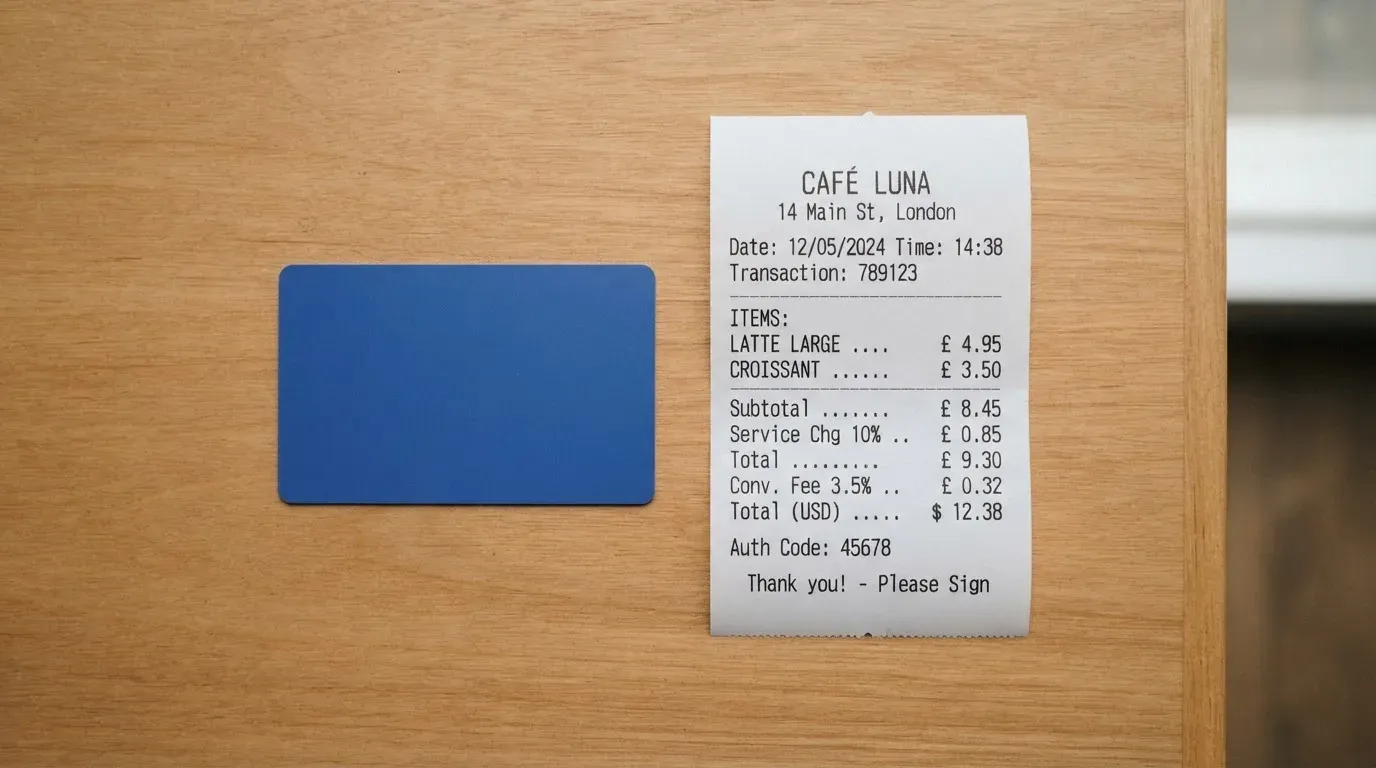
| Fee or limit | Amount |
|---|---|
| Account opening | Free |
| Monthly fee | Free |
| First shipment | Free |
| Reissue | EUR 5.90 (FAQ says EUR 9.90 for damage/loss/theft) |
| Additional physical card | EUR 10 |
| Non-EUR foreign-exchange fee | EUR 0, but “VISA mark-up fees apply” |
| ATM fee | 2% or EUR 2 minimum, whichever is higher |
| ATM daily limit | EUR 500 |
| Daily spending limit | EUR 10,000 |
| Weekly spending limit | EUR 70,000 |
| Monthly spending limit | EUR 280,000 |
| Card-specific top-up fee | Not stated |
Now the three everyday payments I think you will actually make, and which fees touch each one.
Paying 40 EUR in a Berlin café, funded from BTC. This is the core use case. Your chosen main asset (here Bitcoin) is converted to EUR at the moment of payment. Bitpanda’s platform trading fee for selling that asset is debited from your account on each card payment (Product Terms 4.2). The rate of that trading fee is not stated on the card page. There is also a conversion fee, expressed as a spread, which is not disclosed. So the “free” part of this payment is only free at the network level; the conversion cost is real, embedded, and unquantified in public terms. No ATM fee, no FX fee.
Paying 30 EUR in a Tokyo shop, funded from ETH. You are spending euros in a non-euro country. The Bitpanda FX fee is EUR 0 — but the card states that “VISA mark-up fees apply,” meaning Visa’s own currency conversion spreads the difference and that cost lands on you. On top of that, the same underlying asset conversion and trading fee from the first scenario applies. So a non-euro purchase is the most expensive kind of payment this card offers, and the “EUR 0 FX fee” is genuinely misleading if you read it as “free to spend abroad.”
Withdrawing 100 EUR from an ATM in Madrid. The ATM fee is 2% of the amount, or EUR 2, whichever is higher — on 100 EUR that is the 2%, so 2 EUR. Local bank fees may add on top. The daily ATM limit is EUR 500. Worth knowing: free ATM withdrawals used to be a perk of the top VIP tier, but the VIP scheme changed in July 2025 (moved to a Vision token, per a third-party note), so what top VIPs get “each month” is something I would verify in the app rather than trust. And no free allowance is stated for anyone else.
A note on the limits, because they are unusual for a spending card: EUR 10,000 a day, EUR 70,000 a week, EUR 280,000 a month. These are far above what a normal person spends, and they are the numbers to keep in mind for fraud exposure rather than convenience — a compromised card can move a lot before it hits a wall.
Two more details are relevant to these costs. There is a fixed 1% cashback on qualifying crypto transactions, and — this is the important part — it is “no longer determined” by your BEST VIP level (Product Terms 2.0.0, 1 April 2025). If a promotion was the reason you were considering this card, check what it is worth today rather than what it advertised when the page was written.
How to Top up the Card
Here is the thing about the Bitpanda Card that trips people up: it has no separate top-up. It spends a chosen main asset (and an optional fallback asset) straight from your Bitpanda account. So “topping up the card” really means funding your Bitpanda account by the usual Bitpanda deposit methods, and then choosing which of your holdings the card draws on.
Your main asset can be any of the listed cryptocurrencies, precious metals, or EUR. Whatever it is, it is converted to EUR at the moment of payment. Crypto Indices are excluded — if your holdings are index products, this card does not spend them. The minimum payment is EUR 1.
If you want to stop using the card rather than fund it, you permanently deactivate it by contacting customer support (the card page does not spell out the steps). The reassuring part: your money was never sitting “on” the card. It stays as assets or as EUR in your Bitpanda account, and you can sell or withdraw it through normal Bitpanda payouts. One catch: payouts, including the card, are disabled while a “Proof of funds” request is open — more on that under risks.
Paying with it every day
For day-to-day spending, the card behaves like a normal Visa debit card, with a few crypto-flavoured wrinkles.
Apple Pay is supported on the card page. Google Pay is not mentioned there, but a Bitpanda support article says the card can be added to Google Pay like any other Visa card — so treat Google Pay as available in practice. 3-D Secure and Visa’s anti-fraud monitoring are in place, and you can block and unblock the card in the app.
Cashback deserves its own paragraph because the card’s own pages contradict themselves. The body of the page says 1% cashback on crypto spending; the page summary says “up to 2%.” The product terms settle it: cashback is fixed at 1% of qualifying transactions (Product Terms 2.0.0, 1 April 2025), credited to the EToken wallet in the asset you used, and transactions with a non-EToken payment asset are excluded. Fiat, stocks, metals and stablecoins do not qualify. What currency the payout arrives in is not stated. An unofficial third-party site agrees with the official 1%; the “up to 2%” headline is not confirmed by the card.
If a payment goes wrong, the current terms (Product Terms 8.1) say refunds, including chargebacks, are credited to your EUR wallet minus fees. An older card-account terms page — which names Contis/Solaris and shows no date, and conflicts with the current issuer — describes the older process: contact the merchant first, report unauthorised or incorrect payments within 13 months, a decision on a refund within 10 business days, and a refund no later than the end of the next business day for unauthorised payments. The current Transact Payments cardholder agreement was not read, so treat the older page as history rather than as binding terms.
One more everyday detail: merchants can decline the card for reasons that have nothing to do with you. A merchant can look up the BIN — the 6- or 8-digit prefix that identifies the issuing institution — and apply extra scrutiny if the issuer country differs from your billing address. Some shops also decline prepaid or foreign-issued cards. A declined authorisation can also leave a hold on your funds for several days, sometimes up to 7. None of this is Bitpanda’s doing; it is how card payments work everywhere, but a card issued in one country and used in another is more exposed to it.
What can go wrong
These risks are not exotic — they are the ordinary risks of holding crypto with a custodian, plus a few specific to this card.
Custody. Bitpanda is a custodial platform. The private keys are with them, so you are trusting them completely with your crypto. This is a real, category-wide risk: custodial platforms have a documented history of failures (Mt. Gox, Coincheck, Ronin Network), and a stolen key has no recovery mechanism because blockchain transfers are irreversible. If you hold significant value, that risk is the dominant consideration — not the fees.
Proof-of-funds freezes. This is the Bitpanda-specific one to watch. If Bitpanda requests “Proof of funds,” all payouts — including the card — are disabled until approved. So the card you use for daily spending can be switched off by a compliance request you did not initiate. I found no card-specific user complaints, but the wider Bitpanda complaint themes reported for 2026 include blocked withdrawals and account restrictions, high currency-exchange commission and spreads, slow support during compliance reviews, German replies to English messages, and a deposit-cashback promotion paid only in part. Trustpilot, for the whole platform, sits at 4.1/5 from about 15,896 reviews (73% five-star, 17% one-star) — a good score that nonetheless leaves a visible tail of serious complaints.
The issuer. The current card is issued by Transact Payments Malta Limited, under a Visa Europe licence, regulated by the Malta Financial Services Authority (reg. C 91879). That is a real, regulated European issuer. But an older card-account terms page names UAB Finansines paslaugos Contis (Bank of Lithuania licence No. 53) as issuer, which conflicts. The current product terms (2.0.0, 1 April 2025) are clear that it is Transact Payments, with the contract with Bitpanda GmbH in Vienna and payment services by Bitpanda Payments GmbH. The conflict is noted because when documents disagree, the newest terms govern — but it is a small reminder that this card has been through issuer changes.
Segregated funds, with a caveat. The older terms page says customer funds sit in a segregated safeguarding account, not covered by the Lithuanian deposit insurance, and that liability is capped at EUR 50 absent gross negligence. Current Transact Payments terms were not read on this point. The general principle applies: safeguarded e-money funds are not the same as bank deposits and may not sit under a deposit guarantee scheme.
Real-world complaints and news. The card’s product terms are version 2.0.0 dated 1 April 2025; no 2026 card-specific news surfaced. On support: there is a helpdesk and customer-support form on the card page, an Account Portal message and “Contact Us” in the app, and a Vienna post address (Stella-Klein-Loew Weg 17, 1020). A lost-or-stolen card number (+44 (0)333 202 3645) comes from the older terms page. If the card is lost or stolen, block it in the account and report it at once — that is the single most important instruction on this page.
App reputation, unofficial. A Google Play average of 3.60 from about 55 thousand ratings is reported by a third-party site (AppBrain, an undated page seen in October 2026 that may be out of date). The Apple App Store listing was not read. Treat this as unofficial and unconfirmed by Bitpanda.
What to take instead
If the Bitpanda Card’s euro-only, custodial, physically-only design does not match what you need, there are three alternatives worth a look, with their own scores.
International Visa Card — 6.7/10. A U.S.-issued Platinum Visa, virtual, paying in USD; a physical card is listed as “coming soon.” Issuance $5 one-time, no maintenance fee; plans are Classic free, Pro $9.00/month, Max $19.00/month. Card use in USD is free on all plans; foreign currency costs the “Visa exchange rate + 2% FX fee”; deposits are free. No cashback stated. Eligibility excludes residents or registrants of a long list including Belarus, mainland China, North Korea, Cuba, India, Iraq, Iran, Israel, Myanmar, Nepal, Nicaragua, Russia, Syria, Turkey, Ukraine, Venezuela and Vietnam, with FATF grey-list countries reviewed case by case; purchases are blocked in North Korea, Cuba, Iran, Russia, Syria, Ukraine and Venezuela. The rule is by residence or registration, not citizenship. If you live outside the euro area and want a USD card you top up yourself, this is the more relevant comparison.
UNi Card — 6.1/10. A multicurrency card on the Mastercard network, spending from the UNi.Global account balance; physical/virtual not stated. No annual fee and no foreign transaction fee; assets convert at “live OTC rates” with, it says, “no hidden exchange fees.” Spend-to-Earn rewards up to 3%. Eligibility and top-up details are not stated on the pages I saw.
Morse — 7.5/10, the highest-scoring of the four. A fully virtual Visa prepaid debit that spends from Morse Balance “in any currency.” Fees are its strongest suit: zero foreign exchange fees or markups, the real-time Visa exchange rate, and “paying with the Morse Card, online and contactless, is free.” Issuance and monthly fees are not stated (the page says “fees may apply, see Cardholder Agreement”). Eligibility is by residence, not citizenship: 18+, resident in a supported country, app in “over 140 countries,” local add/withdraw in over 70. It cannot serve customers subject to US (also UK, EU, UN) sanctions, and a set of countries including Australia, the UK, Japan, Singapore, Switzerland, Hong Kong SAR China, Serbia, Thailand, Turkey and others is in closed beta behind an invite code — so “available in certain countries” is doing real work in that sentence. The wallet is self-custodial, and USDC, USDG and EURC via Solana are free to deposit while other tokens and blockchains carry a fee. If your priority is a virtual card with genuinely zero FX markup, Morse scores higher — but the invite-only list is the catch.
| Alternative | Score | Card | Where its fees bite |
|---|---|---|---|
| Bitpanda Card | 6.5 / 10 | Physical Visa, EUR only | Conversion spread undisclosed; trading fee on each payment; 2% ATM |
| International Visa Card | 6.7 / 10 | Virtual Platinum Visa, USD | 2% FX fee on foreign currency; plan fees from $9/month |
| UNi Card | 6.1 / 10 | Mastercard, multicurrency | No annual or FX fee stated; conversion at live OTC rates |
| Morse | 7.5 / 10 | Fully virtual Visa prepaid | Zero FX markup; virtual only; invite-only in some countries |
Who I would recommend it to
I would recommend the Bitpanda Card to a very specific person: someone living in the euro area, already verified on Bitpanda, who holds crypto or precious metals and wants to spend them in euros at an ordinary shop without converting through a bank first. For that person, at 6.5/10, it is a good, low-friction card — free to keep, free to open, Apple Pay and Google Pay, a real regulated European issuer behind it, and spending limits high enough that you will never notice them.
I would steer a different set of people away from it. If you are outside the euro area, the card is not for you. If your account was verified via Bankident, it is not for you. If you need a virtual card, a multi-currency balance, or a non-euro card, it is not for you. And if the reason you are here is that you want to keep control of your own keys, a custodial platform card is the wrong shape of product, whatever the fees say.
Above all, know what you are buying into on the conversion. The account fee is zero, the FX fee is zero, the card is free — and the actual cost of turning your crypto into euros at the till is a trading fee plus a spread that the card’s public terms do not put a number to. If that is acceptable to you, this is a fine card. If it is not, none of the zeros will help.
Frequently asked questions
What is the Bitpanda Card?
It is a euro-denominated Visa debit card that spends a balance you hold on the custodial Bitpanda platform. You pick a main asset — listed cryptocurrencies, precious metals or plain EUR — and the card converts it to euros at the moment of payment. It is issued by Transact Payments Malta Limited under MFSA supervision. Crypto Indices are not supported, and there is no separate card balance: the money stays in your Bitpanda account.
How does the Bitpanda Card work day to day?
You choose which holding the card draws on, then pay as if it were an ordinary Visa. The chosen asset is converted to EUR at payment, and Bitpanda’s platform trading fee for that sale is debited on each card payment. Spending limits are generous — EUR 10,000 a day, EUR 70,000 a week, EUR 280,000 a month — and you can freeze and unfreeze the card in the app, with Apple Pay, Google Pay and 3-D Secure supported.
Do I need KYC to get the Bitpanda Card?
Yes. It requires a verified Bitpanda account and residence in a euro-area country; Cyprus and Liechtenstein are excluded, and accounts verified through “Bankident” cannot order it. The card page does not list which documents are needed or set a processing time, so expect a standard identity check. Proof-of-address and age requirements are not stated separately on the card’s pages.
Is the Bitpanda Card free?
Opening the account, keeping it, and the first delivery are all free, and using it in USD-free euro costs no separate card fee. But “free” stops there: each payment converts your asset with a trading fee whose rate is not stated, plus a conversion spread that is not disclosed. Non-euro payments carry EUR 0 in Bitpanda’s own FX fee but still attract a Visa mark-up, and ATM withdrawals cost 2% or EUR 2 minimum.
How do I top up the Bitpanda Card?
There is no separate top-up for the card. It spends a chosen main asset — and an optional fallback — directly from your Bitpanda account, so you fund the account the way you normally would and pick the holding the card uses. The minimum payment is EUR 1. Whatever the asset, it is converted to EUR at payment; Crypto Indices are excluded, and no card-specific top-up fee is stated.
Can I use the Bitpanda Card outside my home country?
Yes, in principle — it is a Visa card, and non-euro payments carry EUR 0 in Bitpanda’s own FX fee. But “VISA mark-up fees apply,” so Visa’s currency conversion cost lands on you, and the underlying asset conversion and trading fee still apply. Two practical warnings: a foreign-issued BIN can attract extra scrutiny or a decline at some merchants, and a declined authorisation can hold your funds for up to 7 days. There is no multi-currency balance; refunds go to your EUR wallet.
How much cashback does the Bitpanda Card give?
The card’s own pages disagree: the body says 1% cashback on crypto spending, the summary says “up to 2%.” The product terms resolve it — cashback is fixed at 1% of qualifying transactions, credited to the EToken wallet in the asset you used, with non-EToken payment assets excluded. Fiat, stocks, metals and stablecoins do not qualify, and the payout currency is not stated. It is also no longer tied to your VIP level since 1 April 2025.
Is the Bitpanda Card safe?
The issuer side is reassuring: a physical Visa from Transact Payments Malta Limited, regulated by the MFSA (reg. C 91879), with 3-D Secure, anti-fraud monitoring and instant app freeze. But Bitpanda is a custodial platform — your keys are with them, and crypto transfers cannot be reversed. The most concrete card-specific risk is that if Bitpanda requests “Proof of funds,” all payouts including the card are disabled until approved.
Is Bitpanda a bank, and who is behind the card?
No — Bitpanda is a crypto platform and card programme manager, not a bank. The card is issued by Transact Payments Malta Limited under a Visa Europe licence, regulated by the Malta Financial Services Authority; your contract is with Bitpanda GmbH in Vienna, with payment services from Bitpanda Payments GmbH. An older terms page names Contis as issuer, which conflicts with the current documents — where documents disagree, the newer product terms (2.0.0, 1 April 2025) govern.
What should I do if the Bitpanda Card is lost or stolen?
Block it in your app and report it at once — that is the single most important step, and the card page’s own guidance is explicit about doing both immediately. Support is reachable through the helpdesk and contact form on the card page, the Account Portal message and “Contact Us” in the app, with a Vienna office at Stella-Klein-Loew Weg 17, 1020. A lost-or-stolen phone number (+44 (0)333 202 3645) appears on an older terms page. Your funds are not on the card — they stay in your Bitpanda account.
App and neobank cards: your questions answered – cryptocardanswers
Content created by the «cryptocardanswers» team