
LBank card: a Visa debit that draws from your exchange balance
 Available in US
The LBank card is a Visa debit card that spends from your LBank Spot balance rather than from a bank account. There are two products: a virtual 8 Card Instant and a physical 8 Card GO, both billed in crypto, both charging a 0.8% transaction fee. It is a clean fit for LBank exchange users who want to spend the coins already on the platform without first cashing out, and the card costs nothing to issue (virtual) or almost nothing (physical). What gives me pause is the thin public information about who actually issues and regulates the card, and the pattern of exchange-level complaints that the card’s own page never addresses. The card earns 6.8 out of 10 in this review; the score is broken down below.
The conditions described here are current as of October 28, 2026.
Verdict
The card is best understood as a convenience layer on top of the LBank exchange, not as a standalone product. If you already keep funds on LBank and want a fast, cheap way to pay at Visa merchants without manual withdrawals, the 0.8% fee and zero top-up cost are genuinely competitive. Apple Pay and Google Pay work, and the 0.8% to 2% monthly cashback for higher VIP tiers is meaningful if you actually spend enough to hit the thresholds.
It is not the right card if you want a regulated payment institution standing behind your balance, if you want a card that works in the United States, Canada, mainland China, Hong Kong, Macao, Cuba, Iran, North Korea, Syria or Sudan, or if you are uncomfortable having your spending balance and your crypto balance on the same custodial platform.
How the score breaks down
| Criterion | Mark | Why |
|---|---|---|
| Who can get it | 7 / 10 | Available to users outside a list of prohibited countries (United States, mainland China, Canada, Hong Kong, Macao, Cuba, Iran, North Korea, Syria, Sudan and others); KYC is required but the exact level is not stated |
| Cost | 8 / 10 | Virtual card issuance, annual and top-up fees waived; physical card has a “low” issuance fee; 0.8% transaction fee on both |
| Top-up options | 6 / 10 | USDT and other supported cryptocurrencies are deducted automatically from the LBank Spot balance; fiat top-up is not offered and networks do not apply |
| Reliability and complaints | 3 / 10 | The card issuer and the licence under which the card is issued are not named on the card page; Trustpilot reviews of the exchange (not the card) are heavily negative on withdrawals and liquidations |
| Everyday use | 10 / 10 | Virtual 8 Card Instant and physical 8 Card GO, Apple Pay and Google Pay supported, ATM use on the physical card |
| Total | 6.8 / 10 |
The strongest points are cost and everyday use: no monthly fee, no top-up fee, virtual issuance is free, and the card pairs with mobile wallets. The weakest point is the gap between the card’s claims and the regulatory transparency you’d expect from a payment product, and that’s the issue worth dwelling on, because it shapes everything else.
Who will they give you the card
LBank says the card is “available to users outside prohibited countries.” The full prohibited list is in LBank’s User Service Agreement, which I have not read end-to-end, but an earlier check turned up the United States, mainland China, Canada, Hong Kong SAR, Macao SAR, Cuba, Iran, North Korea, Syria and Sudan, with “and others” suggesting the list is wider than what is publicly summarised. If you live in any of those countries, you should not expect to be onboarded; the same is true if your citizenship or country of birth matches one of them, because sanctions screening typically covers both.
For everyone else, the card page is unusually quiet about the eligibility details you’d normally want to see. It does not state the minimum age, whether proof of address is required, or which tier of KYC the card sits at. What it does say is that you log in to the LBank app, open the LBank Card section, enter identity information, complete a security verification, and may be asked for additional documents. Issuance can take “as little as 1 minute” if the materials are complete, which is fast — the bottleneck in practice is usually document review rather than the form itself. The conditions on age and address are not stated on the public card page, so if either of those is critical to you, you would have to confirm at the application stage.
The card is also not a separate legal entity from the exchange. LBank says “LBank issues the card,” and the company behind the exchange is LBK Exchange / LBK Blockchain Co., Limited. The card page does not name an issuing bank or e-money institution, and it does not state the licence under which the card is issued. That detail matters because the institution that issues the card is the one that holds the programme licence with Visa, segregates card funds, and answers to a financial regulator; without that name, you are trusting the card programme to the same entity that holds your exchange balance, with no separate payment licence in the picture that I could confirm.
How to get it
The signup flow is short and runs entirely inside the LBank app. You log in, open the LBank Card section, enter your identity information, complete the security verification, and wait while the system decides whether to issue the card. The page says the process can take “as little as 1 minute” if everything is in order, but it does not say what happens if it isn’t; there is no published timeline for review or a fallback if the first attempt is refused.
You then choose which of the two products you want:
- 8 Card Instant — a virtual card for online and mobile-wallet use.
- 8 Card GO — a physical card, ordered through an “Apply for physical card” flow.
Both cards are Visa-accepting. The card currency is not stated on the public page, which is unusual: most Visa debit cards specify whether they settle in USD, EUR or another currency, because that determines what your FX fee looks like when you spend abroad. Here the page only says that cross-currency amounts follow Visa’s clearing result, which is a description of the mechanism rather than the answer to the question “in what currency will my statement show up.” If the card is denominated in USDT, that would explain why the FX rate itself is not stated; if it is denominated in a fiat currency, the silence is harder to explain.
Delivery time, delivery cost, and the list of countries the physical card can be shipped to are not stated. If you need the physical card, you would have to start the order to see those answers. One small but useful detail: freezing or cancelling the card does not affect deposits or withdrawals from your exchange balance, and cancellation is permanent — so if you ever want to undo a closure, you would have to apply again.
Fees and what a LBank payment actually costs
The headline numbers are unusually clean for a crypto card. The virtual 8 Card Instant has its issuance fee, annual fee and top-up fee waived. The physical 8 Card GO has a “low” issuance fee (the exact amount is not stated), no annual fee, and no top-up fee. The transaction fee on both cards is 0.8%.
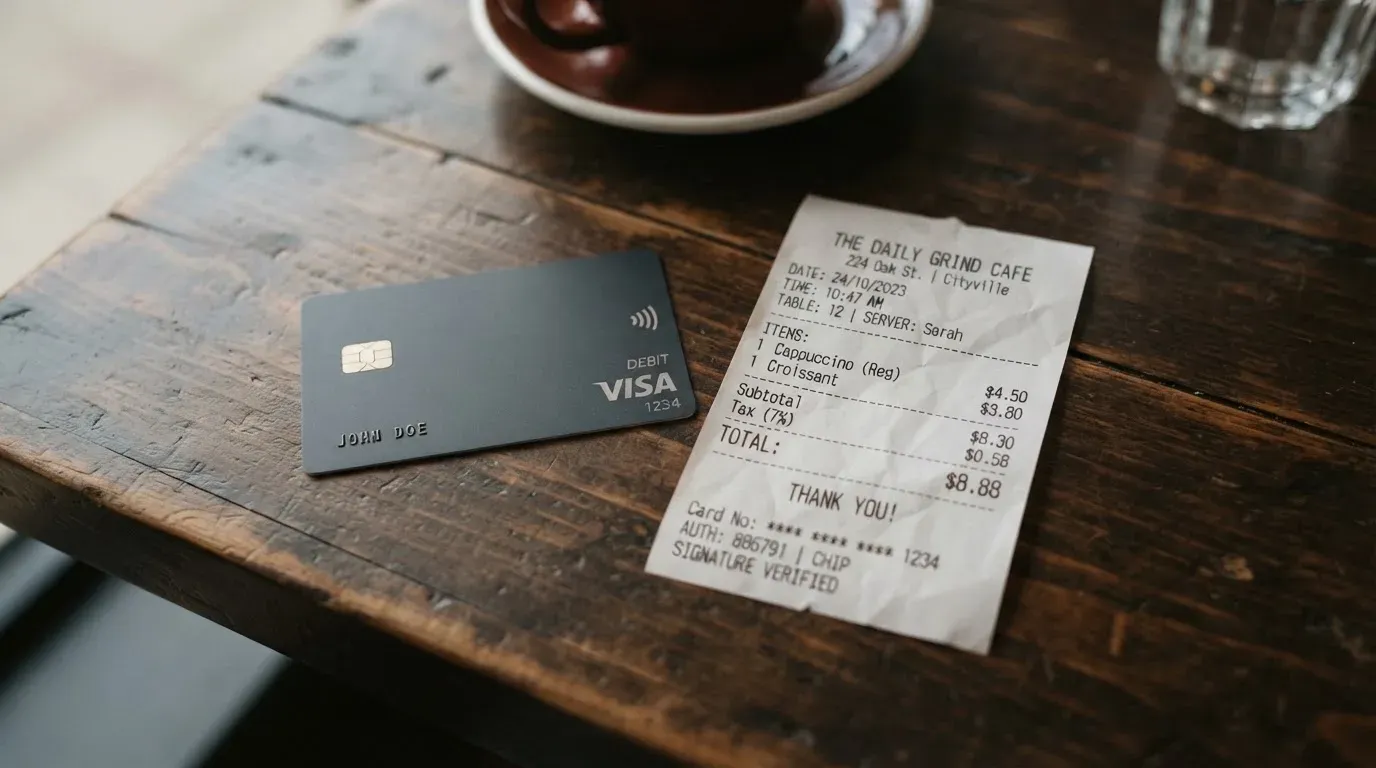
That 0.8% is the number you have to remember, because it is the fee that will appear on every purchase, ATM withdrawal and mobile-wallet payment. The card page also notes that an authorisation fee is charged when you bind the card to a wallet, “whether or not binding succeeds,” but the amount of that fee is not stated. If you bind a card several times during its life, those unbinding-and-rebinding moments can each carry a small charge.
Cross-currency payments are the second cost you should know about. The card says cross-currency amounts “may differ from the authorisation amount” and are “adjusted to Visa’s clearing result.” That is a description of how Visa’s settlement works, not a commitment about how favourable the rate will be; the FX margin itself is not stated. The practical effect is that a payment in a currency other than the card’s base currency will be at the mercy of whatever rate Visa’s pipeline produces, and the card does not publish the markup over mid-market.
The physical card supports ATM use, but the ATM fee and any monthly allowance are not stated on the page. Daily and monthly spending limits are described as “depending on card tier and account status,” and the page does not list the actual figures. The card tiers that the page describes are the two products (Instant and GO), and cashback depends on the LBank VIP level rather than the card itself.
To make the cost picture more concrete, here is the full set of fees and limits that the public card page actually names:
| Fee or limit | What the card page says |
|---|---|
| Virtual card issuance | Waived |
| Virtual card annual fee | Waived |
| Virtual card top-up fee | Waived |
| Physical card issuance | “Low” (amount not stated) |
| Physical card annual fee | Waived |
| Physical card top-up fee | Waived |
| Transaction fee | 0.8% on both cards |
| Authorisation fee | Charged on binding, even if binding fails (amount not stated) |
| Cross-currency / FX | Follows Visa’s clearing result, FX rate not stated |
| ATM fee and allowance | Not stated |
| Daily and monthly limits | Depend on tier and account status, figures not stated |
| Card currency | Not stated |
The three numbers you can plan around are free issuance, annual and top-up, 0.8% (transactions) and “low” (physical card issue). Everything else is a question you’d have to answer at the point of use.
Three everyday payments, and what the fees look like
A subscription paid in your home currency, on the virtual card. You bind the card once (and pay the unbinding-fee-amount-not-stated). The 0.8% transaction fee applies, and because no currency conversion is involved, the FX question doesn’t arise. The total cost is 0.8% plus whatever your card issuer, network and merchant pass on.
A coffee abroad, paid with Apple Pay on the physical card. Visa converts the price into the card’s base currency. The 0.8% transaction fee applies. The FX margin between Visa’s clearing rate and the mid-market rate is not stated, so the only way to know what you really pay is to look at the posted amount after the transaction clears. If the merchant’s MCC falls in a category the card blocks, the payment will fail at authorisation rather than later, which is the safer outcome but not a free one.
A cash withdrawal from an ATM on the physical card. The 0.8% transaction fee applies. The ATM fee itself, and any monthly allowance for free withdrawals, are not stated. The daily and monthly withdrawal limits are not stated either, so a large withdrawal can be declined at the ATM with no prior warning.
Top up
The card is topped up directly from your LBank Spot account balance. The mechanism is automatic: when you pay with the card, USDT or another supported cryptocurrency is sold and the card balance is replenished. You don’t move money to a separate card wallet in the way you would with a prepaid Visa; the card is essentially a view onto your exchange balance, with the conversion happening behind the scenes.
That design has two consequences worth understanding. The first is convenience: there is no manual top-up step, no network to choose, and no risk of sending a deposit to the wrong chain, because the funds never leave LBank. Networks are described as “not applicable” on the card page, and that matches the model: the only transfer happening is an internal one, from your Spot balance to the card programme. The second consequence is dependency: your card balance can never be larger than what you hold on the exchange, and your card can never spend more than your exchange balance supports at the moment of payment. If a payment arrives when the balance is too low, the authorisation is declined, and a declined authorisation can leave a temporary hold on the merchant’s side for several days.
The top-up fee is 0 on both cards. The minimum top-up is not stated. Fiat top-up is not stated, which I read as “not offered” rather than “offered but not described.” If you wanted to load the card from a bank account, the answer on the public page is silent, so the only funding path the card clearly supports is selling crypto you already hold on LBank.
The card’s cashback is paid in something that is not stated on the public page, and the rewards are tiered by LBank VIP level rather than by card product. The monthly cashback per user, as published, is:
- 0.8% (cap 10 USDT) for VIP0 to VIP2;
- 1% (cap 30 USDT) for VIP3 to VIP4, conditional on spending at least 1,500 USDT in the previous month;
- 1.2% (cap 100 USDT) for VIP5 to VIP6, conditional on at least 5,000 USDT in the previous month;
- 2% (cap 250 USDT) for SVIP, conditional on at least 20,000 USDT in the previous month;
- 10% (cap 10 USDT) on coffee purchases.
The higher rate applies if both qualify. The 10% is paid on top of the tier rate, up to the cap. The currency in which the cashback is paid is not stated, which is a small but real gap: cashback paid in a token that swings against the dollar is not the same as cashback paid in USDT, and the card page does not tell you which one you’ll get.
Paying with it every day
Both cards work at Visa-accepting merchants, which is most of them. The virtual 8 Card Instant is built for online and mobile-wallet use. The physical 8 Card GO is built for in-store payments, ATM withdrawals and the same mobile-wallet bindings.
Apple Pay and Google Pay are supported. When you add a card to a mobile wallet, the wallet replaces the card number with a device-specific token, and that token can be restricted by the issuer (magnetic-stripe only, in-app only, etc.); the card page does not state whether LBank applies any such restrictions. Address Verification Service (AVS) is generally unavailable for foreign-issued cards, which can cause some online merchants to decline the transaction; that is a category-level issue with Visa debit cards issued outside the US/Canada/UK, not an LBank-specific one, but it is the kind of thing that surprises people the first time it happens.
The card page mentions “merchant restrictions” as a cause of declined payments, but it does not list the categories that are blocked. Gambling (MCC 7995) is the most common restricted category on crypto cards; if you try to use this card at a betting site, you should expect a decline rather than assume the card is unrestricted. The full blocked list is the kind of thing the card page does not publish, and that is a real limitation if your spending pattern depends on a specific category.
For disputes and refunds, the card says merchant refunds “generally return to the original payment method,” which is the standard behaviour for a debit card. For suspicious transactions, the cardholder is told to freeze the card and contact support; the time frames for review or chargeback are not stated. Funds on the physical card are held in the LBank app (the exchange account, in custodial form), and the cardholder can freeze or unfreeze the card anytime from Card Management. Losing the physical card does not put funds at risk, because the balance is on the exchange side, not on the card; what it puts at risk is the card itself, which would need to be replaced.
The LBank app is the daily-use front end for both cards. Its ratings on the iOS and Android stores were not read for this review, so I can’t tell you how the card section actually feels to use day to day.
What can go wrong
The card-specific risks fall into two groups. The first is product-level: the card page is thin on the regulatory backbone a payment card normally has. The issuing bank or e-money institution is not named, the card’s licence is not stated, and the card currency is not stated. In a normal card review, those are the first three questions; here, all three are open. That doesn’t mean the card is unregulated — LBank may have a programme licence it just doesn’t publish in the card page — but it does mean the reader can’t verify the licence without going through support, which is the opposite of how payment regulation is supposed to feel.
The second group is the exchange-level risk, which is the one I find harder to set aside. The card’s balance is on LBank, in the same custodial account where your Spot funds sit. If the exchange freezes withdrawals, the card stops working. The Trustpilot page for the exchange (not the card) had 325 reviews as of this review, 79 of them in the last 12 months, with 82% of all reviews at one star. The themes users describe, drawn from a user report rather than from the card’s own page, are frozen withdrawals between June and October 2026, disputed futures liquidations in August and September 2026, and fiat deposits not credited in July 2026. None of those reviews mention the card by name; they describe the exchange. But because the card draws from the same balance that is being frozen in those reports, the card inherits the exchange’s reliability problem, and the reliability score (3 out of 10) reflects that inheritance.
A few other risks are worth flagging in plain language:
- Program-level closure. Visa and Mastercard have ended card programmes in the past (FTX in November 2022; WaveCrest’s European crypto card programmes in 2018). A programme closure typically stops new loads, then spending, then asks users to withdraw remaining balances on a deadline. The card page does not describe what would happen to your balance if the programme were wound down.
- Sanctions and BIN behaviour. A card issued through a non-US BIN can look “foreign” to a US merchant, and AVS-based declines are common for foreign-issued cards. The card’s BIN and issuer country are not stated on the page, so I can’t tell you how US-friendly it is in practice.
- Lost-key / lost-card. A lost physical card does not put funds at risk, because the balance is on the exchange. A lost seed phrase for any self-custody wallet you connect is unrecoverable, but the card itself does not require a self-custody wallet.
- Stablecoin depeg. The card is funded from your Spot balance, which is held in supported cryptocurrencies; if you hold USDT and USDT depegs, your spending balance depegs with it. The card does not promise to hold your balance in fiat; the published mechanism is a crypto-to-fiat conversion at the time of payment.
- Support. The card page says “24/7 customer service” and names [email protected] as the contact email (the same address that appears in company replies on Trustpilot). The quality of support is not something I can rate from the card page; it is something users report on Trustpilot, mostly in the context of the exchange.
The “what can go wrong” picture is, in short, a card that works well when the exchange works well, and that has no separate regulator or insurance standing between your spending balance and the exchange’s troubles. That is the trade-off the score reflects.
What to take instead
The closest comparisons are cards that draw from a custodial crypto balance, in a similar price range. None of the three alternatives below is a perfect substitute, because the LBank card’s main appeal is the zero top-up fee and the 0.8% transaction fee on funds that are already on LBank; you only get that if you actually use LBank.
Young Card — 5.7 / 10
A card whose cashback is paid in YNG tokens, with a rate that depends on the user’s Club tier. The published rates are 0.1% for Essential, 1.8% for Gold, and 3.6% for Platinum, with the Bronze and Silver tiers not stated. None of the other details (who can get it, the card’s own fees, top-up mechanics) are stated on the official page, so the comparison is thin. Young Card is interesting if you want a token-denominated cashback structure and are comfortable with the risk that the reward token’s price moves against you.
Coinbase Card — 6.4 / 10
A Visa prepaid debit card available in all US states except Hawaii, with no published international rollout. Account opening follows the USA PATRIOT Act identity rules (name, address, date of birth, ID). The card can be virtual or physical, spends cash or crypto, and converts crypto to US dollars at payment. The headline fees are zero spending fees and no annual fees, with the conversion cost appearing as a spread when Coinbase buys, sells or trades crypto at payment rather than as a separate line item. Rewards are optional, US Card users only, and the user picks from rotating crypto rewards in the app, so the rate varies. Coinbase Card is the cleaner choice if you are a US-based Coinbase customer who wants a card that sits inside a US-regulated payments stack.
OKX — 6.2 / 10
A Mastercard in euro, launched in the EU plus Norway on 28 January 2026, with Iceland and Liechtenstein excluded. The card is issued by an unnamed European licensed payment provider, sits on top of OKX Pay, and is euro-denominated at the point of payment. The card fee is none. The transaction fee is none. The OKX FX fee is none. The conversion spread is described as 0.1% in a May 2026 explainer versus 0.4% in the launch press release (the conflict isn’t resolved on the page, and the explainer is the newer source). The card is funded from USDC or USDG held in OKX Pay; other coins must be converted first, and there is no auto top-up, so a payment is declined if the balance is insufficient. Cashback is paid only on USDG purchases (USDC earns none), with monthly caps in EUR: Regular 2% cap 10; VIP1 4% cap 300; VIP2 4.5% cap 450; VIP3 5% cap 1,000; VIP4+ 10% cap 1,000 (the text says 2% to 5%, the table says 10% for VIP4+, an inconsistency on the source page). OKX is the cleaner choice if you are an EEA user who wants a card denominated in euro, with a regulated EU payment provider in the chain, and you are willing to hold USDG to actually get the cashback.
How they compare at a glance
| Card | Score | Issuing network / currency | Top-up | Notable fee | Notable reward |
|---|---|---|---|---|---|
| LBank | 6.8 / 10 | Visa, currency not stated | Spot balance (USDT and others) | 0.8% per transaction | 0.8%–2% monthly cashback by VIP tier, 10% on coffee |
| Young Card | 5.7 / 10 | Not stated officially | Not stated officially | Not stated officially | 0.1%–3.6% in YNG by Club tier |
| Coinbase Card | 6.4 / 10 | Visa, US dollar | Coinbase balance (cash or crypto) | Spread on conversion | Variable, rotating crypto rewards |
| OKX | 6.2 / 10 | Mastercard, euro | OKX Pay (USDC or USDG) | 0.1% conversion spread (May 2026) | Up to 10% on USDG purchases |
The honest reading of this table is that the LBank card is not the cheapest, the most regulated, or the most rewarding of the four. It is the one with the lowest friction for an existing LBank user who wants to spend from their exchange balance, and the most opaque on the regulatory questions.
Who I would recommend it to
I would recommend the LBank card to someone who already keeps a meaningful balance on LBank, is outside the prohibited-country list, spends most of their money in the card’s base currency, doesn’t need a US-issued card, and is comfortable with the exchange-level risk that the Trustpilot reviews describe. The 0.8% transaction fee and zero top-up fee are genuinely competitive, the Apple Pay and Google Pay bindings work, and the cashback for higher VIP tiers is meaningful at the spend thresholds the card actually requires. The convenience is real, and the card’s costs are the kind of costs you can budget for.
I would not recommend it to someone whose primary reason for getting a crypto card is regulatory protection, because the card page doesn’t name the issuer or the licence, and the card’s balance sits on the same custodial platform that has the Trustpilot profile LBank has. I would not recommend it to someone in the United States, Canada, mainland China, Hong Kong, Macao, Cuba, Iran, North Korea, Syria or Sudan, or with citizenship or country of birth in any of those places. I would not recommend it to someone who needs a clear FX margin in writing, because the FX rate is not stated and the cross-currency behaviour is described only as “follows Visa’s clearing result.”
If you are deciding between this card and one of the alternatives, the practical question is whether your balance is on LBank or somewhere else. If it is on LBank, the card is the cheapest way to spend it. If it is not, the alternatives above will probably serve you better, because the card’s value comes from the integration with the exchange, and the integration is what the alternatives can’t replicate.
Frequently asked questions
What is the LBank card?
The LBank card is a Visa debit card issued through the LBank exchange, with two products: a virtual 8 Card Instant and a physical 8 Card GO. Both cards spend from your LBank Spot balance, with USDT or another supported cryptocurrency sold at the moment of payment. The virtual card is free to issue, the physical card has a “low” issuance fee, and both charge a 0.8% transaction fee.
How does the LBank card work?
When you pay with the card, LBank sells the cryptocurrency in your Spot balance and uses the proceeds to fund the payment, with the merchant receiving fiat through the Visa network. The card is topped up automatically, so there is no manual transfer step. The card binds to Apple Pay and Google Pay, the physical card works at ATMs, and the daily and monthly limits depend on your card tier and account status.
Is LBank a bank?
LBank is a cryptocurrency exchange, not a bank. The exchange’s operating entity is named on the company’s corporate pages; the card page says “LBank issues the card,” but it does not name a separate issuing bank or e-money institution, and it does not state the licence under which the card is issued. In practical terms, that means the card’s balance sits on the exchange, not with a regulated payment institution, and the card inherits the exchange’s regulatory and operational profile.
Who owns LBank?
LBank operates as LBK Exchange / LBK Blockchain Co., Limited, according to earlier checks of the company’s corporate information. The card page itself does not name the operating entity or the issuer, and the licence under which the card is issued is not stated on the public card page.
Is the LBank card available in the United States, the United Kingdom or the European Union?
The card page says it is “available to users outside prohibited countries,” and an earlier check lists the United States, mainland China, Canada, Hong Kong SAR, Macao SAR, Cuba, Iran, North Korea, Syria and Sudan, with “and others” suggesting the list is longer than the public summary. The full list is in LBank’s User Service Agreement, which I have not read end to end. If you are in any of those countries, or hold citizenship there, you should not expect to be onboarded; for the UK and the EU, the card page does not state the position.
How do I apply for the LBank card?
You log in to the LBank App, open the LBank Card section, enter your identity information, complete the security verification, and wait for the decision. Issuance can take “as little as 1 minute” if the materials are complete, but the card page does not state the review timeline for cases that aren’t. You can apply for the physical card through an “Apply for physical card” flow; the countries it ships to, the time it takes and the cost of delivery are not stated on the public page.
Does the LBank card require KYC?
Yes. The application flow includes identity information and a security verification step, and additional documents may be requested during review. The card page does not state the KYC level, the minimum age, or whether proof of address is required, so the exact scope of the checks is not publicly described.
How do I add the LBank card to Apple Pay or Google Pay?
The card page lists Apple Pay and Google Pay as supported. The binding is done inside the LBank app’s card section; the page does not describe the exact steps, and an authorisation fee is charged when the card is bound, “whether or not binding succeeds.” The amount of the authorisation fee is not stated.
How do I top up the LBank card?
The card is topped up automatically from your LBank Spot account balance at the moment of payment, in USDT or another supported cryptocurrency. There is no manual top-up step, the top-up fee is 0 on both cards, and the minimum top-up is not stated. Networks are not applicable because the funds never leave the exchange. Fiat top-up is not described on the public page, which I read as “not offered” rather than “offered but not stated.”
Is the LBank card safe?
The card itself uses standard payment features: freeze and unfreeze in Card Management, mobile-wallet tokenisation, and a 24/7 support channel. The balance, however, sits in the LBank exchange’s custodial account, so the card inherits the exchange’s counterparty risk. Trustpilot reviews of the exchange (not the card) describe frozen withdrawals, disputed liquidations and uncredited deposits; the card’s own regulatory backbone is not fully described on the public page. Safety here depends on your trust in LBank as a custodian more than on the card product itself.
Exchange cards: your questions answered – cryptocardanswers
Content created by the «cryptocardanswers» team