
Moon card review
 Available in US
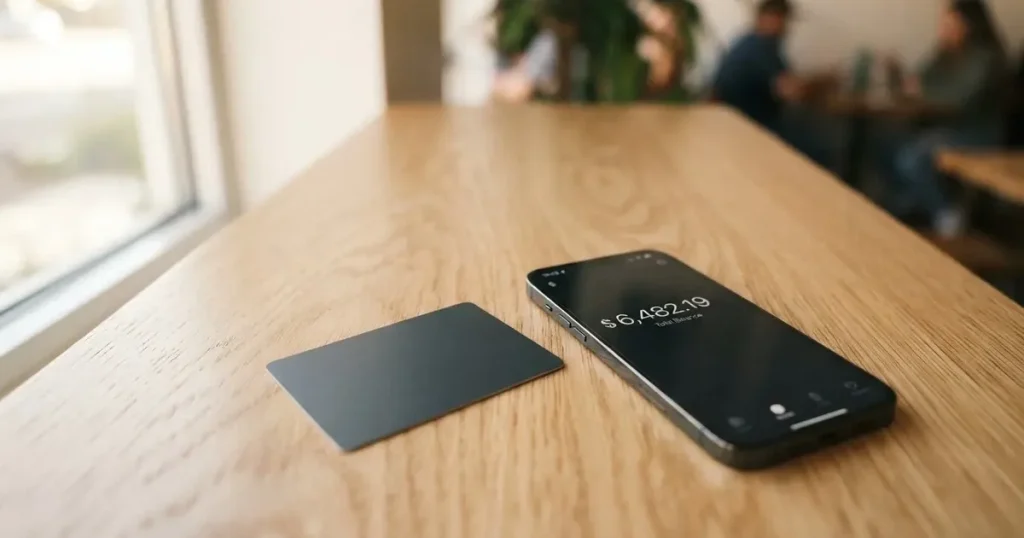
Moon is a crypto-funded Visa card, with a reloadable product called Moon X and a single-load Moon 1X. You convert crypto into a balance on the card and spend it wherever Visa is accepted. The pitch is simple, the fee schedule is straightforward, and the product is aimed at people who want to move small amounts online without going through a bank.
The conditions described here are current as of October 28, 2026. Fees, limits, country availability and complaint patterns were checked on that date. The review covers who Moon suits, what it really costs, how topping up works, what day-to-day use feels like, and what reviewers say goes wrong.
Verdict
Moon earns 5.6 out of 10 in this review. That puts it in the middle of the pack for crypto cards. The number is not a marketing figure; it is the average of the criteria below, weighted roughly by how much each one matters to a typical cardholder.

| Criterion | Mark | Why |
|---|---|---|
| Who can get it | 8 / 10 | Reported in 130+ countries, with standard age and KYC rules |
| Cost | 6 / 10 | First Moon X free, 1% per transaction, no FX fee, but extras add up |
| Top-up options | 8 / 10 | BTC, Lightning, USDT on Tron, USDC on Ethereum, ETH |
| Reliability and complaints | 2 / 10 | TrustScore 2.5 out of 5 across 276 reviews, with frozen-account reports |
| Everyday use | 3 / 10 | Virtual card, ready instantly, but no Apple Pay, Google Pay or Samsung Pay yet |
| Total | 5.6 / 10 | Average of the five criteria |
The high marks are for reach (a long country list, a clean set of coins) and for a fee structure that does not nickel-and-dime you on currency conversion. The low marks are about trust: Moon does not publish who issues the card or which legal entity stands behind it, and user reviews are full of accounts of frozen balances and slow refunds.
If you want a card to make quick, small online payments in USD funded from crypto you already hold, Moon is a reasonable tool. If you are planning to load a large balance, leave it on the card for months, or rely on it as your only payment method, the complaint record should give you pause.
Who they will give the card to
Moon does not publish a country list. Third-party summaries of the terms (solcard.cc, October 2026, reporting what Moon’s own pages say) describe the reach as “over 130 countries” for Moon X, with sanctioned regions excluded. Purchases from a country that Moon does not serve will not go through. If your country is not on the list, the safest assumption is that Moon will decline to issue or that the card will be refused at checkout.
There are a few practical consequences of an unpublished list:
- You only find out your country is excluded by trying to sign up, not by checking a page first.
- “Over 130 countries” is a count, not a promise; specific countries inside that range can be barred at any time.
- Sanctions rules can change without notice, so a country that works today may not work next month.
Beyond the country question, the standard rules apply: you need to be 18 or older, you sign up with an email and password, and you use email-based 2FA codes. Moon does not publish the list of identity documents it accepts, and it reserves the right to ask for proof of eligibility. The card is virtual, so there is no shipping address to worry about for Moon X, and Moon 1X (the US single-load card) is also issued digitally.
The one point to check first: if you live somewhere that Moon’s pages do not name, do not fund the account with a large amount before you have made at least one small successful purchase. The terms leave room for Moon to refuse purchases from disallowed countries after the fact.
How to get it
Signup is a standard email-and-password flow with 2FA codes sent to your inbox. There is no published list of accepted identity documents, and Moon may ask for additional proof if it cannot verify you from the information you have given. Some merchants blocked by Moon are reported to “open up after verification,” which means the verification step is not only for the card itself but for the kinds of shops you can spend at.
Once your account is set up, the card itself is quick. Moon X is a reloadable Visa linked to a Moon Credit balance, valid for three years from purchase, and it is virtual, so it is ready the moment you finish creating it. Moon 1X is a single-load card that you can use at US merchants. The card network is Visa. The exact difference between virtual and physical for each product is not stated on the pages I read; the practical experience is that you receive a card number, expiry and CVC you can type into a checkout form or save to a password manager.
Trustpilot reviewers in January and February 2026 report that getting a refund from Moon has required ID verification. That is worth knowing in advance: even if you are happy to share documents to open the account, you may be asked for them again if you ever need your money back. Keeping a clear scan of whatever you submitted for the original verification may save time if that happens.
Delivery time is not stated. Because the card is virtual, “delivery” is really the moment the card details appear in your account, which is immediate.
What it really costs
The headline is that Moon does not charge FX or foreign transaction fees. The catch is the rest of the schedule. Here is what the third-party summaries of the terms (solcard.cc, October 2026, reporting what Moon’s pages say) describe:
| Fee or limit | Amount |
|---|---|
| First Moon X card | Free |
| Additional Moon X card | $2.99 each |
| Moon 1X card | $1.49 each |
| Monthly account fee | None stated |
| Moon X transaction fee | 1% with a $1.00 minimum per transaction |
| Moon 1X transaction fee | None |
| FX / foreign transaction fee | None |
| Decline / reversal / refund fee | $0.50 after 20 per month |
| Excess refund fee | $40 |
| Overdraw fee | $25 |
| Chargeback dispute fee | $17.50 |
| Unused balance at card expiry | Charged as a fee |
| Moon X monthly spend cap | $4,000 across all cards |
| Card creation limit | 10 per day, 30 per month |
| Moon Credit purchase limit | $10,000 daily, $30,000 monthly |
| Moon 1X load | $5 minimum, $1,000 maximum per card |
| ATM withdrawal fee | Not stated |
A few everyday scenarios show how this plays out:
- A $10 online subscription. On Moon X you pay the 1% fee, with a $1.00 minimum, so the fee on a $10 purchase is $1.00, not $0.10. On Moon 1X the same purchase costs you nothing in transaction fees.
- A $200 flight in EUR (or any non-USD currency). The card is loaded in USD and the merchant receives USD; Moon does not charge an FX fee, but Visa’s wholesale rate applies. The 1% on Moon X still hits, with the $1.00 minimum, so on $200 you pay $2.00.
- A hotel booking. The transaction is well over the $4,000 monthly cap (an unofficial figure per third-party terms summaries), so you can place it on a single Moon X card, but the ceiling means a second large booking the same month would not go through. The fee is 1% (no minimum applies at this level).
The unused-balance fee at expiry is the easiest one to overlook. A $30 balance left on a Moon X card that you do not top up before the three-year mark is treated as a fee, not a refund. If you stop using the card, withdraw the balance first. How to withdraw it is described in the next section.
What this section did not find: a published ATM withdrawal fee, a published inactivity fee, a published minimum balance, or any monthly maintenance charge. If those exist they are not on the pages I read, so do not assume they are zero.
How to top it up
Moon funds the card through a Moon Credit balance that you fill with crypto. The coins and networks Moon accepts are:
- Bitcoin (BTC)
- Bitcoin Lightning
- Tether (USDT) on Tron (TRC-20)
- USD Coin (USDC) on Ethereum (ERC-20)
- Ether (ETH)
The Moon 1X single-load card has a $5 minimum per load (an unofficial figure per third-party terms summaries) and a $1,000 maximum per card, and that load counts against the same $4,000 monthly account maximum (also an unofficial figure). Moon X has the broader limits: up to $10,000 per day and $30,000 per month in Moon Credit purchases.
What is not stated clearly: which party pays the network fee on the deposit, what happens to a deposit sent on the wrong network, whether you can top up in fiat (bank transfer, card), and what the exact minimum network fee is for each coin. The general rule of the category is that blockchain network fees are paid by the sender, not by Moon, and a deposit sent on a network Moon does not support, or to an address that does not match the network, can be lost. USDT on Tron is a separate token from USDC on Ethereum, even though both are “dollar coins,” and Circle stopped supporting USDC on Tron in February 2024, so “USDC on TRC-20” is not a native option with Moon either.
Refunds work the other way. If a merchant pushes money back to the card, the refund is paid out in Bitcoin, minus network and partner fees. That matters if your balance was funded by USDT and you expect the refund in USDT. It does not. And the unused balance at card expiry is forfeited, as noted in the costs section. How to close the account entirely is not stated on the pages I read.
The check first: before you send anything larger than a test amount, send a small test transfer to the address Moon gives you, on the network Moon specifies, and confirm that Moon Credit has been credited. Only then send the rest.
Paying with it every day
The card is virtual and ready the moment you create it, so the “first purchase” experience is fast: you save the card details in your browser or password manager, type them into a checkout, and the transaction goes through. The 1% Moon X fee shows up on the confirmation, with the $1.00 minimum applying to small purchases.
What the daily-use score reflects is everything that is missing:
- Apple Pay, Google Pay and Samsung Pay are not currently supported. The terms are reported as “on the way,” but they are not live. That rules out tap-to-pay on a phone or watch for now.
- The ATM partner is not disclosed, and the ATM withdrawal fee is not published. If you plan to take cash out, you are operating in the dark.
- The blocked-merchant list is not published. Some categories (gambling, adult, crypto purchases) are common across the industry, but the exact Moon list is not in the pages I read.
- Cashback, rewards and any spending-based perk are not stated. If you are used to a card that gives you 1% back, Moon is not pitching that.
- The mobile app and its ratings were not read for this review.
For a $5 coffee or a $15 streaming subscription, Moon X is workable once you remember the $1.00 minimum fee. For a $200 grocery run, the 1% feels normal. For a larger trip, the lack of a rewards programme and the $4,000 monthly cap (an unofficial figure per third-party terms summaries) are real constraints.
3-D Secure (the extra confirmation step at online checkout) is part of standard Visa processing, so some merchants will send you to your bank’s app for a one-time code. The card details include a Visa BIN, and that BIN can be checked by merchants. If you are paying a US shop from a non-US IP, or vice versa, address-verification and BIN-based declines are part of the experience. These are not Moon-specific issues, but they are the everyday texture of a Visa issued in an unclear jurisdiction.
What can go wrong
The two big risks for Moon are counterparty risk and complaint patterns.
On the company side, Moon does not publish its issuer bank, its licences, or the legal entity behind the card. The footer reads (c) 2025 Moon LLC and the brand uses “Pay with Moon,” but the registered entity, regulator, and issuing partner are not named on the pages I read. The card is issued “under a Visa licence” by a partner financial institution, but the partner is not named. This is the same shape that crypto cards have taken in the past when programmes have been wound down: the user knows the brand, not the bank.
Moon’s own page says it is “not a custodial service,” which is a legal way of saying your crypto does not sit with Moon in a wallet, and that the relationship is closer to a payment service than to a custodian. In practice, of course, the Moon Credit balance that pays the card is held by Moon or its issuer, and the practical question of whether you can get that balance out is the same as with any prepaid card.
The complaint record is the second risk. The numbers below are from Trustpilot, read on 2026-10-21:
- TrustScore: 2.5 out of 5
- Total reviews: 276
- Reviews in the last 12 months: 79
- 47% five-star, 44% one-star
The themes in the negative reviews, all user reports, are:
- Frozen or restricted accounts with funds held (January to August 2026).
- Refunds delayed or tied to KYC checks (December 2025 to September 2026).
- Outages and cancelled cards (December 2025, January 2026).
- Unresponsive support (November 2025 to May 2026).
The themes in the positive reviews (also user reports) are about fast card issuance, low fees, and the convenience of paying from a crypto balance. Both sides are credible: a 47% five-star rating alongside a 44% one-star rating suggests the product works well for some users and badly for others. The pattern, though, is the one to watch: the negative reviews are about getting your money out, not about the product itself.
On outages, the December 2025 event (3-6 December 2025) and the January 2026 disruption were reported on Trustpilot by users but not confirmed by an official Moon notice. There is no public shutdown of Moon as a business, and the card programme is reported to be live, but the absence of an official post-mortem is itself a data point.
What to check first: before you load more than a small balance, make at least one full round-trip payment and refund (or a small top-up and a withdrawal if a withdrawal path is available), so you have evidence the system works end to end. Keep your KYC documents current. Avoid leaving a balance sitting on the card for months.
What to take instead
If the things you want from Moon are a virtual Visa, crypto top-ups, and a quick signup, but you want a different risk profile, three alternatives are worth comparing. None of these is presented as a Moon replacement in every detail; they are the closest fits in the same category.
CardFlow
CardFlow pitches itself as “Nigeria’s smartest fintech card platform,” aimed at Nigerians and global users. The product is a virtual USD Mastercard, created in minutes, and the site says creating a virtual card is free. Funding options include Bitcoin, USDT, ETH or a Naira bank transfer. The country list, the fees beyond issuance, the FX policy, and the rewards programme are not stated in the public material I read. CardFlow scores 4.9 / 10 in this comparison.
HyperCard
HyperCard is a prepaid card with a balance in USD or EUR, sold through an app. The App Store page says the card works in “more than 176 countries” (this is acceptance, not eligibility) and the issuer country is not named. Funding is by crypto deposit in the app, with USDT, BTC and ETH mentioned and the network not specified. The fees, the rewards and the exact eligibility are not on the pages I read. HyperCard scores 4.7 / 10.
Card.fi
Card.fi is the most fully disclosed of the three. It ships cards to “200+ countries,” blocks residents of sanctioned countries, and offers Virtual Classic, Virtual Premium, physical Classic, physical Premium and a metal card in stainless steel. The headline numbers:
- Virtual Classic: $49 one-time; top-up fee 1.5% plus $1.00; FX fee 3.5%.
- Virtual Premium: $249 one-time; top-up fee 1%; FX fee 2.5%.
- Cashback on Classic: 0.8%, capped at 10 USDT per month.
- Cashback on Premium and Metal: 1% to 2%, with higher caps on Metal.
Funding is 32 coins across 5 networks (Ethereum, Base, BNB Chain, Solana, Kaanch), converted at market rate on arrival, with a clear warning that sending on the wrong chain can permanently lose the funds. There is no monthly or annual fee. The card programme sits “under licence from the relevant card schemes” without naming Visa or Mastercard explicitly. Card.fi scores 6.6 / 10 in this comparison, the highest of the four.
A few practical differences:
- If you want a free first card, Moon X and CardFlow both offer that; Card.fi starts at $49.
- If you want cashback on spending, only Card.fi publishes one.
- If you care about the issuer and licences being named, none of the four names them clearly; Card.fi is the most explicit about the structure.
- If you need Apple Pay or Google Pay today, none of the four is a fit.
Who I would recommend it to
Moon is a sensible choice for a narrow profile. The card works best for someone who:
- Already holds BTC, USDT, USDC or ETH and wants to convert small amounts into a Visa balance without going through a bank.
- Lives in a country Moon serves, and is comfortable that the list of 130+ countries is not a published promise.
- Plans to spend the balance soon, not park it on the card.
- Uses the card online, where the lack of Apple Pay and Google Pay does not matter.
- Does not need cashback, rewards, or an ATM withdrawal partner.
The card is not a good fit for someone who:
- Plans to load a large balance and leave it on the card for months (the unused-balance fee at expiry; the frozen-account reports).
- Needs a mobile wallet for in-person payments (no Apple Pay, Google Pay or Samsung Pay).
- Wants to know which bank issues the card, which regulator oversees it, or which legal entity is the counterparty (not published).
- Is reliant on cash access (the ATM partner and fee are not stated).
- Has had KYC friction in the past and worries about getting money out if a refund is needed.
In one line: Moon is a small, online USD card for people who already hold crypto, and who treat the balance as a tool rather than a savings account.
Frequently asked questions
What is Moon card?
Moon is a Visa card, available as Moon X (reloadable) and Moon 1X (single load), funded by converting crypto such as BTC, USDT, USDC or ETH into a Moon Credit balance. The card is virtual and is intended for online payments in USD.
How does Moon card work?
You create an account, buy Moon Credit with one of the supported coins on the supported network, and the credit is held as a balance that the card spends. At checkout the card is treated as a Visa, and the 1% Moon X fee (with a $1.00 minimum) is taken on each transaction.
Is Moon a bank?
Moon describes itself as “not a custodial service.” It is a payment-product brand, with the card issued by a partner financial institution under a Visa licence. The issuer and the legal entity are not named on the public pages.
Is Moon card available in my country?
Third-party summaries describe Moon X as available in “over 130 countries,” without publishing the list. Sanctioned regions are excluded, and Moon can refuse purchases from disallowed countries. The only reliable check is to sign up and try.
How do I get Moon card?
You sign up with an email and password, set up email-based 2FA, complete whatever KYC Moon asks for, and create a Moon X or Moon 1X card from the dashboard. The card is virtual and the details are issued immediately.
Does Moon card require KYC?
The signup form is an email and password, but Moon may ask for proof of eligibility and may request documents again when you ask for a refund. Trustpilot reviewers in early 2026 reported that getting a refund required ID verification.
How do I top up Moon card?
You buy Moon Credit with BTC, Bitcoin Lightning, USDT on Tron, USDC on Ethereum or ETH, sent to the address and network Moon provides. Moon 1X has a $5 minimum (an unofficial figure per third-party terms summaries) and a $1,000 maximum per card; Moon X has broader daily and monthly limits.
Is Moon card free?
The first Moon X card is free, and additional Moon X cards are $2.99. Moon 1X is $1.49. The Moon X transaction fee is 1% with a $1.00 minimum, and there is no FX fee. Other fees, including an unused-balance fee at expiry, are listed in the costs section.
Is Moon card safe?
The card runs on Visa’s processing network and Moon says it is “not a custodial service.” The risks are about the brand: the issuer is not named, and Trustpilot shows a 2.5 out of 5 score with user reports of frozen accounts and delayed refunds in 2025-2026.
Is Moon card worth it?
For small, frequent online payments funded from crypto you already hold, Moon is a reasonable tool with no FX fee and a clean top-up flow. For larger balances, long holding periods, or any reliance on cash access or mobile wallets, the published fees, the missing wallets, and the complaint record make it a weaker choice.
Virtual cards: your questions answered – cryptocardanswers
Content created by the «cryptocardanswers» team