
A virtual Mastercard with an IBAN, aimed at Zoomex exchange users who want a simple way to spend a stablecoin balance
 Available in US
The Zoomex card is a virtual Mastercard aimed at people who already keep funds with the Zoomex crypto exchange. In the broadest terms, it is a prepaid-style card that draws on a fiat balance you fund with USDC, comes with a dedicated IBAN, works with Apple Pay, Google Pay and Samsung Pay, and has no issuance or annual fee. It is not a full bank account replacement, and the public information about it is thin: the press release does not name the issuing bank, the supported deposit networks, the ATM terms, or the verification tiers, so a reader has to weigh what is stated against what is not.
Conditions are current as of October 28, 2026, checked against the Zoomex launch press release and UR platform details.
I went through the card’s official announcement, looked at the supporting materials from the partner mentioned in it, and cross-checked the basics. The total I land on is 6.8 out of 10. The breakdown is below, after I walk through who can get the card, what it costs, how it is funded, how it works day to day, and where the rough edges are.
Verdict
Zoomex scores 6.8 out of 10 for its card. The full breakdown:
| Criterion | Mark | Reason |
|---|---|---|
| Who can get it | 8 / 10 | Most of the world; press release names no country list, earlier check excludes USA, Russia, Iran, North Korea and a few US territories |
| Cost | 8 / 10 | No issuance fee, no annual fee, 1% crypto-to-fiat conversion, Mastercard real-time FX |
| Top-up options | 5 / 10 | USDC deposit only, networks not named, USDC transfer from a Zoomex exchange account |
| Reliability and complaints | 5 / 10 | Zoomex in Seychelles, claims Canada MSB, US MSB, NFA and AUSTRAC; issuer not named; third-party rating of the exchange is poor |
| Everyday use | 7 / 10 | Virtual Mastercard with dedicated IBAN, Apple/Google/Samsung Pay; no physical card, ATM terms not stated |
6.8 / 10
If you are already a Zoomex user who wants a simple way to turn a USDC balance into card spending without opening a separate account, this card is built for that job and the conversion fee is fair. If you live in the United States, Russia, Iran or North Korea, the early check suggests the card is not for you, and the press release does not give a current list to confirm. If you want a physical card, ATM access spelled out, or a published list of supported top-up networks, this is not the product for that.
Who will they give you the card
The press release for the Zoomex card does not list supported countries. An earlier check indicated the card is offered worldwide except the United States, Russia, Iran, North Korea and a few US territories. Citizenship and residence are not stated separately, so it is worth checking with support for your specific situation before relying on a sign-up page.
Zoomex itself is announced from Victoria, Seychelles, and was founded in 2021. The card sits on the infrastructure of UR, which the company describes as licensed. UR is not named as the issuer in the public materials, and UR’s own country and licence footprint is not stated in the Zoomex announcement. That gap matters: the card is a payment instrument, and the institution standing behind it determines who can issue it where, who supervises that, and who you turn to if something goes wrong.
Membership has two stated levels, Basic and UR Pro. New cardholders are automatically upgraded from Basic to UR Pro at no cost, and UR Pro brings higher limits and “better withdrawal fees”. The exact verification tiers that move you between them are not stated.
How to get it
The card is issued through a UR account, so getting one starts with opening and verifying an account on that platform. The press release does not state the identity documents or KYC steps for the card itself; it describes the card as a feature of a UR membership. In practice, that means the steps you see at sign-up are UR’s, and Zoomex is acting as the brand on top.
The card is virtual only. There is no physical card mentioned in the public materials, and shipping, delivery times, and replacement are not applicable. Balances are held in USD, EUR, CHF, SGD, HKD, JPY and more, and a dedicated IBAN is included with the card, which is what lets you receive fiat by bank transfer as well as spend it.
Activation is tied to the UR app, where you would also add the card to Apple Pay, Google Pay or Samsung Pay and set a PIN. New users who make a purchase of $5 or more within 30 days of activation get a $10 reward, credited in real time.
Fees: what it really costs
The Zoomex card has no card issuance fee and no annual fee. The headline cost is the 1% crypto-to-fiat conversion fee charged when USDC is moved to a spendable fiat balance. Cross-currency transactions use Mastercard’s real-time exchange rates, and the card supports multi-currency balances in USD, EUR, CHF, SGD, HKD, JPY and more.
ATM terms are not stated in the public materials. UR Pro members are described as getting “better withdrawal fees”, but the actual figures are not published. Upgraded UR Pro members get a monthly limit of up to 100,000 CHF, and other limits are not stated.
A few everyday payments to make this concrete:
- Coffee in your home currency, paid from a USD balance. Mastercard converts at the real-time rate. There is no foreign-transaction fee layered on top, and the 1% was already charged when you converted USDC into the USD balance.
- Coffee in a currency you hold, paid from a EUR balance. No conversion, no FX. Only the 1% conversion fee applies, and only at the moment you converted USDC to EUR.
- Online subscription in a third currency, paid from a USD balance. Mastercard applies the real-time rate; no extra FX fee, no spread disclosed by Zoomex.
What this table does not show is also worth seeing:
| Fee or limit | Value |
|---|---|
| Card issuance | None |
| Annual fee | None |
| Crypto-to-fiat conversion | 1% |
| Cross-currency rate | Mastercard real-time |
| ATM fee | Not stated |
| Daily limit | Not stated |
| Monthly limit (UR Pro) | Up to 100,000 CHF |
| Monthly limit (Basic) | Not stated |
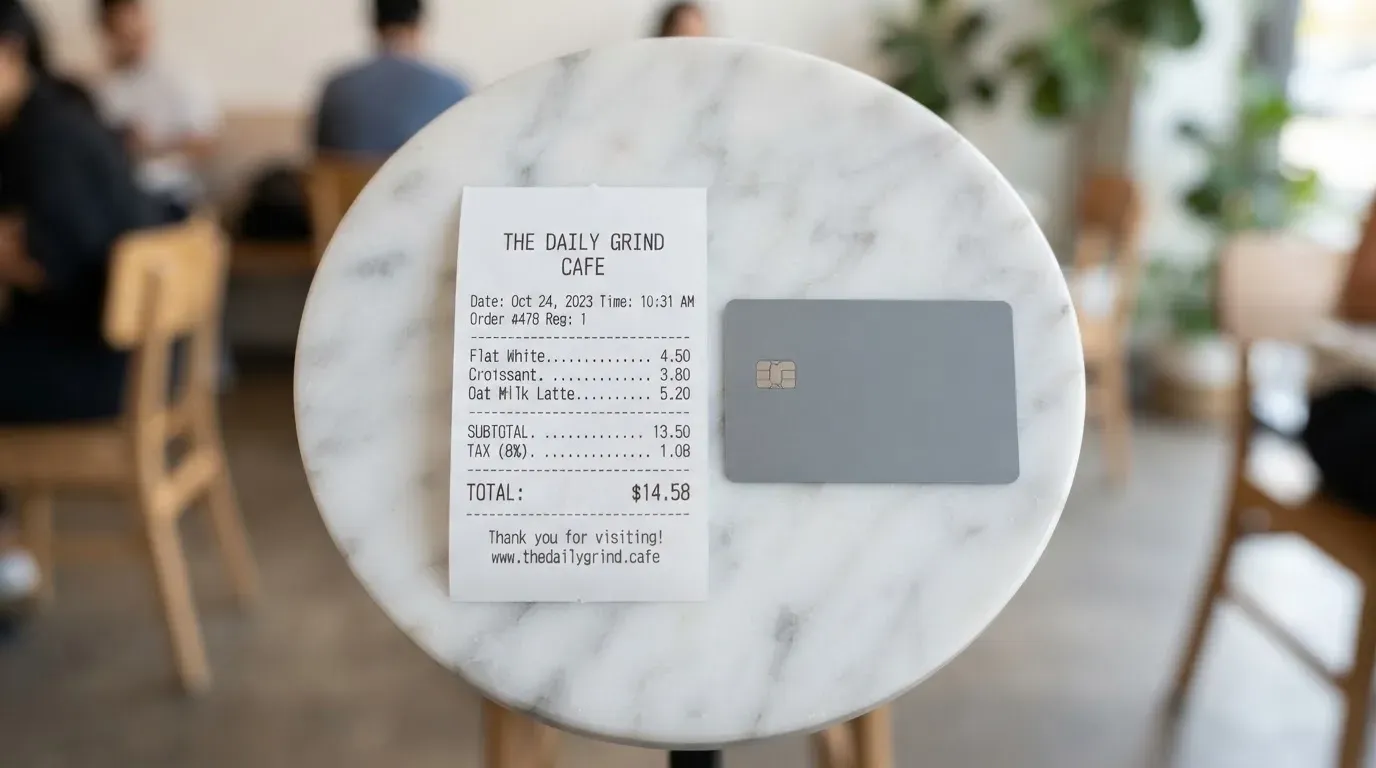
A receipt and a card on a café table. What a Zoomex payment costs depends on the conversion and currency fees.
The two numbers that will bite if you do not plan for them are the 1% conversion, which applies every time you top up, and the silence around ATM withdrawals. If you intend to use this as your everyday card, plan the top-up frequency to keep the conversion drag small, and check the in-app terms before relying on cash access.
Top up: how to fund the card
The card is funded by USDC. Public materials describe instant funding with digital assets, a USDC deposit, and a USDC transfer from a Zoomex exchange account to a UR account. The networks used for that USDC transfer are not stated in the press release. Minimums, fees and processing times for top-up are not stated either, which is a real gap if you want to plan when the balance is available to spend.
In practice, the only funding flow the press release confirms is moving USDC from a Zoomex exchange account to the UR account that holds the card. There is no stated support for bank transfers as a top-up, no stated support for cards funding the balance, and no stated support for other stablecoins. The dedicated IBAN that comes with the card suggests fiat can be received into the account, but the public materials do not describe how a fiat inflow becomes a spendable card balance.
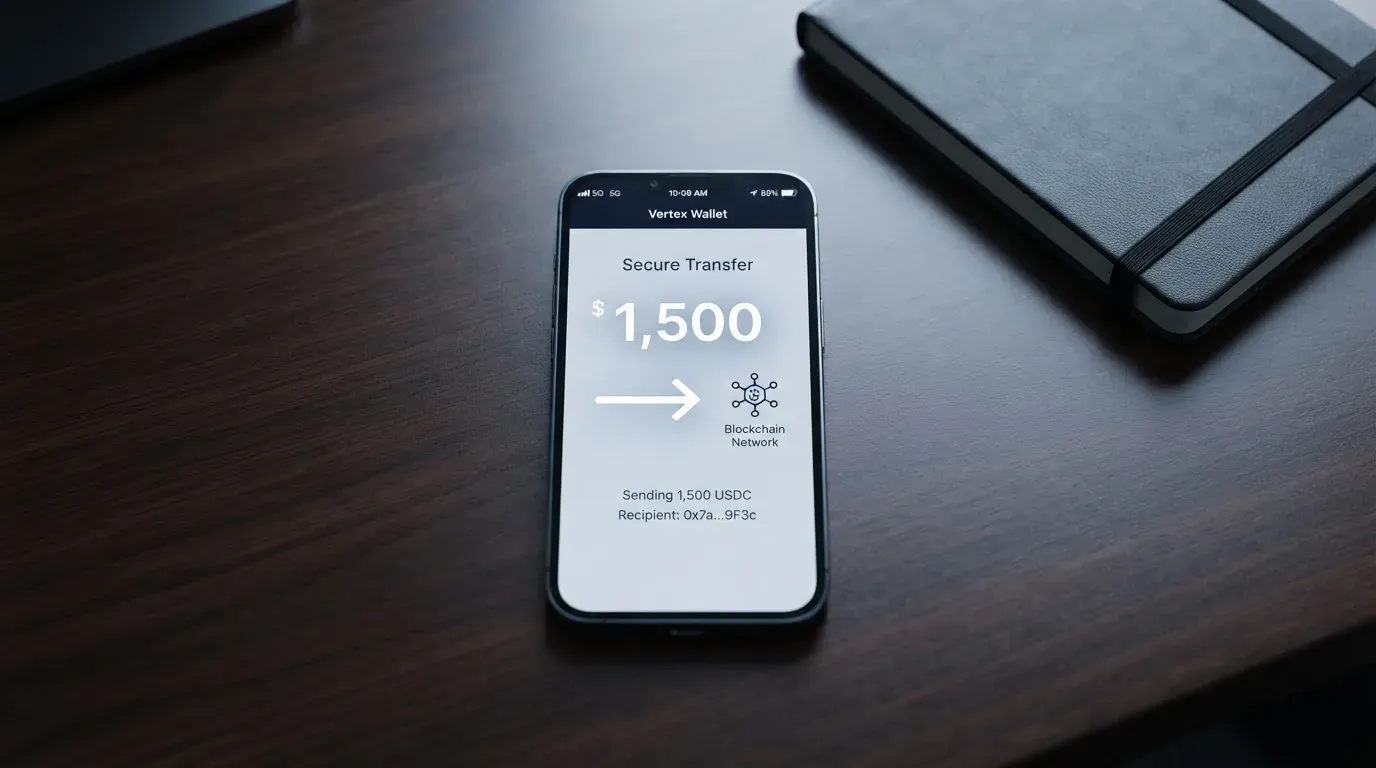
A phone showing a stablecoin transfer screen. Topping up Zoomex starts with a transfer to the right network.
A few practical points that come from how USDC and card funding usually work, and that are worth checking in-app before you commit funds:
- Circle lists USDC as natively supported on 38 networks. The card does not say which of those it accepts, so do not send a USDC transfer on a network you have not confirmed with the provider.
- Circle stopped supporting USDC on Tron in February 2024, so USDC over TRC-20 is not a native option.
- Blockchain transfers are irreversible, so a deposit sent on a network the card provider does not support, or to an address of another network, can be lost or need manual support recovery with no guarantee.
- On-chain network fees for the deposit are charged by the blockchain, not by Zoomex.
Paying with it every day
The card is a virtual Mastercard that works with Apple Pay, Google Pay and Samsung Pay. A dedicated IBAN is included with the card, which is what makes it useful as a receiving account as well as a spending card. The card settles in USD, EUR, CHF, SGD, HKD, JPY and “more”, and cross-currency transactions use Mastercard’s real-time exchange rates.
Cashback during the launch promo is 1% on compliant purchases through 30 April 2026 23:59 UTC, credited in real time, and new users get a $10 reward for a $5+ purchase within 30 days of activation. The cashback rate after the promo is not stated, so it is reasonable to assume the 1% is a launch figure, not a permanent one.
Blocked merchant categories are not stated. Most crypto cards in this category block gambling, and the merchant category code 7995 covers casinos, betting and lotteries, but the exact block list for the Zoomex card is not published. If a category matters to you, the only reliable way to check is to look in the in-app card controls after activation.
A few day-to-day points worth keeping in mind:
- The card is virtual and only virtual. There is no plastic to swipe, and any in-person use goes through a phone wallet.
- 3-D Secure adds an identity check to online card payments. The issuer assesses risk and either approves frictionlessly or challenges you with a one-time code or biometric.
- Some merchants decline prepaid or foreign-issued card BINs because the BIN lookup reveals the card type and issuer country.
- Address Verification Service is mainly offered in the US, Canada and the UK and is generally unavailable for foreign-issued cards, which can cause declines on US sites.
- Declined authorisations may leave a hold on funds that can remain for several days, typically up to 7.
The mobile app for the card is the UR app; ratings and review counts are not stated. Disputes, chargebacks, and the process for contesting a transaction are not stated in the press release.
What can go wrong
The honest summary is that the press release is short on the practical details a cardholder needs when something goes wrong, and that the third-party signal on the brand is weak.
The card programme sits on UR’s “licensed financial infrastructure”, but the issuer is not named in the Zoomex announcement, and UR’s country and licence footprint is not stated. Zoomex the exchange is announced from Victoria, Seychelles, and claims registration with Canada MSB, US MSB, US NFA and Australia AUSTRAC. The card itself is a payment instrument, and the institution behind it is what determines who supervises it and what protections apply if the programme is interrupted.
A third-party rating of the Zoomex exchange on Gridinsoft is 1.9 out of 5 from 81 reviews. That is a low number, although it is a rating of the exchange, not the card, and it is not the card’s Trustpilot or Reddit footprint, which I did not find. No official card incidents have been published, and there is no Trustpilot page for the card to read. I am flagging the rating because it is a real signal on the brand, not because it is a verdict on this specific product.
The promo timeline is tight, and the rate after it ends is not stated. The 1% cashback runs through 30 April 2026 23:59 UTC, and there is no public number for what comes next. The reward mechanics in general are best-effort and can change, so the 1% should be treated as a launch bonus, not a permanent return.
Other gaps worth seeing in one place:
- ATM terms, daily and monthly limits for Basic, and any inactivity or closure fees are not stated.
- Sanctions, PEP, and enhanced-due-diligence triggers for the card are not stated.
- The exchange claims it passed a Hacken audit, but the card’s own security disclosures are not stated.
- The supported USDC networks, minimum top-up and top-up fee are not stated.
- Customer support channels, hours and response times are not stated.
A general point worth making: crypto cards have a track record of being wound down. Visa terminated its global agreements with FTX in November 2022, and the FTX US debit card programme was wound down by its issuer. WaveCrest, a Visa card issuer that supplied several crypto card brands, was suspended by Visa in Europe in 2018, closing all WaveCrest-issued Visa programmes. The pattern, when a card programme is closed, is a notice period, then a stop on spending and loading, then a request to withdraw remaining balances. The Zoomex card sits on a Mastercard-licensed programme, and the same risk applies if the issuer or the network pulls support.
What to take instead
Three alternatives I would weigh against the Zoomex card, depending on what you actually need. The figures below are from the providers’ own materials and from third-party ratings, and they do change, so treat them as a starting point for your own check.
| Card | Score | Country | Form | Conversion | Rewards |
|---|---|---|---|---|---|
| Young Card | 5.7 / 10 | not stated | not stated officially | not stated | Cashback in YNG tokens, by Club tier: Essential 0.1%, Gold 1.8%, Platinum 3.6% (Bronze and Silver not stated) |
| Coinbase Card | 6.4 / 10 | All US states except Hawaii | Visa, virtual or physical | Spends cash or crypto, all converted to USD; spread on Coinbase conversion | Optional crypto rewards on every purchase, US Card users only; rate variable, shown in the app |
| OKX | 6.2 / 10 | EU plus Norway, launched 28 January 2026; Iceland and Liechtenstein excluded (one source says “entire EEA”, inconsistent) | Mastercard, euro-denominated virtual debit, no physical stated | Spread 0.1% per the explainer (May 2026) vs 0.4% per the launch release; explainer is newer | USDG-only cashback, monthly caps in EUR: Regular 2% / cap 10, VIP1 4% / 300, VIP2 4.5% / 450, VIP3 5% / 1,000, VIP4+ 10% / 1,000 (text says 2-5%, table 10%, inconsistent) |
Coinbase Card is the natural pick if you live in the US outside Hawaii. It is a Visa prepaid debit card, virtual or physical, spends cash or crypto, and converts everything to USD at the till. There are no Coinbase transaction fees, but a spread applies on Coinbase’s crypto buy, sell or trade. Funding is by linking a bank account or depositing part of a paycheck into Coinbase, and the crypto balance on Coinbase can be spent and is converted to USD. Optional crypto rewards on every purchase are for US Card users only, the rate is variable and shown in the app, and you pick from a rotating set of crypto rewards. The card follows US PATRIOT Act identity rules, so you provide name, address, date of birth and ID at account opening.
OKX is the natural pick if you are in the EU or Norway. It is a Mastercard euro-denominated virtual debit card linked to OKX Pay, with no card fee and no transaction or OKX FX fee per the explainer. The conversion spread is given as 0.1% in the explainer (May 2026) and 0.4% in the launch press release, and the explainer is the newer source. The card is held under OKX Europe Ltd., a MiCAR-licensed entity, and conversion to euro happens at the point of purchase. Funding is USDC or USDG held in OKX Pay, other coins have to be converted first, and there is no auto top-up; if the balance is short, the payment is declined. Cashback is only on USDG purchases (USDC earns none), and the published reward tiers are inconsistent across the company’s own materials.
Young Card is a weaker fit. The public information is thin: country list, card form, cost and funding are not stated officially, and the only concrete number is the cashback in YNG tokens by Club tier (Essential 0.1%, Gold 1.8%, Platinum 3.6%; Bronze and Silver not stated). It is worth watching rather than committing to today.
A general point on the alternatives: every crypto card is two products at once, a payment service and a crypto service, and each side has its own licence and its own risks. The exchange or wallet behind the card can be wound down even if the card programme is still running, and the card programme can be wound down even if the exchange is fine. Both risks are present here, and they are present in the alternatives too.
Who I would recommend it to
I would recommend the Zoomex card to a Zoomex exchange user who already holds USDC, wants a virtual Mastercard with an IBAN, and is comfortable with the gaps in the public information. The conversion fee is fair, the launch cashback is competitive, and the inclusion of Apple Pay, Google Pay and Samsung Pay covers the everyday spending most people actually do. The dedicated IBAN is the feature that lifts this above a basic crypto-to-card conversion, because it lets you receive fiat by bank transfer as well as spend it.
I would not recommend it if you live in the US, Russia, Iran or North Korea, given the early check on country coverage. I would not recommend it if you need a physical card, or if ATM access is a deal-breaker, because neither is published. I would not recommend it if you want the issuer named, the licence footprint of the issuer stated, the supported top-up networks listed, or a transparent schedule of fees after the launch promo, because none of those are in the press release. And I would not recommend it as a primary banking substitute: a card that draws on a single USDC funding source and sits on a programme whose issuer is not publicly named is a tool for a specific job, not a foundation for everyday money.
The honest read is that this is a small, focused product. It does a few things well and says little about a lot more, and the right reader is the one whose use case fits the few things it does well.
Frequently asked questions
What is the Zoomex card?
The Zoomex card is a virtual Mastercard that draws on a fiat balance you fund with USDC. It is issued through a UR account, comes with a dedicated IBAN, and works with Apple Pay, Google Pay and Samsung Pay. It is available in several major fiat currencies.
How does the Zoomex card work?
You hold USDC, transfer it to a UR account that holds the card, pay a 1% conversion into a spendable fiat balance, and spend that balance wherever Mastercard is accepted. Cross-currency purchases use Mastercard’s real-time exchange rates, and there is no issuance or annual fee.
Is Zoomex a bank?
Zoomex is announced as a crypto exchange, headquartered in Victoria, Seychelles, founded in 2021, and claims registration with Canada MSB, US MSB, US NFA and Australia AUSTRAC. The card sits on UR’s licensed financial infrastructure, and the issuer is not named in the public materials, so neither Zoomex nor UR is presented as a bank.
Who owns Zoomex?
The press materials do not name the owner. Zoomex is described as founded in 2021 and announcing from Victoria, Seychelles. The card sits on infrastructure operated by UR, and the relationship between the two companies is not detailed publicly.
Is the Zoomex card available in my country?
The press release does not list supported countries. An earlier check indicated worldwide availability except the United States, Russia, Iran, North Korea and a few US territories. Citizenship versus residence is not stated, so it is worth confirming with support before relying on a sign-up page.
How do I get the Zoomex card?
You open and verify a UR account, since the card is a feature of that membership, and the card is virtual only. There is no physical card, no shipping step, and activation, PIN and wallet add all happen in the UR app. A purchase of $5 or more within 30 days of activation pays a $10 reward.
Does the Zoomex card require KYC?
The press release does not state the card’s identity-verification steps. Since the card is a feature of a UR account, the KYC you go through is UR’s, and Zoomex is acting as the brand. Membership levels Basic and UR Pro are stated; the verification tiers that move you between them are not.
How do I top up the Zoomex card?
The stated top-up is a USDC transfer from a Zoomex exchange account to a UR account, with instant funding. The supported networks, fees and minimums are not stated in the public materials, and no other funding flow is confirmed, so the in-app instructions are the source of truth for your specific deposit.
Where can I use the Zoomex card?
Anywhere Mastercard is accepted in person, with Apple Pay, Google Pay or Samsung Pay, and online. Some merchants decline prepaid or foreign-issued card BINs because the BIN lookup reveals the card type and issuer country, and Address Verification Service is largely unavailable for foreign-issued cards on US sites.
Is the Zoomex card safe?
The card sits on UR’s licensed financial infrastructure, but the issuer is not named publicly, and Zoomex’s third-party exchange rating is low. No official card incidents have been published, and the rate after the 30 April 2026 cashback promo ends is not stated, so the launch numbers should be treated as a temporary figure rather than a permanent return.
Exchange cards: your questions answered – cryptocardanswers
Content created by the «cryptocardanswers» team