
A cheap Mastercard that spends your crypto balance, with two rules that decide whether it suits you
 Available in US
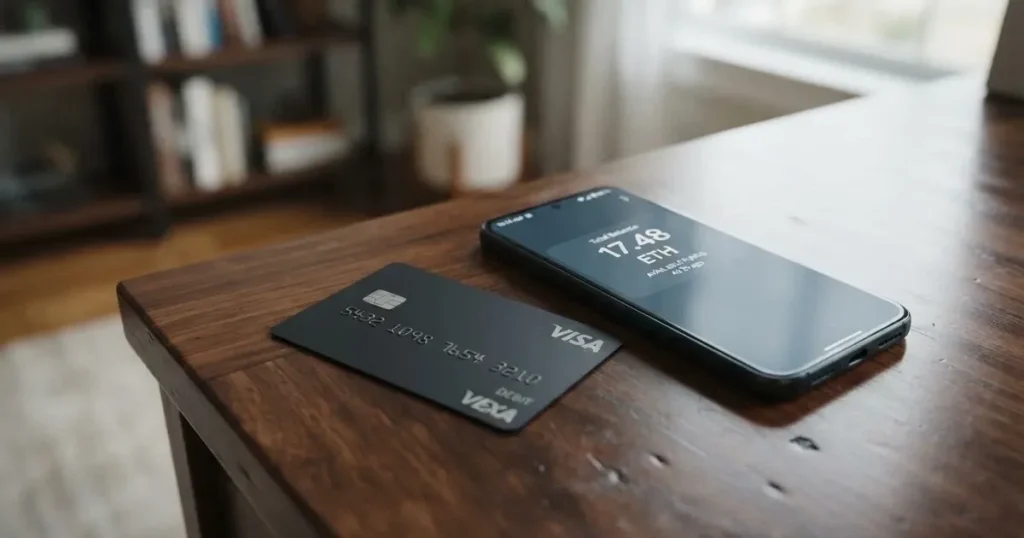
The Krak card is a Mastercard you load from a crypto platform’s balance rather than from a bank account. There is no monthly fee, no FX markup, no ATM fee from Krak itself, and a virtual card that arrives before a physical one does. In exchange, you accept a narrow geographic footprint, a variable spread when you pay across assets, and the fact that a crypto platform is sitting between you and the money. That trade is good for some people and wrong for others, and where you live decides a lot of it.
The conditions described below are current as of October 28, 2026.
Verdict: 7.1 out of 10, and a clear-eyed case for it
Krak scores 7.1 / 10 in my assessment. That is a good card with narrow doors. It earns its highest marks on everyday use and its lowest on access and on the reliability people report after problems start.
If you live in the UK or the EU, want a card that spends a crypto balance at shop prices with no monthly charge, and care more about cashback than about a wide list of spendable coins, this is a strong fit. If you are anywhere else, if you need a card in a currency the card does not issue, or if you hold crypto you would rather not have touched by a platform’s compliance system, pass.
Here is the score broken down.
| Criterion | Mark | Why |
|---|---|---|
| Who can get it | 5 / 10 | Residents of the UK and the EU, with “more countries coming soon” |
| Cost | 9 / 10 | Free to order, no monthly or annual fee, no transaction, FX or Krak ATM fees; card replacement $4.99; variable spread when paying with assets |
| Top-up options | 7 / 10 | Spends the Krak Everyday balance, spend order set in the app, 600+ assets offered but not all usable on the card |
| Reliability and complaints | 5 / 10 | Issued by Monavate (UK, FCA FRN 901097) and Monavate UAB (Lithuania, licence no. 92); Trustpilot readings of krak.app differ widely between sources, with complaints about account limits after a transfer |
| Everyday use | 10 / 10 | Virtual card immediately, physical and metal options, Mastercard, Apple Pay and Google Pay, no Krak ATM fee in 190+ countries |
| Total | 7.1 / 10 | Strong daily card, narrow access, and a complaints picture you should read before committing |
Two people should note something before anything else. Krak is an app from Kraken, not a bank. The card itself is issued by Monavate in the UK and by Monavate UAB in Lithuania, which is the arrangement that lets a crypto brand put a Mastercard in your pocket without being a bank. The wallet holding your balance is e-money issued by Kraken. If you were hoping for a deposit guarantee on your crypto balance, this is not the structure that gives you one.
Will they give you the card?
Yes, but only if you live in one of a small set of places, and the card’s own wording and its help article do not quite agree.
The card page says it is “currently available to residents of the UK and the EU, with more countries coming soon”, and it makes the point on residence, not citizenship. A footnote notes that geographic restrictions apply. Separately, a Krak help article says personal accounts are for UK, EEA and US residents, which is a wider list than the card page gives. That is a discrepancy I would not try to interpret; if you are in the US and the help article is what you find, you may be able to hold an account while the card itself remains UK/EU-only. The card page’s residency rule is the one I would plan around.
There is another residency point worth holding onto, and it applies to everyone who eventually succeeds. Nationality and country of birth get screened separately from where you live, because sanctions screening and issuer risk policy usually follow citizenship as well as address. A UK or EU address does not neutralise a citizenship that appears on a sanctions list, and I am not going to describe how to work around that — the honest answer is that if your citizenship is flagged, the application may simply fail, and no legitimate route changes that.
How to get it
The path is short, and the requirements are stated plainly: you need a verified Krak account with completed KYC, and Monavate must verify your identity before it issues a card. You must be at least 18.
What the public pages do not tell you is worth knowing before you start: which documents are accepted, what proof of address looks like, what the verification levels are, and how long verification takes. Those specifics are simply not stated on the pages I could read, so do not plan around a timeline. What is stated is the sequence:
- Open and verify a Krak account (KYC).
- Order the virtual card, which arrives in minutes.
- Or order a physical card, which ships free.
On the card itself: it is a Mastercard debit card, available virtual or physical. The physical card comes in orange or black. There is also a metal card in stainless steel, 16g, which requires an average of GBP/EUR 50,000 in combined assets held across Krak, Kraken and Kraken Pro. You can spend in 600+ currencies.
There is no fee to order the physical card, and delivery is to the UK and the EEA. How long it takes is not stated. Replacing a card costs $4.99 or the card-currency equivalent, charged by Monavate, and virtual and physical cards are cancelled separately, so remember both if you are closing down.
UNOFFICIAL, from a third-party comparison site rather than from Krak: plastic cards are said to arrive “normally within 14 business days”, and metal card replacement is put at GBP/EUR 60. Treat both as orientation, not as a promise.
Fees: what it really costs
The headline is genuinely good, and this is where the card scores highest. The card is free to order. There are no monthly or annual fees. Krak states “zero transaction fees, FX fees, ATM withdrawal fees or monthly fees on your spend”.
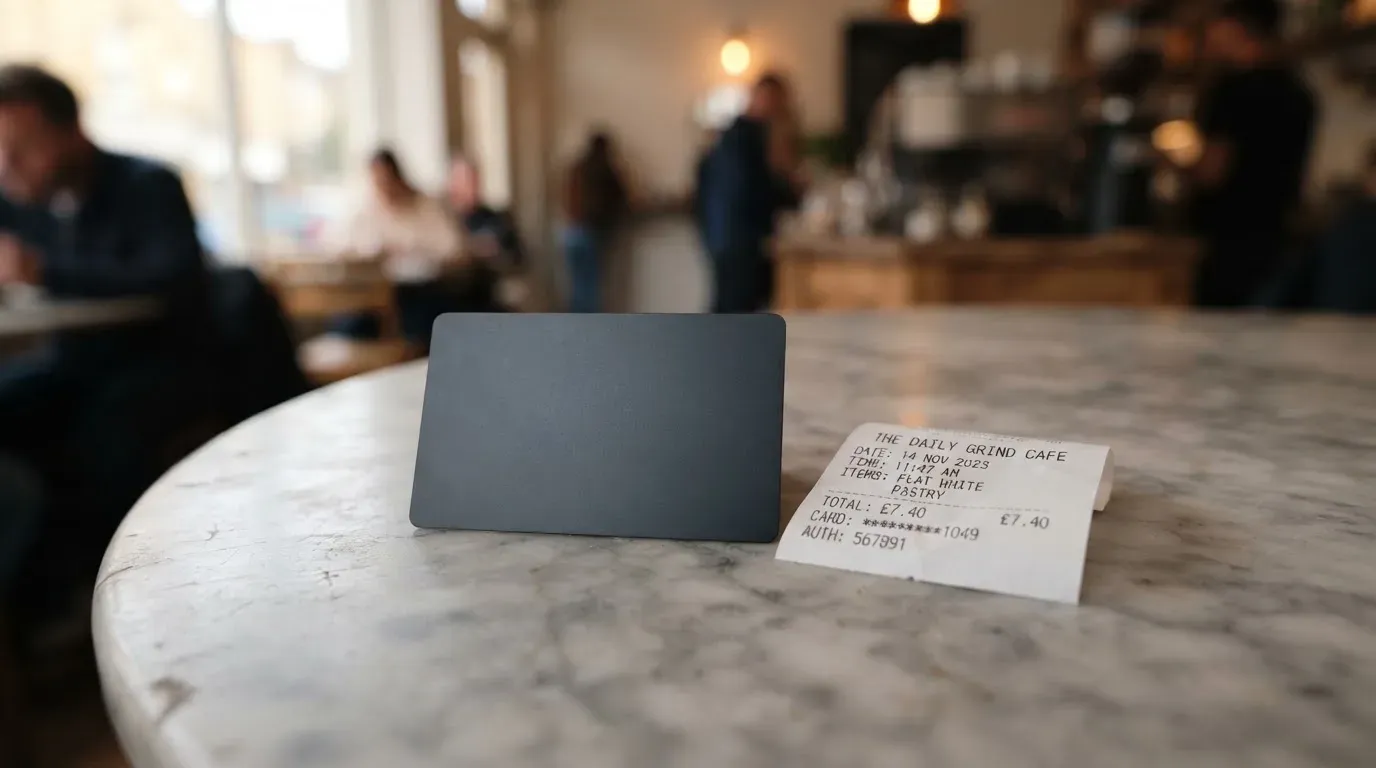
The catch is one line: “a variable spread applies when spending across assets”. The size of that spread is not stated. That is the single number a regular user would most want, and it is the one Krak does not publish on the pages I read. Until you can see it in your own app, treat it as unknown rather than as small.
Here is the full cost picture as far as the card’s own material goes.
| Fee or limit | What the card says |
|---|---|
| Card issuance | Free to order |
| Monthly or annual fee | None |
| Transaction fee on spend | Zero |
| FX fee | Zero; “passed through at the Mastercard rate with no markup” |
| Krak ATM withdrawal fee | None; “over 190 countries” |
| Third-party ATM fee | May apply, shown before the withdrawal |
| Crypto conversion | A variable spread applies when spending across assets; size not stated |
| Card replacement | $4.99 or the card-currency equivalent, charged by Monavate |
| Metal card | Requires average GBP/EUR 50,000 combined assets across Krak, Kraken, Kraken Pro |
| Daily, weekly and monthly limits | Apply to card spending and ATM withdrawals; vary by region and shown in the app; the terms say counts and amounts “may be limited” |
UNOFFICIAL contact thresholds, from a third-party site: before a PIN is demanded, GBP 300 in the UK and a cumulative EUR 150 in the EEA; up to two virtual and two physical cards active; three virtual card creations per rolling 30 days. No universal limit table is published by the card.
Now three everyday payments, and which of the above lines actually bites.
A £12 coffee in London. Nothing applies. You tap, it goes through, and there is no transaction fee and no FX question because the UK card is denominated in GBP and the coffee is in GBP. This is the payment the card is built for, and the reason it scores 10 out of 10 on everyday use.
A €30 dinner in Paris. Also clean. EEA cards are denominated in EUR, so no conversion and no markup. The Mastercard rate is passed through untouched.
A €30 dinner in Prague, paid from a card that spends your crypto balance. Here the variable spread becomes relevant, because you are spending assets rather than a fiat balance. The FX markup is zero, but the cost of turning the asset into spendable value is not published. This is the payment where two people on identical terms can have genuinely different costs.
Two things to keep in mind on limits: hotels and car rentals may hold an extra 10–20%, and the unused portion can take up to seven days to clear. A declined authorisation can also leave a hold that persists for several days, typically up to seven — a card payment that appears to fail may still be tying up your balance.
Top up: how money gets onto the card
The card spends from your Krak Everyday account balance. Multi-currency spending draws on currencies in the order you set in the app, so the order is your decision, not the platform’s. Fiat balances can be spent too, which is the part many people find genuinely useful: this behaves like an ordinary prepaid card when you fund it with pounds or euros.
Deposits can be made “at any time in the app”. Some deposit methods carry a 3-day withdrawal hold, which is the detail to watch if you need the money quickly. Fiat funding runs through Plaid for EUR/GBP, and there are separate PayPal articles. Deposit fees and minimums are not stated on the pages I read.
The order in which your assets are consumed is the part that catches people out. In the app you set a Spend Order; 600+ assets are offered, but not all of them are available for card use, and the ones that are not show as “Unavailable” when you try. The card does not name the specific coins or networks it will accept, so you have to check inside your own account rather than assume from a list somewhere else.
UNOFFICIAL, from a third-party site: near-instant card deposits are described as GBP/EUR 0.25 plus 3.75%. Krak’s own pages do not confirm that figure.
On the way back out: withdrawing your card balance to a bank account or on-chain is not described in the card’s FAQ. Cancelling means contacting Krak Support. A fee may apply if the agreement ends within six months. Closing the Kraken E-Wallet ends the Monavate agreement with it, and redemption of remaining balances is governed by Kraken’s terms, which I did not read.
Paying with it every day
This is the card’s best section. The virtual card is available in minutes, the physical one is free, and you can add the card to Apple Pay and, per a third-party report, Google Pay as well — Google Pay is not mentioned on the card pages I read, so treat that as unofficial. Whether any merchant categories are blocked is not stated.
Rewards are the reason many people look at this card. You get up to 2% cashback in cash or crypto, depending on the average assets you hold across Krak, Kraken and Kraken Pro. There is also up to 4% on travel booked through Krak Concierge. So the cashback rate is not a flat number: it moves with your balance, which means the card quietly rewards you for keeping assets on the platform.
The app is on iOS and Android. Official pages do not state the store ratings, so I will not guess at them.
Disputes and refunds work like this: you open the transaction in the app and tap “Get help with this transaction”. A refund goes back to the Everyday account in the card’s primary currency, and crypto is not automatically converted back. On complaints timelines, a UK complaint is acknowledged within 24 hours with a final response within 15 business days, extendable by 20; in the EEA it is 15 business days, or 35 if delayed. Fees can be refunded within a 14-day cooling-off period. A Krak help article says disputes may take 45–60 days, which is the number to plan your cash flow around.
| Reward or feature | Detail |
|---|---|
| Cashback | Up to 2% in cash or crypto, depending on average assets held |
| Concierge travel | Up to 4% on travel booked via Krak Concierge |
| Cashback on fiat balances | Fiat balances can be spent through the card |
| Blocked categories | Not stated |
| Wallet support | Apple Pay stated; Google Pay appears in third-party reports only |
What can go wrong
Let me separate three things here: what the card’s own pages say, what the regulator’s register says, and what users report. They do not agree, and you should hold all three loosely.
The issuer structure is real and checkable. The UK card comes from Monavate, FCA registration FRN 901097, company number 12472532. The EEA card comes from Monavate UAB, authorised in Lithuania under licence no. 92. The wallet holding your balance is Kraken’s e-money account, not Monavate’s. Krak’s own security page describes instant freeze, unfreeze and replace of a physical card, real-time transaction monitoring and data encryption; two-factor authentication is not stated, and the card terms say safeguarding is not covered.
Where the risk concentrates is funds sitting on a platform rather than in your own wallet. Crypto held with Krak is custodial: Kraken holds the keys, so you are trusting a provider with your assets. Transfers are irreversible, and custodial platforms have a real history of failure — Mt. Gox, Coincheck, Ronin. UNOFFICIAL, from a third-party site: fiat is said to be held in segregated accounts at regulated institutions, and the same source says UK e-money is not covered by FSCS and the EEA wallet has no deposit-guarantee coverage. That last point matters more than it sounds, because it is the difference between a bank balance and an e-money balance.
On stability, official channels state nothing. UNOFFICIAL reporting (third-party, dated 11 August 2026) describes a July 2026 Reddit report of an 11-day security review that suspended deposits, withdrawals and card use, with Kraken support later saying it “dropped the ball”. The same source notes a Bank of Lithuania fine or warning against Monavate UAB relating to AML and safeguarding. Another third-party aggregator, undated and unverified, reports card payments failing for several hours at a time in the UK and EEA, automatic freezes after small transfers from sanctioned addresses, and an undisclosed spread. I would not treat any of these as established fact, and I would also not dismiss them: the pattern they describe is the ordinary way compliance systems behave, and it is the thing that most reliably makes people’s money unavailable.
The complaint themes that recur are consistent enough to plan around: accounts restricted after a bank transfer or deposit with funds then inaccessible; generic escalation replies with no timeline; a UK cardholder reporting terminals asking for a signature instead of a PIN and a delayed refund; and a slow response to an unauthorised-transaction claim. Trustpilot readings for krak.app are reported at 3.8 from 34 reviews in one place and 1.9 from 126 in another, and I am not going to average those for you, because a 34-review sample and a 126-review sample are different measurements. The direction of travel across both is more useful than either number.
One last structural risk that belongs to the whole category rather than to Krak: card programmes close. Visa terminated its global agreements with FTX in November 2022, and WaveCrest was suspended by Visa in Europe in 2018, closing all WaveCrest-issued programmes. Closures typically mean a notice period, then spending and loading stop, then you are asked to withdraw what is left. UNOFFICIAL, single-source: one 2026 closure had new loads ending 8 July 2026 and spending stopping 8 August 2026.
What to take instead
| Alternative | Score | Where it is available | What it costs | What it spends |
|---|---|---|---|---|
| Young Card | 5.7 / 10 | Not stated | Not stated officially | Not stated officially |
| Coinbase Card | 6.4 / 10 | All US states except Hawaii; no other countries | Zero spending fees, no annual fees | Visa prepaid debit spending cash or crypto, converted to US dollars |
| OKX | 6.2 / 10 | EU plus Norway, launched 28 January 2026; Iceland and Liechtenstein excluded | No card fee; conversion spread quoted as 0.1% by one source and 0.4% market spread in the launch release | Mastercard virtual euro debit card linked to OKX Pay, USDC or USDG |
| Krak | 7.1 / 10 | UK and EU residents | No monthly or annual fee; no FX or Krak ATM fee; variable spread on asset spend | Mastercard, virtual and physical, 600+ currencies |
Coinbase Card is the closest thing to a like-for-like comparison, and it is really a different proposition: US-only, a Visa prepaid card rather than a debit card, and every crypto balance converted to US dollars for purchases and ATM withdrawals. Its published fees are cleaner — zero spending fees, no annual fees, all fees disclosed in the Cardholder Agreement — but conversion happens at payment with Coinbase’s own spread, and there is no stated avoidance of it. Rewards are optional, variable, US users only, and paid in crypto you pick from a rotating list. If you are in the US and only in the US, this is a reasonable alternative; if you are anywhere near the UK or the EU, it is not available to you.
OKX is narrower in a different way: a virtual Mastercard in euro only, no physical card mentioned, no auto top-up, and a payment declined if your balance is short. Its eligibility rule is per-user rather than per-country — an EEA user is subject to the rule of OKX Europe Ltd., the MiCAR-licensed entity. Its cashback structure is the most elaborate of the group. Cashback is offered only on USDG purchases (with USDC earning none), and monthly caps in euro range from 2% for Regular up to 5% for VIP3 and 10% for VIP4+; one source notes an inconsistency, with text suggesting a 2–5% range while the table shows 10%. Promotional offers have also been marketed, including 30-day windows of up to 20% for VIP and 15% for regular. I would not model a budget around those figures.
Young Card I cannot compare properly. Its card eligibility, card terms and fees are not stated officially, and what is published about rewards is that cashback is paid in YNG tokens at a rate set by Club tier — Essential 0.1%, Gold 1.8%, Platinum 3.6%, with Bronze and Silver not stated. Paid in your own token is a different proposition from paid in cash or in a stablecoin, and you should price that difference yourself.
Who I would recommend it to
Three groups. First, UK and EU residents who already hold assets on Krak, Kraken or Kraken Pro and want to spend them without a monthly fee, and who are content to have the card draw on a platform balance rather than a bank account. Second, people who travel in the eurozone or the UK and want a card with no foreign-exchange markup — the pass-through at the Mastercard rate is a real advantage over most travel cards. Third, Apple Pay users who want a virtual card usable within minutes and a cashback rate that improves if they leave assets on the platform.
Four groups I would steer away. Anyone outside the UK and the EU, because “more countries coming soon” is not an availability date. Anyone whose priority is custody or deposit protection, because the balance is custodial e-money and the guarantee structure is not the bank’s. Anyone who needs a wide, predictable list of spendable crypto — 600+ assets are offered and not all of them work on the card, and the spend order has to be set by you. And anyone who has previously had an account frozen or limited by an exchange and is looking for an alternative: this is an exchange card, so the same compliance behaviour comes with it.
Before you commit, check three things inside your own account rather than on a marketing page: what the variable spread actually is on your assets, which of your assets the card will really spend, and what your daily, weekly and monthly limits are. Then read the complaints, because the free part of this card is the part that is clearly good, and the part that is unclear is where your money can get stuck.
Frequently asked questions
What is the Krak card?
The Krak card is a Mastercard you spend from a crypto platform’s balance rather than from a linked bank account. Krak is an app from Kraken, and the card is issued by Monavate in the UK and by Monavate UAB in Lithuania. It comes as a virtual card available in minutes or a physical card shipped free, with a metal version requiring a large average asset balance. You spend in 600+ currencies.
How does the Krak card work?
You hold a balance in the Krak Everyday account, and the card draws on it when you pay. In the app you set a Spend Order choosing which currencies or assets are consumed first; 600+ assets are offered and not all are usable on the card, with the rest showing as unavailable. Fiat balances can also be spent. Card payments settle in the card’s primary currency — GBP in the UK, EUR in the EEA.
Is Krak a bank?
No. Krak is an app from Kraken, and the card is issued by Monavate (UK, FCA FRN 901097) and Monavate UAB (Lithuania, licence no. 92). The balance you spend comes from an e-money account issued by Kraken, not from a bank account. That distinction matters for what happens to your money if the provider has problems.
Who can get the Krak card?
The card page says residents of the UK and the EU, with more countries coming soon, and it is based on residence rather than citizenship. A separate help article mentions personal accounts for UK, EEA and US residents, so the two official statements do not match. You must be at least 18, have a verified Krak account with completed KYC, and pass Monavate’s identity check. Documents and timelines are not stated publicly.
How much does the Krak card cost?
The card is free to order with no monthly or annual fees. Krak states zero transaction fees, zero FX fees and no Krak ATM withdrawal fee, with foreign exchange passed through at the Mastercard rate without markup. Replacing a card costs $4.99 or the equivalent. The one cost that is not quantified publicly is the variable spread applied when you spend across assets, so check its size in your own app before relying on it.
How do I top up the Krak card?
You deposit in the app at any time, and some deposit methods carry a 3-day withdrawal hold. Fiat funding runs through Plaid for EUR and GBP, and PayPal articles exist. Deposit fees and minimums are not stated on the pages I read. A third-party site describes near-instant card deposits at GBP/EUR 0.25 plus 3.75%, which Krak itself does not confirm.
Can I use the Krak card in Apple Wallet?
Yes, Apple Pay is supported on the card’s own pages, and third-party reporting also indicates Google Pay works. Google Pay is not mentioned officially, so I would confirm that one in your app before relying on it. Merchant category blocking is not stated. You can also block individual currencies from being spent through your Spend Order.
Is the Krak card safe?
It carries ordinary card protections: instant freeze, unfreeze and replacement of a physical card in the app, real-time transaction monitoring, data encryption, and tokenised mobile wallets. Two things to weigh. Crypto held with Krak is custodial, so you trust the provider with it. And a third-party source says UK e-money is not FSCS-covered and the EEA wallet has no deposit-guarantee coverage.
Where can I use the Krak card, and what about cash?
The card is a Mastercard, so it works wherever Mastercard is accepted, though some merchants decline prepaid or foreign-issued cards. ATMs are available in over 190 countries with no Krak withdrawal fee, though the ATM operator may charge a fee shown before you withdraw. Daily, weekly and monthly limits apply to both spending and withdrawals and vary by region.
Is the Krak card worth it?
Worth it if you live in the UK or EU, hold assets on Krak, Kraken or Kraken Pro, and want spending with no monthly fee, no FX markup and up to 2% cashback that rises with your average balance. Not worth it if you are outside those regions, if you need deposit-guarantee protection, or if you want to spend a wide range of specific coins. Read the complaints about account limits before you commit — that is the risk that costs people access to their own money.
Exchange cards: your questions answered – cryptocardanswers
Content created by the «cryptocardanswers» team