
A no-fee Mastercard for Peru, with the fee details left unsaid
 Available in US
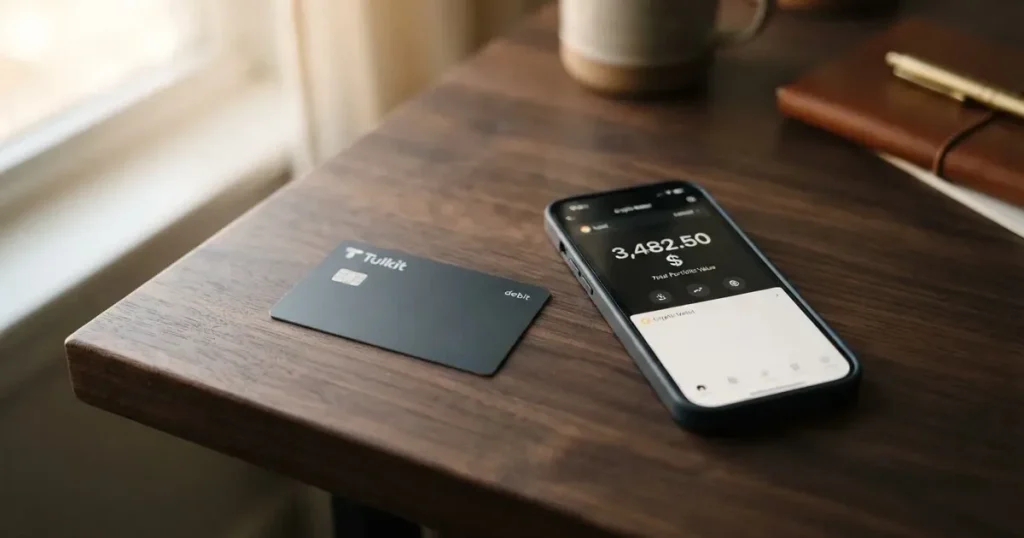
The Tulkit card is a prepaid Mastercard you can hold in crypto and spend like an ordinary bank card, with no monthly fee and no annual charge. That sounds like the ideal setup, and in the specific case of someone living in Peru who tops up through Yape, Plin or a crypto transfer, it very nearly is one. Outside Peru the picture changes sharply: the only country the card’s own pages name is Peru, the plastic ships anywhere in Peru, and nothing on those pages says otherwise. My score is 5.5 out of 10 — average not because the card is badly built, but because it solves a problem for one country’s residents and leaves several money questions unanswered for everyone else.
Conditions are current as of October 28, 2026.
This review covers Tulkit as it stands: a Tulkit Pay app for iOS and Android, a virtual Mastercard issued immediately, a physical card in twelve designs delivered free within Peru, and crypto that stays withdrawable at any time. I have gone through the card’s public pages carefully and marked every gap rather than filling it with a guess, because the gaps here are mostly about fees, and fees are the whole point of this kind of card.
Verdict: 5.5 out of 10
The score is not a verdict on the company. It is a verdict on fit. Tulkit does the simple version of a crypto card well: a Mastercard number, free to open, free to hold, usable for the ordinary things you pay for, with up to 2% back in Bitcoin on each purchase. What holds it back is that the exchange rate is claimed to be “one of the best on the market” with no figure attached, the crypto conversion fee is not stated, and there is no foreign-exchange fee disclosed either — while the prepaid cards settle only in soles. So the card is generous with the parts of the price it shows you and silent on the parts that decide what you actually pay abroad.
If you live in Peru, use Yape or Plin or transfer crypto, and want a second card that costs nothing to keep, this is a reasonable pick. If you are anywhere else, or you spend in dollars, or you plan to lean on the card abroad, you are outside the design and you should read the costs section twice before you commit a single sol.
| Criterion | Mark | Why |
|---|---|---|
| Who can get it | 1 / 10 | Of countries, only Peru is named; the plastic ships within Peru |
| Cost | 8 / 10 | No monthly fee and no annual charge; account and cards are free; the rate is “one of the best on the market” with no number, and the crypto conversion fee is not disclosed |
| Top-up options | 5 / 10 | Topping up 24/7 via Yape, Plin, bank transfer or crypto; coins and networks not disclosed |
| Reliability and complaints | 7 / 10 | Tulkit Pay S.A.C.; e-money issued by GMoney S.A. under SBS supervision in Peru; licence number not named, and no complaints found |
| Everyday use | 7 / 10 | Virtual Mastercard immediately, plastic in 12 designs with free delivery in Peru; Apple Pay, Google Pay and ATM are not disclosed |
| Total | 5.5 / 10 | Strong on price and everyday payment inside Peru, unproven outside it |
Will they give you the card
Peru is the only country named. The physical card ships anywhere in Peru, and the card’s pages mention foreigners with a valid Peruvian immigration card. That single line matters more than any fee, so read it as the whole answer: this is a Peruvian card. If your situation is that you cannot get an ordinary bank card, that is likely exactly why you are reading about crypto cards at all, and the honest answer to “will they give it to me” is “yes, if you are in Peru, and if your documents are Peruvian immigration papers rather than a foreign passport.”
I would not go further than that. The card’s public pages do not state the minimum age, they do not publish a document list, they do not say whether proof of address is required, and they do not say how many identity-verification levels exist. All of that is the kind of thing you discover at the sign-up screen rather than on a marketing page, and it is a fair reason to try — registration is described as taking under two minutes — but it is not a reason to trust in advance.
How to get it
Registration is described as quick and paperless. Identity verification “takes a few photos”, registration takes minutes, and the card states no paperwork, under two minutes and no credit check. The credit-check point is worth noticing if you are reading this because of a credit problem: a prepaid card draws on a stored balance and does not look at your borrowing history at all, which is why a card like this exists as an alternative in the first place.
What you get on the way through: a Mastercard, in virtual and physical form, with twelve designs to choose from for the plastic. The virtual card is issued instantly. The physical one is shipped free within Peru — though how long that takes, and what a replacement costs if it is lost or stolen, are both not stated on the public pages. And a structural fact you should know before you start: these are prepaid cards, and prepaid cards settle only in soles. Even where the page says you can pay in soles, dollars or crypto, the settlement currency is the sol.
Fees: what it really costs
Here is the honest summary: the card has no monthly fee and no annual charge, and opening an account and requesting either the physical or the virtual card is free. Sending and receiving soles through Yape, Plin and banks is free. In the card’s own words, “sin costo mensual, ni anualidad”. A detailed schedule exists in a document called the “Tarifario Tulkit Card” — a pricing PDF that I have not seen the contents of, and it is the first place to look if you need the exact numbers rather than my summary.
The gap is in conversion. The exchange rate is claimed to be “one of the best on the market”, but no figure is published, so I cannot tell you what you actually get per dollar or per sol converted. The crypto conversion fee is not stated. The foreign-exchange fee is not stated. ATM fees are not stated. If you pay in a currency other than soles, this is precisely the information you need and precisely what the card does not publish. For someone paying a coffee in soles, that absence costs nothing. For someone converting crypto into dollars and spending the result abroad, it is the whole decision.
| Fee or limit | What the card says |
|---|---|
| Monthly fee | None (“sin costo mensual”) |
| Annual fee | None (“ni anualidad”) |
| Account opening | Free |
| Physical card | Free to request |
| Virtual card | Free to request |
| Sending/receiving soles (Yape, Plin, banks) | Free |
| Exchange rate | Claimed “one of the best on the market”; no figure given |
| Crypto conversion fee | Not stated |
| Foreign-exchange fee | Not stated |
| ATM fee | Not stated |
| QR payments | Capped at S/5,150 per day |
| Card limits | Settable in the app; no other figures given |
Two everyday payments, so this is concrete. A taxi or a coffee shop in Lima, paid by QR: the daily QR ceiling of S/5,150 is far above anything you would spend, and soles moving through Yape or Plin costs nothing, so the effective cost of that payment is close to zero. A subscription billed in dollars while your balance sits in soles: now you are paying whatever spread sits behind the unstated exchange rate plus an unstated FX fee, and the card’s promise that prepaid cards settle only in soles means the conversion happens somewhere in that chain. I cannot tell you the rate. Neither, it seems, can the public pages.
Top up: how the balance gets there
Topping up works 24/7, which is the genuinely useful part of the design — no branch, no business hours, no waiting for a bank window. You have four routes named: Yape, Plin, bank transfer, or crypto. The first three are free of charge for soles. Deposit fees, minimum amounts and network fees are all not stated.
The crypto route is where you must be careful, and the care is not about Tulkit. The page lists coins only as “starting data: BTC, ETH, USDT etc.” — no official list of which coins and which networks are supported. That matters more than it sounds: blockchain transfers are irreversible, and a deposit sent on a network the provider does not support, or to an address belonging to another network, can be lost or need manual support recovery with no guarantee. There is another layer with stablecoins specifically. USDT exists on Ethereum, Tron, Solana, Polygon and Avalanche and others, while USDC is natively supported on 38 networks and stopped being supported on Tron in February 2024 — so “USDC over TRC20” is not a native option. Fees on those transfers are charged by the blockchain, not by the card. So: get the supported-coin-and-network list from support before you send anything, not after.
Crypto withdrawals are described as working at any time, with transfers called instant and no fees stated. What happens to your balance if you close the account is not stated — that is a question worth asking support while you are still a customer rather than after.
Paying with it every day
Day to day, this is a normal Mastercard. That is the appeal. You use the number, you tap, you pay, and it behaves like the card everyone else has. The virtual card is instant so you can add it to a subscription or a travel booking in the same hour; the physical one has twelve designs if the look of the thing matters to you, which for a card that sits in a wallet every day is not a trivial point.
On rewards, purchases earn up to 2% back in Bitcoin, with further conditions not stated — “up to” is doing work in that sentence, and I would want to know what caps it before I valued it. A “Tulkit+” tier is mentioned in connection with crypto withdrawals, but its content is not detailed anywhere public, so treat it as a name rather than a benefit.
Three things the pages do not tell you, and each is a real gap in daily use: Apple Pay and Google Pay support are not stated, ATM withdrawals are not covered, and the dispute process is not stated — that is, what happens when a charge goes wrong and you want the issuer to reverse it. There is a multip-currency FAQ answer on the site that is missing, which is a small hint that the currency picture is still being worked out rather than settled. I have not checked app-store ratings.
What can go wrong
No complaints is not the same as no risk, so here is what I looked for and what I found. I found no official incident and no third-party complaints — and no Trustpilot page for tulkitpay.com either, which means there was nowhere for complaints to have collected. Tulkit Pay S.A.C. handles the fiat and crypto conversion; the e-money is issued by GMoney S.A., described as authorized and regulated by the SBS in Peru, though no licence number is published. That regulator is real, and the structure — a licensed e-money issuer behind a card brand — is the normal structure for this category, but you are checking it without the licence number, and I would ask for it.
On security, the card claims bank-level security and encryption, says 90% of assets are held offline, and offers in-app card lock, freeze, adjustable limits and a report-account-theft form. Whether customer funds are safeguarded in a manner comparable to a bank deposit is not stated, and it should be: e-money institutions are expected to safeguard customer funds, but such funds are not the same as bank deposits and may not be covered by a deposit guarantee scheme. That distinction is worth sitting with, because it is the difference between a lost balance being a paperwork problem and a lost balance being your problem.
Support is email: [email protected], and at GMoney [email protected], with a complaints book called “Consultas y Reclamos”. There is no phone number, the WhatsApp link is a placeholder, and hours are not stated. Email-only support is workable and slow; the WhatsApp placeholder is the detail that suggests an unfinished corner of the operation.
Set against that: custodial platforms have a record of catastrophic failure. Mt. Gox reported about US$350 million stolen between 2011 and 2014, Coincheck about US$400 million in 2018, Ronin Network US$625 million in 2022. Card programmes have been switched off by networks too — Visa terminated its global agreements with FTX on 13 November 2022 and WaveCrest, an issuer supplying several crypto card brands, was suspended in Europe in 2018. Closures typically mean a notice period, then spending and loading stop, then you are asked to withdraw what is left. If you keep money on this card, keep it small enough that losing access to it for a month would be an inconvenience rather than a crisis.
What to take instead
Three alternatives, each with its own shape, all with a higher score than Tulkit’s 5.5. None of them is a copy of Tulkit, and none of them is universally better.
Morse (7.5/10) is the strongest on cost transparency. “Zero foreign exchange fees or markups”, the real-time Visa exchange rate, conversions at the real rate with no markup, and paying online or contactless is free. Its catch is scope: the card is fully virtual for now, eligibility is by residence rather than citizenship with users at least 18 and resident in a supported country, the app works in over 140 countries for P2P, and a list of countries — including the UK, Japan, Australia and Singapore — is closed beta needing an invite code. Deposits include debit card, stablecoin transfer, and USDC, USDG and EURC via Solana free, other tokens fee-bearing; its wallet is self-custodial. Issuance and monthly fees are not stated.
International Visa Card (6.7/10) is a U.S.-issued Platinum Visa, virtual only, paying in USD, with a $5 one-time issuance and no maintenance fee; plans run Classic free, Pro $9.00/month, Max $19.00/month. It excludes residents or legal registrants of seventeen named countries including Russia, Turkey, India, Vietnam and Ukraine, and blocks purchases in seven including Russia and Syria — the rule follows residence or registration, not citizenship. Foreign currency costs “Visa exchange rate + 2% FX fee”.
UNi Card (6.1/10) is a multicurrency Mastercard spending from a UNi.Global balance, with “no annual fee or foreign transaction fee”, conversion at live OTC rates and “no hidden exchange fees”, plus spend-to-earn rewards up to 3%. Its card form, issuance fee and funding route are all not stated, and who can get one is not stated either.
| Alternative | Score | Card | Standout point | Catch |
|---|---|---|---|---|
| Morse | 7.5 / 10 | Virtual Visa, 18+, by residence | Zero FX fees, real-rate conversions, self-custodial wallet | Virtual only; invite-only in some countries; fees not stated |
| International Visa Card | 6.7 / 10 | U.S.-issued Platinum Visa, virtual, USD | $5 once, no maintenance fee, 2% FX fee stated | Long country exclusion list; physical card “coming soon” |
| UNi Card | 6.1 / 10 | Multicurrency Mastercard | No annual fee, no FX fee, up to 3% rewards | Card form, funding and eligibility not stated |
| Tulkit | 5.5 / 10 | Mastercard, virtual and physical, soles | Free to hold, 24/7 local top-up | Peru only; conversion and FX fees undisclosed |
Who I would recommend it to
To a resident of Peru who already moves money with Yape or Plin, who wants a second card that costs nothing to keep, and who is comfortable that the useful version of this card is a soles card. The free account, the free virtual Mastercard available immediately, the free physical card in twelve designs, the S/5,150 daily QR ceiling and crypto that stays withdrawable are a coherent, generous package for daily life in one country.
I would not recommend it to you if you are outside Peru, if your income or spending is in dollars, or if the plan is to use it abroad — because the exchange rate, the crypto conversion fee and the FX fee are all unstated while settlement is soles-only, and the card is simply not advertised anywhere but Peru. Nor would I recommend it as a place to hold a balance you would miss, given email-only support, a placeholder WhatsApp link, no published licence number and no stated safeguarding of customer funds.
And if the reason you are here is that a bank declined you something, take this as one option among several rather than the only one: the three alternatives above score higher overall, and two of them state their fees outright, which is more than most cards in this category do.
Frequently asked questions
What is the Tulkit card?
The Tulkit card is a prepaid Mastercard that works like an ordinary payment card but draws on a balance you load yourself, including from crypto. Tulkit Pay offers it as a virtual card issued immediately and a physical card in twelve designs, with the plastic delivered free anywhere in Peru. Opening the account and requesting either card is free, and there is no monthly fee and no annual charge. Rewards of up to 2% back in Bitcoin are advertised on purchases. It settles only in soles.
Is Tulkit a bank?
No. Tulkit Pay S.A.C. is the company behind the card and handles the fiat and crypto conversion, while the e-money itself is issued by GMoney S.A., described as authorized and regulated by the SBS in Peru — though no licence number is published. An e-money issuer is not a bank: it cannot lend, and customer funds are not the same as bank deposits or necessarily covered by a deposit guarantee scheme. When you read about a “Tulkit bank account”, that is the account behind the card, not a separate banking relationship.
Who can get a Tulkit card?
Peru is the only country the card’s own pages name, and the physical card ships anywhere inside Peru. The pages also mention foreigners holding a valid Peruvian immigration card. Everything else about eligibility is not stated — no minimum age, no document list, no proof-of-address requirement, no description of verification levels. If you are reading this from outside Peru, the honest answer is that the card is not advertised to you and I cannot tell you what would happen if you tried.
How much does the Tulkit card cost to keep?
Nothing, according to the card: “sin costo mensual, ni anualidad”, no monthly fee and no annual charge. Opening an account and requesting the physical or virtual card is free, and sending and receiving soles through Yape, Plin and banks is free. The costs that are not published are the ones that would bite you: the exchange rate is claimed to be “one of the best on the market” with no figure, and the crypto conversion fee and foreign-exchange fee are both not stated. A detailed schedule sits in the “Tarifario Tulkit Card” PDF.
How do I top up the Tulkit card?
You have four routes, available 24/7: Yape, Plin, bank transfer, or crypto. The three fiat routes are free of charge for soles. Deposit fees, minimum amounts and network fees are not stated, and on the crypto side the coins are listed only as “starting data: BTC, ETH, USDT etc.” with no network list — which matters because transfers are irreversible, so confirm the supported coin and network with support before sending. On-chain fees are charged by the blockchain, not by the card.
Can I use the Tulkit card in another country?
Do not plan around it. These are prepaid cards and prepaid cards settle only in soles, so spending abroad means a currency conversion whose rate, crypto conversion fee and FX fee the card does not publish. The card’s pages say you can pay in soles, dollars or crypto per page, but the multicurrency FAQ answer is missing. The only geographic commitment the card makes is delivery within Peru. If cross-border spending is the point for you, the Morse card or the International Visa Card, which at least publish their FX terms, fit better.
Does the Tulkit card support Apple Pay or Google Pay?
The public pages do not say. Apple Pay and Google Pay support are both not stated, which is a real limitation rather than a technical impossibility — tokenised mobile wallets are common in this category, and the issuer can restrict a tokenised number to certain channels. The same pages also leave ATM withdrawals and the dispute process uncovered. Your fastest route to a real answer is the support email, [email protected], which is the only contact channel published: there is no phone number and the WhatsApp link is a placeholder.
Is the Tulkit card safe?
Reasonable, with two open questions. It claims bank-level security and encryption, says 90% of assets are held offline, and offers app-based card lock, freeze, limits and an account-theft reporting form. The open questions are whether customer funds are safeguarded and how strong the dispute route is — neither is stated. No official incident and no third-party complaints were found, but there is also no Trustpilot page for tulkitpay.com, so that absence is weak evidence. It is custodial, which means you are trusting the provider with the credentials.
How do I withdraw from the Tulkit card?
Crypto stays available for withdrawal at any time, with transfers described as instant and no withdrawal fees stated. Fiat movement is through the same rails as funding — Yape, Plin and banks are free for soles. What is not stated is what happens to any remaining balance if you close the account, which is exactly the question to ask support while you are still able to ask it. Remember too that a blockchain transfer cannot be reversed by anyone, including by support.
Is the Tulkit card worth it?
In Peru, for a secondary card, yes — it costs nothing to hold, arrives instantly in virtual form, and works at QR counters with a S/5,150 daily ceiling. Outside Peru, the value proposition is not there, because the card is not advertised beyond Peru and its conversion and FX fees are unstated while settlement is soles-only. And if what you need is a way to hold crypto and spend it worldwide, compare it first with the three alternatives above: Morse, the International Visa Card and UNi Card all score higher on my scale and publish more of their fee terms.
App and neobank cards: your questions answered – cryptocardanswers
Content created by the «cryptocardanswers» team