
The USDT-funded Visa card with a zero monthly fee — what it costs, who gets one, and what to check first
 Available in US
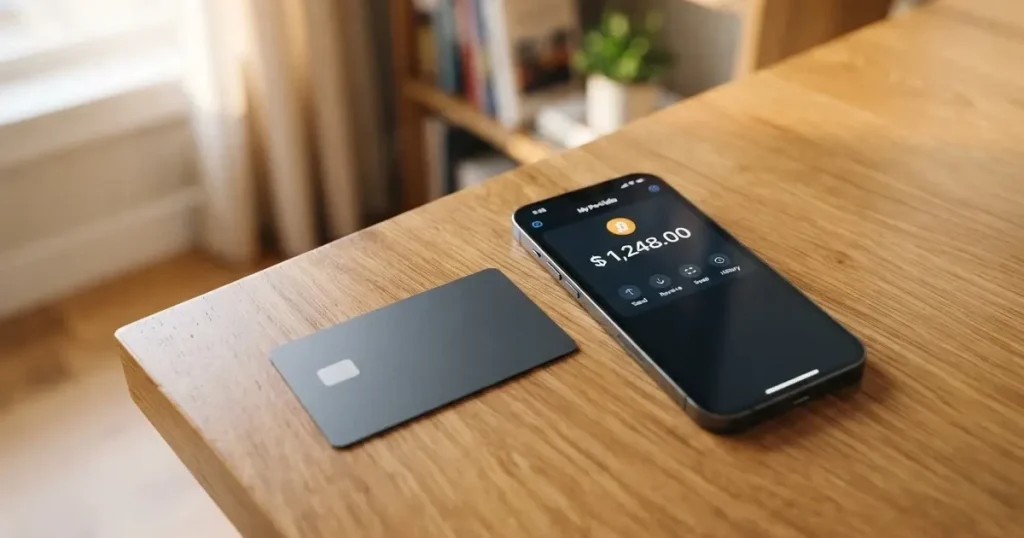
The Tevau card is a crypto-funded Visa card whose whole design assumes you already hold USDT. You keep your stablecoin in the app, move it onto the card balance, and then spend it like an ordinary prepaid card — online, in stores, through Apple Pay or Google Pay, or at an ATM if you chose a physical version. There is no monthly fee, the virtual card is cheap, and the daily spending ceiling is high enough that most people will never approach it. In exchange you accept a narrow funding rail (USDT only), an issuer that is not named, and a set of small fees that quietly stack up if you pay in anything other than dollars. I scored it 6.0 out of 10. That is a “works, but read this first” card, not a confident recommendation to everybody.
Conditions are current as of October 28, 2026.
The short verdict
Here is where the 6.0 comes from, criterion by criterion, with my reasoning in plain words.
| Criterion | Mark | Why |
|---|---|---|
| Who can get it | 9 / 10 | The pages claim 200+ countries with availability that “varies by region”, but no country list or exclusion list is published |
| Cost | 4 / 10 | Virtual 20 USD, plastic 100 USD, top-up 1%, non-USD payment 1.2%, ATM 1.9%, monthly fee $0, then $3 after 90 days without operations |
| Top-up options | 4 / 10 | USDT only; the app shows you the network but the page never names it; fiat funding is not disclosed |
| Reliability and complaints | 4 / 10 | Hong Kong office, issuer unnamed, a claimed Bank of Canada registration that is not verified, and no complaints or independent reviews found |
| Everyday use | 9 / 10 | Virtual, plastic, metal and 24K Gold, Apple Pay and Google Pay on all types, ATMs on physical cards |
| Total | 6.0 / 10 | A good everyday card for USDT holders, thin on funding options and on independent evidence |
Who this suits: you already hold USDT, you want a prepaid-style card you can top up from the app in seconds, and you mostly pay in dollars or use Apple Pay. Who it does not suit: you want to fund with a bank transfer or a card, you live somewhere the availability rules might exclude you and cannot check the list, you need a card whose issuing bank you can name, or you are put off by an absence of independent reviews. Most of the reasoning behind those two lists lives in the sections below, so read on rather than deciding from this paragraph.
Will they give you the card
Broadly, probably — but “broadly” is doing real work here, and it is the part of this card I would want you to sit with.
The pages say the card is available in “200+ countries” with availability that “varies by region”. Both halves of that sentence matter. The first half is the marketing claim; the second half is the caveat, and it is the caveat that decides your case. No country list and no exclusion list are published, so there is no way to check in advance whether your place of residence falls in one of the regions where it does not work. This is not Tevau’s own page saying so — it comes from tevau.co, which describes itself in its FAQ section as an independent information site and not Tevau itself, while its card page sits on the same domain. I found no confirmation of the availability claim from the company directly, and none of the numbers in this review come from Tevau itself.
That matters more than it sounds, because of how this card is structured underneath. A card number begins with a six- or eight-digit issuer identification number, and merchants look it up to see which institution and which country issued it. If the issuer country differs from the customer’s billing address, the merchant may apply extra scrutiny. That is why a card issued in one country can look foreign to a shop in another, and it is why a card whose issuing country you cannot find out is a worse bet at an unfamiliar merchant. Later sections come back to this, because it shapes both how often your payments go through and how you handle a decline.
Identity checks are mandatory here, so this is not an anonymous card and it is not an anonymity tool of any kind. The detail of that check is in the next section. Age is 18 and over.
How to get it
There is one KYC flow, not several. One government ID — passport, driving licence or national ID — plus a selfie in the app, 18+, and no tiered or upgraded levels along the way. Blurry photos are the usual reason a submission gets sent back, so take the picture in decent light and hold still.
Two things I could not find. The processing time is not stated as a policy anywhere I could read, and where you must be resident or a citizen to be accepted is not published. The second one is the gap that matters: the pages say the card works in 200+ countries, but the eligibility rule is the missing half of that sentence.
The card itself is a Visa, offered in four versions: Virtual, Plastic, Metal and 24K Gold. The card currency is not stated. Delivery works like this — a virtual card appears in the app instantly; card shipping and replacement are free; which countries it ships to is not specified, and neither is delivery time. If a card has not arrived within 14 days, the advice is to check the tracking code first, then contact in-app support.
There is one app. On iOS, “Tevau” by Tevau Technology Limited sits at 4.4 out of 5 from 7 ratings as I read it on 2026-10-20, with the latest version 2.0.010 dated 11 September. An Android listing exists but shows no rating. Seven ratings is not a foundation to trust, but it is not nothing either.
Again: the KYC, card-type and delivery detail above all come from that third-party site, not from Tevau’s own pages.
Fees: what it really costs
The headline is good: a zero monthly fee, and no annual fee stated. The costs arrive in three other places — the card itself, the conversion, and small per-transaction charges that add up.

| Item | Value |
|---|---|
| Virtual card | 20 USD one-time |
| Plastic card | 100 USD one-time |
| Metal card | 199 USD one-time (unofficial, not confirmed by Tevau) |
| 24K Gold card | 499 USD one-time (unofficial, not confirmed by Tevau) |
| Monthly fee | $0 |
| Annual fee | not stated |
| Closing the card | $2 (unofficial, not confirmed by Tevau) |
| Card validity | 3 years |
| Top-up from wallet | 1% |
| Deposit to wallet | no fee |
| USD payment | $0.20 + 0.5% (unofficial, not confirmed by Tevau) |
| Non-USD payment | 1.2% |
| Small authorisation (up to $3) | first 5 per month free, then $0.20 (unofficial, not confirmed by Tevau) |
| Declined transaction | first 3 per month free, then $0.50 (unofficial, not confirmed by Tevau) |
| ATM withdrawal | 1.9% |
| ATM availability | at “supported ATMs”; operator fees may apply |
| FX | only an “FX rate spread for overseas spending” is mentioned, not quantified |
| Inactivity | $3 after 90 days without a transaction, then $1 every 30 days |
| Minimum top-up | not stated |
Two contradictions deserve your attention before you decide anything. First, a Product Hunt listing by the maker dated 2026 puts the virtual card at $10, while the fee table says 20 USD — treat 20 USD as the better-supported figure and expect price to be the thing that changes. Second, the FAQ describes an inactivity charge after 90 days while the fee table shows no such line at all. Do not plan to leave a card untouched and then be surprised; assume the FAQ’s $3-then-$1-per-30-days is the live rule. The pages also warn that fees “can differ by card type, campaign, and region”, which is another way of saying the table is not a promise.
Three everyday payments, with the arithmetic left visible so you can check my working rather than take it on faith:
- A $40 subscription paid in dollars costs $40 plus $0.20 (unofficial, not confirmed by Tevau) plus 0.5% of $40 ($0.20). Total roughly $40.40, so about 1.0% of the purchase.
- The same $40 subscription paid in euros costs $40 plus 1.2% ($0.48). Roughly $40.48. On its own that is cheap; but a payment that is declined and retried brings the per-attempt charges below into play.
- A $200 cash withdrawal in a local currency costs 1.9% ($3.80) from Tevau’s side, plus whatever the ATM operator charges, plus the local bank rate on the cash. USD ATM withdrawals in local currency carry no FX fee from the card, but the bank rate still applies. This is the most expensive everyday action on the card.
Top up: how to get money onto it
USDT. That is the whole story, and it is the card’s narrowest point. The app shows you which network to use, but the page never names those networks — so the one instruction that would prevent an expensive mistake is the one you have to read off a screen at the moment of sending. Funds sent on the wrong network are not recoverable.
Every hard number attached to funding, from that same unofficial source:
- Top-up from your wallet: 1% (unofficial, not confirmed by Tevau). On the 24K Gold card, 0.5% (unofficial, not confirmed by Tevau) on up to 5 top-ups per month — though one part of the table says 5 waivers a month and another says a 50% discount on up to 5 top-ups, which does not obviously mean the same thing.
- Deposits into the wallet itself: free.
- Minimum top-up: not stated.
- Fiat top-up: not stated. A “Withdraw to bank (IDR supported)” guide is linked with no details attached, which tells you something exists without telling you what.
On-chain network fees are charged by the blockchain, not by Tevau — true of every crypto card, not a Tevau perk.
The withdrawal side is where the model becomes clear. USDT can be withdrawn from the wallet to an address shown in the app. Once you have topped the card up, that balance can only be spent or withdrawn at an ATM — it is not the same pool as your wallet balance. Closing a card returns the remaining balance to the wallet, costs $2 (unofficial, not confirmed by Tevau), and cannot be undone; the application fee is not refunded, and a virtual card with no transactions for four consecutive months closes automatically.
That structure is the thing to understand before your first payment, because it means an unexpected block of several thousand dollars sitting on the card is a problem you solve at an ATM or by closing the card, not one you solve in the app.
Paying with it every day
Apple Pay and Google Pay work on all card types, physical and virtual — which, in practice, is what you will use most. You can lock the card in the app, and close it if it is lost or you think the details leaked.
Where it falls short:
- Virtual cards cannot be tapped in stores and cannot be used at ATMs. That is the headline restriction, and it is why the virtual card at 20 USD is a good deal for online subscriptions rather than for the supermarket.
- OpenAI billing is not supported.
- Blocked merchants and categories are not stated. There is no published list of what gets declined.
- Declines and refunds can occasionally be delayed.
- Cashback is not mentioned anywhere.
That last list deserves a paragraph of context. A merchant category code is a four-digit number classifying a business, and many issuers block specific codes by policy rather than by law, with the blocked list differing per issuer. Address verification, which compares the numeric parts of the billing address you type against the issuer’s records, is mainly offered in the US, Canada and the UK and is generally unavailable for foreign-issued cards, which causes declines. And some merchants decline prepaid or foreign-issued card numbers precisely because the issuer lookup reveals the type. None of this is specific to Tevau; it is what prepaid and crypto-funded cards generally meet. But it means a payment failing at the till is a foreseeable outcome rather than a personal failure, and it is worth remembering which side of it the fee table charges you for.
What can go wrong
The honest answer starts with what I could not find: no Trustpilot page, no Reddit thread, no independent review, and no complaints. That is not evidence of a good record — it is an absence of evidence, and for a service launched in 2024 it is genuinely ambiguous. The company is described as headquartered in Hong Kong and launched in 2024; a promotional article from IPS News dated 22 May 2026 also calls it a Hong Kong-based platform, but company registration and card issuer are not independently confirmed.
On the regulatory side, the site’s own claims run as follows, and I give them to you as claims: a Payment Service Provider registration with the Bank of Canada said to have been approved in August 2026, not independently verified; 500,000 users claimed on 19 August 2026; a security update on suspicious transactions published 21 August 2026; a USDT card guide on 27 August 2026. And plainly: the page states Tevau is not a bank licensed in Japan, the US or the EU, and home-country deposit protection may not apply. Take that last one seriously — it tells you what your money is and is not.
Because this is custodial, the balance you top up is held by a provider. The FAQ says assets are “stored with licensed custodians” and claims cold and hot wallet separation; two-factor authentication and insurance are not stated. Control of crypto belongs to whoever holds the private key, so with a custodial wallet you are trusting the provider completely. Worth remembering the company record here: Mt. Gox reported about US$350 million stolen in 2011-2014, Coincheck about US$400 million in 2018, Ronin Network US$625 million in 2022. And stablecoins are not censorship-proof either — Tether says it disables tokens in wallets on the OFAC sanctions list and has frozen funds tied to illicit activity.
Two more concrete failure modes:
- A frozen account must be re-verified personally through support. If the KYC system decides something is off, that is your problem, not a click.
- A declined authorisation can leave a hold on your funds for several days, typically up to 7. The declined-transaction fee still applies.
Support is in-app chat — a bot first, a live agent on request, with “business hours” left undefined. There is a Help Center, a Telegram community at t.me/tevau_community, and X at @tevau_official. The website offers 17 languages including Russian, though the languages the support channels actually use are not confirmed.
What to take instead
I found no country list or stated exclusions for any of these, which is itself informative: the information asymmetry runs in the same direction for all four cards. The scores below use the same 10-point scale as Tevau, so you can read them side by side.
| Card | Score | Funding | One-time cost | Notable |
|---|---|---|---|---|
| CardFlow | 4.9 / 10 | Bitcoin, USDT, ETH or Naira bank transfer | Virtual card free; monthly fee not stated | Aimed at Nigeria (“Nigeria’s smartest fintech card platform”) and at Nigerians and global users; USD Mastercard in about 3 minutes |
| HyperCard | 4.7 / 10 | USDT, BTC, ETH in the app, converted to USD or EUR | Not stated; the App Store page lists no fees | Official pages state no country list; the App Store says it works in “more than 176 countries” — acceptance, not eligibility |
| Card.fi | 6.6 / 10 | 32 coins across 5 networks (Ethereum, Base, BNB Chain, Solana, Kaanch) | Virtual Classic $49, Virtual Premium $249; physical and metal not listed | Ships to “200+ countries”; terms bar residents of, or orders from, sanctioned countries; cashback on spending, 0.8% Classic to 2% Metal |
Card.fi is the closest comparison and it beats Tevau on the score. It accepts 32 coins rather than one, charges 1% top-up on Premium against Tevau’s 1% across the board, and has a stated cashback on spending where Tevau has none. It costs more to start — $49 for a Virtual Classic against 20 USD — and carries its own risks: wrong-chain deposits risk permanent loss, the FX fee is 3.5% on Classic and 2.5% on Premium, and its “earn on balances up to 18%” on Metal is described as variable. The one genuinely better thing about Tevau on price is the fee schedule for dollar payments: $0.20 (unofficial, not confirmed by Tevau) plus 0.5%, or 1.2% for non-USD, is the lowest non-USD rate of the three.
HyperCard is the least documented of the four, and I would not put money in front of it without asking questions first. CardFlow’s Naira bank transfer is a different rail entirely, which makes it a comparison rather than a substitute unless you are in Nigeria.
Who I would recommend it to
To someone who already holds USDT on an exchange or in a self-custody wallet, wants a second prepaid-style card for online spending, does not want a monthly fee, and is comfortable holding a custodial balance with no deposit protection. In that situation the 20 USD virtual card plus Apple Pay is a good deal, and paying in dollars keeps the cost near 1%.
I would think twice if any of these applies to you. If you need to load the card from a bank account — because fiat top-up is not stated — you are relying on an undocumented rail, and the linked “Withdraw to bank (IDR supported)” guide is not a description of how top-up works. If you are outside the dollar area and pay mostly in local currency, the 1.2% plus the unquantified FX spread is the number to test against a plain bank card. If you need an ATM, the virtual card has none, the plastic card costs 100 USD, and then there is 1.9% plus the operator’s fee. If you cannot establish whether your country is on the list, find that out before you send a transfer. And if you need an independent review or a named issuing bank before trusting a balance, this card has neither, and its own page tells you it is not a licensed bank in Japan, the US or the EU.
One last practical note: if you do keep money on the card, remember that a declined payment can hold funds for up to 7 days, and that an unused card starts accruing an inactivity charge after 90 days. Between them they argue for spending what you load rather than parking a float on it.
Frequently asked questions
What is the Tevau card?
The Tevau card is a Visa payment card funded from a stablecoin balance rather than a bank account. You hold USDT, move it onto the card inside the app, and spend it online, in stores, through Apple Pay or Google Pay, or at an ATM on a physical version. The pages describe it as available in 200+ countries, though availability varies by region and no country list is published.
How does the Tevau card work?
It works like a prepaid card: the card draws on a balance you have already loaded, so it cannot overdraw. You convert or transfer USDT into the card balance, and each payment is charged to that balance in the merchant’s currency at checkout. Once money is on the card it can only be spent or withdrawn at an ATM until you close the card, which returns the remainder to your wallet.
Is Tevau a bank?
No, and the company’s own page says so plainly. It states Tevau is not a bank licensed in Japan, the US or the EU, and that home-country deposit protection may not apply to your balance. The card issuer is not named. The site claims a Payment Service Provider registration with the Bank of Canada approved in August 2026, but that claim is not independently verified.
Who owns Tevau?
The company is described as headquartered in Hong Kong and launched in 2024, and a promotional article from IPS News dated 22 May 2026 also describes it as a Hong Kong-based platform. The iOS app is published by Tevau Technology Limited. Neither company registration nor the card issuer has been independently confirmed, and the licence claim rests on the site’s own statement.
Is the Tevau card available in my country?
That is genuinely unknown from the public pages. They say “200+ countries” with availability that “varies by region”, but no country list and no exclusion list are published, so there is nothing to check against. Several other facts are also unstated — processing time, the card currency, and the required documents and proof of address — so ask in-app support before transferring anything.
Does the Tevau card require KYC?
Yes, identity verification is mandatory, so it is not an anonymous card and offers no anonymity. There is one flow: a government ID (passport, driving licence or national ID) plus a selfie in the app, 18 and over, with no levels to work up through. Blurry photos are the usual reason a submission is sent back, and a frozen account has to be re-verified personally through support.
How do I top up the Tevau card?
With USDT, and the app shows you which network to use — though the page never names those networks. The top-up fee is 1% (unofficial, not confirmed by Tevau), or 0.5% (unofficial, not confirmed by Tevau) on up to 5 top-ups per month on the 24K Gold card, and deposits into the wallet itself are free. Funds sent on the wrong network are not recoverable. The minimum top-up and any fiat top-up route are not stated.
What are the Tevau card fees?
The monthly fee is $0 and the virtual card costs 20 USD, with plastic at 100 USD, metal at 199 USD (unofficial, not confirmed by Tevau) and 24K Gold at 499 USD. Beyond that: 1% to top up, $0.20 (unofficial, not confirmed by Tevau) plus 0.5% per USD payment, 1.2% per non-USD payment, 1.9% per ATM withdrawal, and $2 (unofficial, not confirmed by Tevau) to close. Small authorisations up to $3 are free five times a month then $0.20 (unofficial, not confirmed by Tevau), and declined transactions are free three times then $0.50 (unofficial, not confirmed by Tevau).
Is the Tevau card safe to use?
The card itself has ordinary safeguards: lock it in the app, use Apple Pay or Google Pay tokenised numbers, and close it if you think the details leaked. The balance, however, is custodial — held by the provider, not by you — and the FAQ says assets are “stored with licensed custodians” without stating two-factor authentication or insurance. There is no deposit protection, and no independent reviews or complaints were found either way.
Is the Tevau card worth it?
Worth it if you hold USDT, want a cheap prepaid-style card for online spending, and mostly pay in dollars — entry is 20 USD with no monthly fee. Less worth it if you need bank-transfer funding, need an ATM, live outside the dollar area, or want an independent track record: fiat top-up is not stated, the ATM fee is 1.9% plus the operator’s, and non-USD payments cost 1.2% on top of an unquantified FX spread.
Virtual cards: your questions answered – cryptocardanswers
Content created by the «cryptocardanswers» team