
What VantaCard does well, and what it never tells you
 Available in US
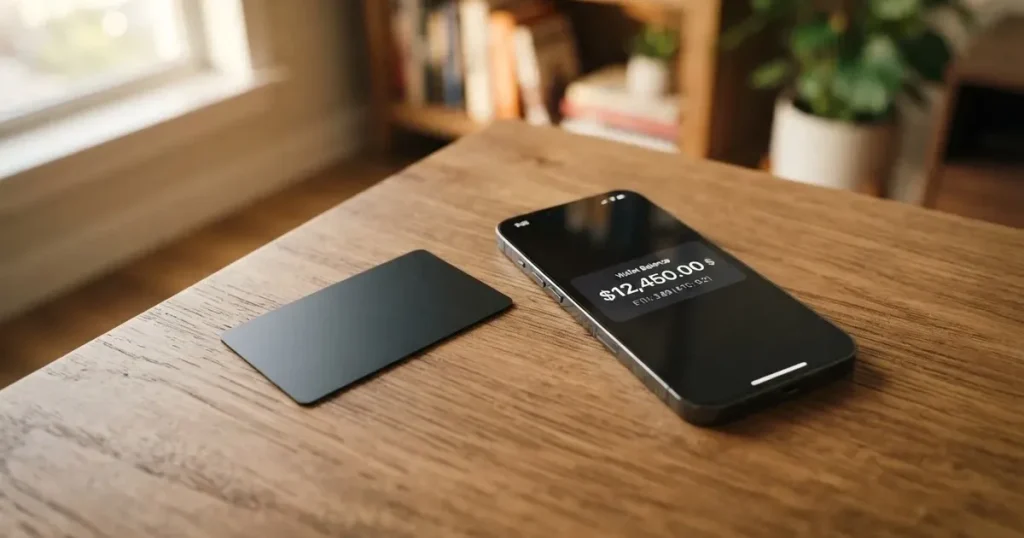
VantaCard is a Visa you open inside Telegram, funded from crypto rather than from a bank account. That single sentence is both its attraction and its constraint. It gets you a card number in a couple of minutes, adds it to Apple Wallet, and lets you spend the balance of the card without ever opening a current account in the ordinary way. In exchange you accept a card whose issuer is not named, whose licence nobody publishes, whose fee schedule has visible gaps, and whose support is a bot inside the messenger app where you already signed up.
I went through the card’s own pages with the questions a real applicant would have: can I have it, what will it cost me at the moment of paying, what happens if something goes wrong. My score is 5.9 out of 10. The number sits where it does because the card is genuinely convenient in the narrow sense — fast to open, wide in the top-up options, well suited to spending crypto — while several of the things you need in order to trust a card that spends your money are simply not on the public pages.
The conditions here are current as of October 28, 2026.
Verdict: 5.9 out of 10
| Criterion | Mark | Why |
|---|---|---|
| Who can get it | 6 / 10 | Not available in “certain countries and territories”; the list lives inside the app, and the number of countries is not disclosed |
| Cost | 3 / 10 | Issuance 20 USDT (Online) or 125 USDT (USD + ATM); top-up 1 USD + 3.8% or 4.5%; no monthly fee or conversion charge published |
| Top-up options | 9 / 10 | 14 cryptocurrencies across 38 deposit networks, BTC, ETH and USDT named, balance updates automatically |
| Reliability and complaints | 6 / 10 | Vanta Group Ltd in England and Wales, company number 16546788; issuer given only as “card issuing partners”; no licences published |
| Everyday use | 7 / 10 | A real Visa issued in about 2 minutes, Apple Wallet and contactless; ATMs only on the USD + ATM tier, up to $750 a day |
The audience that fits best is narrow and specific: people who already live inside Telegram, who want a USD Visa quickly, and who intend to use Apple Pay. For them the card does a decent job of one thing. The audience it does not fit is anyone who needs to predict the cost of a payment before making it, anyone who needs to raise a dispute when a shop takes the money and never delivers, and anyone who cannot open the app to find out whether their own country is allowed.
Will they give you the card?
Yes, probably, provided you are not resident somewhere the app says it will not serve. The card’s pages say the product is not available to residents of “certain countries and territories”, and that the list is shown inside the app. That is the entire published eligibility statement. The number of countries is not disclosed, the list is not published on a page you can read before signing up, and no explanation is given for which countries are included.
Why this matters more than it sounds: the restriction the card names is about residence, not citizenship. Someone whose nationality is unrestricted but whose address sits in an excluded place faces the exclusion; the card gives no way to check this without opening the app. And even then you get a list, not a promise. Cards of this kind can also be withdrawn from individual countries or restricted later, and when that happens the balance question is the one that matters — see the risks section below.
The broader point about why a card looks “foreign” to a shop is worth understanding before you get frustrated at a till. A payment card number starts with an issuer identification number of 6 or 8 digits that identifies the institution issuing it; the rest is an account identifier and a check digit. Merchants can look that up and see which institution and country issued the card, and some apply extra scrutiny when the issuer country differs from the customer’s billing address. So a card issued in one country can look unusual in another for reasons that have nothing to do with you.
For eligibility generally, expect the same treatment as any regulated business: age and identity documents, because prepaid and debit cards are generally available to adults (18+) and some issuers set higher limits. What documents exactly, and from which age, VantaCard’s public pages do not state. That is a real gap, not a formality, and you should find out before you send anything.
How to get it
The route runs through Telegram. VantaCard has no separate app of its own — the whole interface is a bot inside Telegram, and you open a dashboard there. Issuance is “subject to identity verification and eligibility”, and a “quick identity check” follows once the dashboard is open. That is as specific as the public pages get: the documents, the age limit, and the depth of the check are not stated.
Then you pick one of two products:
- Online & Apple/Google Pay — a USD virtual card built for phone wallets and online spending.
- USD + ATM — a USD card that also works in cash machines.
The pages describe the product as “a real Visa card”, in USD, with 16 designs to choose from, valid for 36 months. Whether the ATM tier hands you a physical piece of plastic or a virtual card that merely works at cash machines is not stated, which for a product whose headline feature is the ATM is an odd omission.
There is no delivery to wait for. The card is issued in about 2 minutes according to the page, and becomes usable once you have funded it. So the practical sequence is: open the Telegram bot, pass the identity check, choose a tier, choose a design, receive the card details, and load money before the first payment. That last point deserves emphasis. An unfunded card is just a number.
What it really costs: fees and limits
Here is where this card is weakest, and the gap is not so much in the numbers as in the numbers that are missing. What is published is coherent; what is not published includes two fees that will touch almost every payment.
| Fee or limit | Online & Apple/Google Pay | USD + ATM |
|---|---|---|
| Issuance | 20 USDT | 125 USDT |
| Starting balance | 3 USD | not stated |
| Minimum top-up | 20 USD | 5 USD |
| Top-up fee | 1 USD + 3.8% | 1 USD + 4.5% |
| Monthly or annual fee | not stated | not stated |
| Currency conversion (FX) fee | not stated | not stated |
| ATM fee | not available | up to $750 a day, fee not stated |
| Per-transaction limit | $10,000 | $50,000 |
| Monthly spending limit | $150,000 | $100,000 |
The currency is USD throughout. That is worth sitting with for a moment if you are not paid in dollars: every purchase in your own currency means a conversion, and the charge for that conversion is exactly the number the card does not publish.
Three everyday payments, worked through with what is actually known:
A coffee in your local currency. You tap. The card draws down the USD balance. If your coffee costs a certain amount, the top-up fee you already paid is the only cost you can see. The FX fee, if one applies, is not disclosed — so the real price of the coffee is somewhere above that amount by an amount you cannot determine in advance.
A $30 online subscription. If the merchant prices in dollars, no conversion happens at the card’s level and you are looking only at the rate at which your crypto became the USD balance you started with. If the merchant prices in your currency, you are back to the unknown conversion charge. Online payments may also trigger 3-D Secure, an identity check where the issuer assesses risk and either approves frictionlessly or challenges you, for example with a one-time code or biometric. Visa’s version of that is called Visa Secure.
A $200 withdrawal from a cash machine. Only possible on the USD + ATM tier, capped at $750 a day. The ATM fee is not stated, so take the number you are quoted at the machine rather than any figure from these pages.
One more thing about declined payments, because it is a cost that shows up in a statement rather than a fee schedule: a declined authorisation may leave a hold on funds that can remain for several days, typically up to seven. A card that declines more often than you expect — and foreign-issued prepaid cards often do — will show holds rather than charges.
If you spend crypto to pay for things, that is also a tax event you should be aware of, though the rules where you live decide how. The IRS treats digital assets as property, so exchanging them for goods, services, dollars or other digital assets generally produces a taxable gain or loss; for personal holdings the result is a capital gain or loss, short-term if held one year or less, measured in the local fiat currency at fair market value on the date of the transaction. Which means each card payment funded from crypto may be a separate disposal. I am not advising you on what you owe — read your own country’s rules or ask someone qualified.
How to top it up
This is the strongest part of the product, and it is where the card genuinely earns its mark. You can fund it with 14 cryptocurrencies across 38 deposit networks, with BTC, ETH and USDT named specifically, and the balance updates automatically. You do not, on the public pages, have to reach for a bank transfer first — the money arrives from the network.
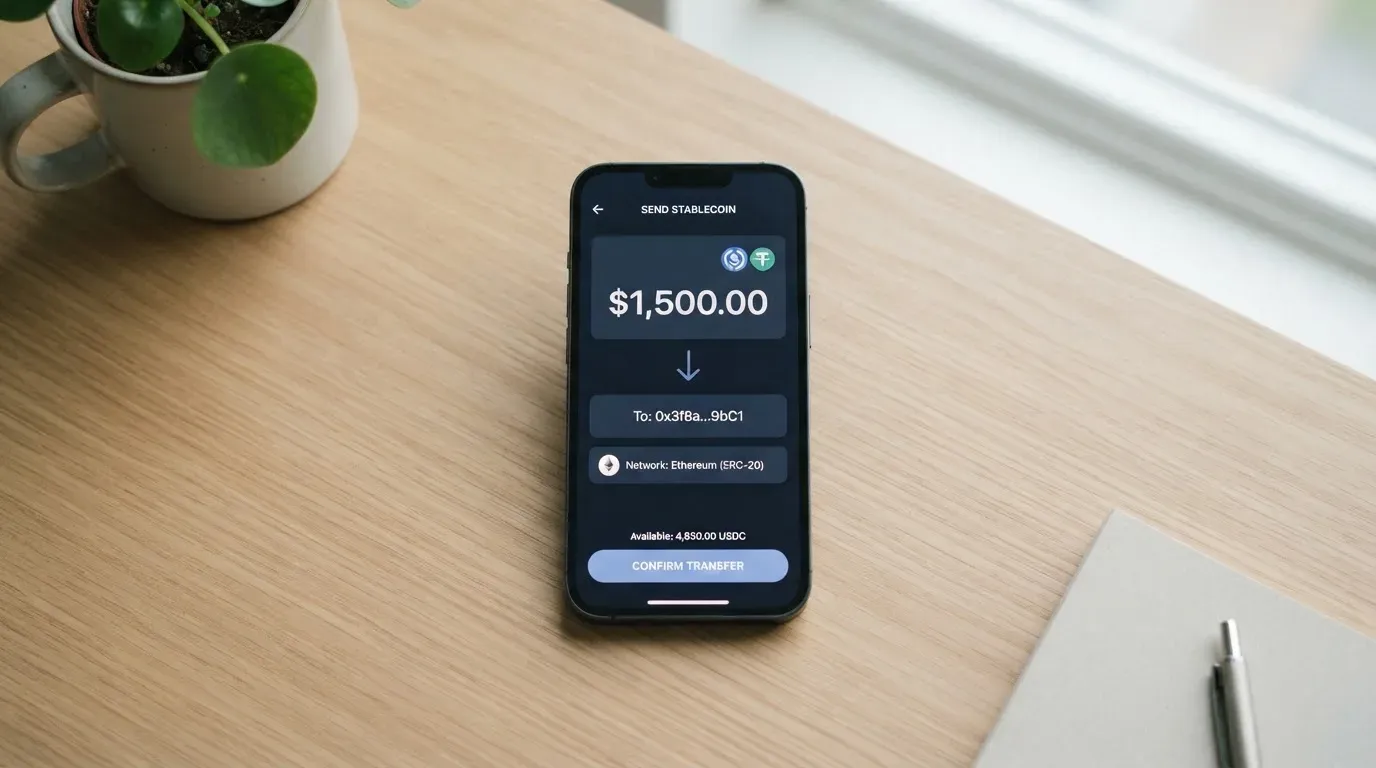
The mechanics are simple in outline. You transfer crypto to the address the app gives you, on the network the app tells you, and the card credits itself. Getting the network right is the whole ball game. Blockchain transfers are irreversible, so a deposit sent on a network the card provider does not support, or to an address belonging to another network, can be lost or need manual support recovery with no guarantee. The 3.8% versus 4.5% top-up charge, plus the 1 USD, is not the main risk in topping up; the main risk is sending on the wrong chain.
Minimums differ by tier: 20 USD for the Online card, 5 USD for the USD + ATM card. Fiat top-up is not stated — there is no public page saying you can add money by bank transfer or card payment instead of crypto.
And this is the question readers ask more than any other: how do you get money back off the card? The public pages do not say whether a balance can be withdrawn back to crypto or to a bank account. Combined with the terms allowing suspension or termination of access — where the fate of the balance is also not stated — this is the single most important thing to settle with support before you load anything meaningful.
A general note on network fees: the on-chain gas or bandwidth charge for your deposit is set by the blockchain, not by the card provider. A second, more specific trap: ERC-20 is the Ethereum token standard, and gas on Ethereum is paid only in ETH, so a wallet holding USDT with no ETH left in it cannot send. Tron prices fees through bandwidth and energy instead, often burning TRX. On BSC-based chains the token has its own conventions entirely. Check that the gas asset is there before you press send.
Paying with it every day
In the practical sense this is a normal card. Add it to Apple Wallet or your phone wallet, and you have contactless payment at any terminal that takes it. Apple Pay replaces the card number with a device-specific number stored in the Secure Element, never on Apple’s servers, and each payment uses a one-time dynamic security code — so tokenising it is a genuine improvement over typing your number into websites.
The card works like a prepaid card, which is the model most crypto cards use: you load a fiat or stablecoin-denominated balance, and the card spends only that balance. This is a real advantage. The card cannot overdraw, because there is no credit line to exceed. It is also the source of its main weakness: everything you do is limited to what you have already loaded.
What is not on the pages: which merchant categories are blocked. This is not a detail, because a merchant category code is a four-digit number classifying a business by type, and codes such as 7995 for gambling are blocked by many issuers as policy rather than by law, with the list varying by issuer. You do not know whether hotels, car hire, fuel or ticket sites will take this card until you try. What the page does tell you is worse news for anything you might query a payment for: “Crypto and card transactions are generally irreversible once confirmed”, and no dispute process is described at all.
That is the line that should decide this card for most people. A chargeback is a refund ordered by the card issuer to settle a dispute, with reason codes such as fraud, duplicate billing or goods not received. There is a reason codes system; VantaCard’s pages do not describe a process for using it. In the US, debit card reversal rights come from Regulation E, prepaid-card coverage varies and should not be assumed. So if a shop takes money and delivers nothing, the honest reading is that you have no described route to get it back.
Rewards: not stated. There is no cashback, no points, no referral scheme described anywhere in the pages I read. Do not assume one exists.
What can go wrong
I found no official incident with VantaCard. Searching for reviews across the usual forums and review sites returned nothing at all about VantaCard — no Trustpilot page, no Reddit thread, no complaint pattern. There is a lesson in that, and it cuts both ways. No complaints can mean nothing has gone wrong. It can equally mean almost nobody has used the card long enough, or that people who had trouble did not write it down. A brand with no searchable footprint is a brand whose reputation you cannot check before you hand it your money.
The company behind it is Vanta Group Ltd, registered in England and Wales, company number 16546788, at 17 Montgomery Road, Newark, NG24 4HA. That registration is real and you can look it up. But the card’s own pages name the issuer only as “card issuing partners” — plural, unnamed — and do not state licences. That matters structurally, not cosmetically. A payment card is a payment service, regulated separately from the crypto side, and a crypto card often depends on two licences: one under payments law for the card, one under crypto regulation for custody, exchange and transfer. When the card pages name neither, you cannot check either register.
The wider pattern is worth knowing so you are not surprised. Card programmes do close. Visa terminated its global agreements with FTX on 13 November 2022 and the FTX card was wound down by its issuer. WaveCrest, a Visa issuer that supplied crypto card brands, was suspended by Visa in Europe in 2018, closing all WaveCrest-issued Visa programmes. Closure typically follows a shape: a notice period, then loading and spending stop, then users are asked to withdraw remaining balances. That is why the unstated withdrawal question above is the one to ask first — not the transaction fees.
On safeguarding: the pages say the balance is “held in your name”. They do not state whether there is two-factor authentication, an instant freeze, or spending limits you can set. Those are the typical safeguards a card of this kind offers, and if support cannot confirm them, you have no way to respond quickly if the card details leak. Note also that safeguarded customer funds are generally segregated or insured but are not the same as bank deposits and may not sit under a deposit guarantee scheme.
Support is “ask in the app” — that is, inside the Telegram bot. The contact details in the terms are a placeholder. So the whole of your recourse is a messenger conversation with the same front-end that sells the card, and the one page that might describe a complaint route is empty.
One more thing that applies to anyone holding stablecoins on these networks: they are not censorship-proof. Tether says it disables tokens in wallets on the OFAC sanctions list and has frozen funds tied to illicit activity. Blockchain transfers are irreversible and a stolen key has no recovery. Custodial platforms also have a documented history of failures — Mt. Gox (about US$350 million reported stolen, 2011-2014), Coincheck (about US$400 million, 2018), Ronin Network (US$625 million, 2022). You are trusting a provider you cannot audit.
What to take instead
I looked at three other cards in this category. None of them is a recommendation either — the point of the comparison is to show that the trade-offs in this category are real and that you are choosing between uncertainties, not between a good option and a bad one.
| Card | Score | Card type | Cost | Top-up | Who can get it |
|---|---|---|---|---|---|
| VantaCard | 5.9 / 10 | Visa, USD, virtual and ATM tiers | 20 / 125 USDT to issue; 1 USD + 3.8% / 4.5% per top-up | 14 coins, 38 networks, BTC/ETH/USDT named | Excluded in “certain countries and territories”, list inside the app |
| Azul Card | 5.3 / 10 | Virtual Mastercard, USD balance | $20 to create, refunded after $2,000 of spending, then $5 a month | 4% crypto top-up, $0.25 per transaction | Worldwide except a named list of countries; restrictions apply regardless of nationality |
| Telecard | 6.1 / 10 | Virtual Mastercard, USD, no physical card | $5 standard one-time; VIP $49 then $19 a month | USDT on Tron or Ethereum, USDC on Ethereum | Usable in over 150 countries; barred if sanctioned by the US Government, including OFAC |
| OnCards | 4.6 / 10 | Virtual Mastercard/Visa in Telegram | Not stated | USDT BEP20 only | Not stated |
Azul Card publishes its excluded countries, which VantaCard does not, and that alone is worth something: Russia, Belarus, North Korea, Iran, Syria, Cuba, Sudan, Venezuela, Ukraine and the Crimea, Donetsk, Luhansk, Zaporizhzhia and Kherson regions, with the note that the restrictions apply regardless of the user’s nationality. It is virtual only, works anywhere Mastercard is accepted, keeps the balance in USD, charges 4% on crypto top-up and $0.25 per transaction, and gives the $20 creation fee back after $2,000 of spending. Its referral programme pays up to 40% of fees from your referrals’ transactions. No cashback. A physical card is not available but may come later.
Telecard scores highest here, mostly because it is the most transparent of the three. It is a virtual Mastercard, instant, with no physical or metal card, and the site says it works in over 150 countries wherever Mastercard is accepted. It takes USDT on Tron (TRC-20) or Ethereum (ERC-20) and USDC on Ethereum; Polygon is not supported, bank transfers are “coming soon”, and there is an inconsistency worth knowing — the main page lists ETH and TRX which the help page does not. Its fees are specific: 1.5% currency conversion on non-USD payments, 0.5 USDT gas per successful transaction, FX and cross-border “up to 3% each”, deposit fee advertised as 0%. There is a $99 minimum deposit to activate, which the card states is “NOT a fee” and which stays in your wallet. Its plans are the awkward part: $5 one-time standard, or VIP at $49 setup then $19 a month with $15 to reissue — though the main page also says signing up is free with no monthly fee on the basic plan. Referral pays 1 USDT per activated friend as “Fiorini” plus cashback when they spend, at a rate not specified.
OnCards is the thinnest of the four. Virtual only, obtained “directly in your Telegram”, network not fixed, card currency not stated, fees described as “simple and clear — no hidden charges” with no amounts. It takes USDT on BEP20 only and does not accept bank transfers. Nothing about who can get one is stated. I would not load real money into it on the strength of its own pages.
Comparing all four: every one of them converts crypto to a fiat balance and spends that balance. Every one of them is virtual-first. None of them publishes a dispute process. None of them is a bank. What differs is how much they tell you, and on that measure VantaCard is mid-table — more forthcoming about top-up networks than Telecard, less forthcoming about eligibility than Azul.
Who I would recommend it to
To someone who already uses Telegram as their main app, who wants a USD Visa today rather than next month, who pays mainly by phone, and who has decided that the cost of convenience is worth paying without knowing the conversion charge in advance. If that is you, the top-up breadth here is genuinely better than the competition: 14 coins across 38 networks is more than any of the three alternatives I checked, and the automatic balance update removes the fiddly part of the experience.
I would not recommend it as a first crypto card if you have any doubt about how the balance gets back to you, because the public pages do not tell you. Nor if you are buying anything you would want to complain about afterwards, because the pages say transactions are generally irreversible and describe no dispute process. Nor if your country is not obviously on the safe side of the app’s internal list. Nor as a place to hold a significant sum.
Before you load anything, get three answers in writing inside the app: what is the conversion fee, how do I withdraw my balance back to crypto or to a bank account, and what happens to my balance if access is suspended or the programme ends. If support answers all three clearly, this is a considerably better card than its paperwork suggests. If they answer vaguely, treat the balance as money you are prepared to lose, because that is the only conclusion the public pages support.
Frequently asked questions
What is VantaCard?
It is a Visa payment card you open and manage inside a Telegram bot rather than a separate app. You fund it with crypto, the balance is held as dollars, and you spend that balance with a card number, physically or in Apple Wallet. It is a prepaid-style card, not a bank account: it spends only what you have loaded and cannot overdraw.
How does VantaCard work day to day?
You send crypto to the address the bot gives you, on the network it names, and the card balance updates automatically. You then pay by card, by contactless tap, or through your phone wallet. The pages say the card is issued in about 2 minutes and usable once funded, and that it is valid for 36 months.
Is VantaCard a bank?
No, and it does not present itself as one. The company behind it is Vanta Group Ltd, registered in England and Wales under company number 16546788. The card’s pages name the issuing institution only as “card issuing partners”, without naming it, and do not state any licences. So you hold a prepaid card balance, not a bank deposit.
Who owns VantaCard?
Vanta Group Ltd, registered in England and Wales, company number 16546788, at 17 Montgomery Road, Newark, NG24 4HA. That is the registered company behind the product. It is not the same question as who issues the card, and the card’s pages leave that one unanswered.
Which countries is VantaCard available in?
The public pages say it is not available to residents of “certain countries and territories” and that the list is shown inside the app. The number of countries, and the list itself, are not published. The restriction is framed around residence rather than nationality. If your country is borderline, open the app and check before you commit anything.
Does VantaCard require KYC?
Yes. Issuance is “subject to identity verification and eligibility”, with a “quick identity check” after you open the Telegram dashboard. The specific documents required, the minimum age, and whether there are different verification levels are not stated on the public pages, so ask in the app before you start.
How much does VantaCard cost to open?
Issuance is 20 USDT for the Online & Apple/Google Pay tier and 125 USDT for the USD + ATM tier. The Online tier also shows a starting balance of 3 USD. Any monthly or annual fee is not stated, and neither is the currency conversion fee, which is the number you will want most.
How do I top up VantaCard?
Send one of 14 supported cryptocurrencies on one of 38 supported deposit networks — BTC, ETH and USDT are named — to the address in the app, and the balance credits automatically. The minimum top-up is 20 USD on the Online tier and 5 USD on the USD + ATM tier, and the fee is 1 USD + 3.8% or 1 USD + 4.5% respectively. Make sure the network matches, because transfers are irreversible.
Can I get my money back off VantaCard?
The public pages do not say. Withdrawing a balance back to crypto or to a bank account is not stated, and the terms allow the provider to suspend or terminate access without stating what happens to the balance. This is the first thing to resolve with support, before you load an amount you would mind losing.
Is VantaCard safe and worth it?
Safe enough if you keep the balance small and treat it as spendable rather than stored. Worth it for convenience inside Telegram, particularly with Apple Pay. Not worth it if you need predictable costs, a dispute route when a merchant fails to deliver, or an answer about the issuer. My score is 5.9 out of 10 for exactly those reasons.
Virtual cards: your questions answered – cryptocardanswers
Content created by the «cryptocardanswers» team