
Spent straight from your own wallet, if you are in the EU — with prices the card never states
 Available in US
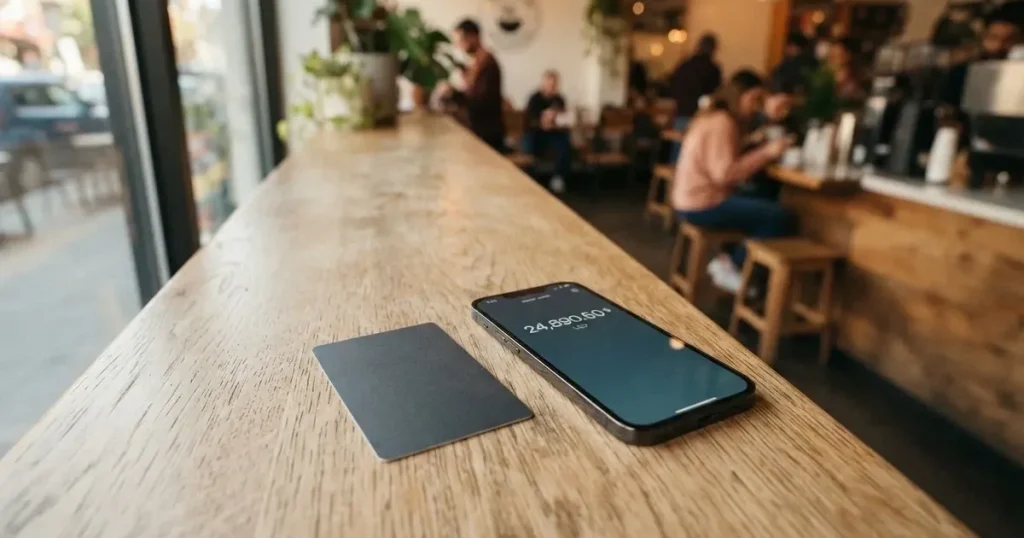
The OWNR Wallet card is a Visa prepaid card that spends directly out of a self-custody crypto wallet. No bank account is required, and there is no credit line — the card can only go as far as the balance you have already moved onto it. In exchange you get a physical card in the post, a virtual card you can create in seconds, Apple Pay, and an ATM withdrawal function, all inside the OWNR app for iOS and Android.
It suits a fairly specific person: someone living in the EU who already holds crypto and wants to spend it directly, in ordinary shops, without first selling it to a fiat account somewhere else. If that is you, the card is worth reading about. If you are anywhere outside the EU, the card’s own pages say plainly that it is not for you yet.
If you are the other kind of reader — someone whose problem is that a normal bank card is hard to get, or someone who wants a card that works in dozens of countries with a well-documented fee sheet — keep reading, because the honest answer is that OWNR Wallet does not publish most of the numbers you would need to decide.
The conditions described below are current as of October 28, 2026.
Verdict: 4.9 out of 10
The score is not a verdict on the crypto, and it is not a verdict on Visa. It is a score on how well the card answers the questions a person has to answer before handing over money and identity documents: who can get one, what it charges, what you can fund it with, what happens when something goes wrong, and how it behaves in a real shop.
Here is the breakdown, and then I’ll walk through the parts that actually hurt.
| Criterion | Mark | Why |
|---|---|---|
| Who can get it | 5 / 10 | “So far the card is only available for EU countries” |
| Cost | 3 / 10 | Commission for issue, amount not stated; unofficial: $1.5 monthly, 4% crypto purchase, FX listed free |
| Top-up options | 6 / 10 | BTC, LTC, ETH, USDT (ETH) from the crypto account; transfer from another Visa card; instant |
| Reliability and complaints | 4 / 10 | OWNR WALLET EUROPE s.r.o. and OWNR WALLET CRYPTO CANADA LTD; issuer not named; Trustpilot 3.8 of 5 over 469 reviews |
| Everyday use | 8 / 10 | Physical and virtual Visa, Apple Pay, ATM; Google Pay not mentioned |
| Total | 4.9 / 10 |
Cost is what drags the whole thing down. Not because the fees are necessarily high — because they are not stated. The card’s own pages say you pay “a commission for its issue” and leave the number blank. Three third-party summaries give three different answers. That is the whole problem in one sentence: to price this card, I have to guess, and you should be extremely reluctant to do the same with your own money.
Reliability scores 4 out of 10 for a mix of two things: a Trustpilot rating of 3.8 out of 5 across 469 reviews, and the recurring themes in those reviews — money stuck in wallets since May 2024, refund demands after disputed gambling transactions in October 2025, identity checks that failed, and withdrawals blocked by transaction costs. On top of that, the card issuer is not named on the pages I read. You are being asked to trust a programme managed by one entity, issued by an unnamed one.
Everyday use is the bright spot, at 8 out of 10, and it deserves it. A physical and a virtual Visa, Apple Pay, and ATM cash withdrawal is genuinely more than many crypto cards offer. The gap is that Google Pay is not mentioned anywhere.
Who Will Give You the Card
The card’s own statement on this is short and unambiguous: “So far the card is only available for EU countries”. That is the whole eligibility rule the pages publish. Not a list of member states, not a list of accepted ID documents, no country-by-country table — EU, and that is all.
This is the first thing to check before you spend any time on the application. If you live in an EU country, read on. If you do not, there is nothing further in this review that will change your answer, and no waiting list to join. The card is described as being available now, not as a roadmap item for other regions.
One thing to note about how this works in the industry generally: a payment card’s issuing bank can look up the BIN — the first six or eight digits of the card number — and see which institution issued it and in which country. If that country differs from your billing address, some merchants apply extra scrutiny, or decline. This is why a card issued in one country can look “foreign” in a shop in another, and it is a general fact about card payments rather than anything specific to OWNR Wallet. It is one reason that “EU only” is a simpler promise than it sounds, and also one reason a card issued inside the EU can still be awkward at a non-EU merchant.
How to Get It
The application runs through the OWNR app, available on iOS and Android. The App Store listing showed 4.5 out of 5 from 115 ratings when it was read on 2026-10-21; the Google Play rating was not read and I make no claim about it.
What you get on approval is a physical and a virtual card, on the Visa network, structured as prepaid. The physical card is mailed to the real address you specify. How long that takes and what it costs — the card does not say.
On identity checks, the honest answer is that the public pages do not tell you what level is required. One third-party source, cryptocards.so in 2026, lists the level as “Phone” — email and phone only — while the same source’s cons column says “Full KYC required”. Those two statements sit in the same table. Treat both as unofficial: neither is confirmed by OWNR Wallet’s own pages, and the card’s footer links to an AML/KYC policy that could not be read.
That matters more than it sounds. In the EU, customer due diligence for a regulated firm covers your name, address, date of birth, nationality and identity documentation, a sanctions check, the purpose of the relationship, and whether you are a politically exposed person. If that cannot be completed, the firm is required to hold back from the transaction and, where necessary, end the relationship — which is exactly why accounts get frozen pending documents. And nationality is screened separately from residence, because sanctions screening and issuer risk policy apply to citizenship and country of birth as well as to your address. So the practical consequence of the EU-only rule is that living in the EU gets you past the first gate; your document’s country of issue is a separate question the card does not answer publicly.
So: expect to be asked for identification, expect the process to be slower than the “email and phone” version of the story suggests, and expect that a failed check is a real possibility rather than a formality. Cards are generally available to adults aged 18 and over, and some issuers set higher limits.
Fees and What a Payment Actually Costs
Here is where I have to be blunt. The card does not publish its price list.
It says you pay a commission for the issue of the card, without an amount. It says crypto is converted to fiat during top-up, without naming the rate. It says cash withdrawal at ATM is supported, without naming the fee or the allowance. Spending limits are not stated. Card currency is not stated. There is no tier structure — a single card is described.
What follows is the costs table. Where a value comes from OWNR Wallet’s own pages it is marked as such; where it comes from a third-party summary it is marked unofficial, and OWNR Wallet has not confirmed it.
| Fee or limit | Value | Source |
|---|---|---|
| Card issuance | “paying a commission for its issue”, amount not stated | Card pages |
| Issuance, third-party reading | listed as free | Unofficial (cryptocards.so, 2026) |
| Issuance, another reading | €30 | Unofficial summary |
| Issuance, a 2021 article | €40 | Unofficial, and eight years out of date |
| Monthly fee | $1.5 | Unofficial (cryptocards.so, 2026) |
| Crypto purchase / conversion | 4% | Unofficial (cryptocards.so, 2026) |
| Crypto conversion at top-up | fee not stated | Card pages |
| Foreign exchange fee | listed as free | Unofficial (cryptocards.so, 2026) |
| ATM withdrawal | supported, fee and allowance not stated | Card pages |
| ATM fee and allowance | listed free and unlimited | Unofficial (cryptocards.so, 2026) |
| Purchase limit | up to 5000 EUR per month | Unofficial (cryptocards.so, 2026) |
| Daily, monthly and ATM limits | listed as unlimited | Unofficial (cryptocards.so, 2026) |
| Deposit fee and minimum | not stated | Card pages |
| Rewards | 0% cashback, no bonuses | Unofficial (cryptocards.so, 2026) |
Note the contradiction in that table. One source calls issuance free; another says €30; a 2021 article said €40 with €1 a month instead of €1.50. These are not small differences between providers — they are the same card described differently. Set aside the third-party numbers for a moment, though, because they are not the part that will cost you money.
Three everyday payments
Buying a coffee. This is the case where the card has the least room to surprise you. You have topped up, the crypto has been converted to a fiat balance, and the purchase is drawn from that balance. There is no foreign transaction if the café is in your own country and your card currency matches. If the card currency does not match the café’s, you are exposed to the FX fee — which the unofficial reading calls free, and which the card’s own pages simply do not mention. This is the payment to use for calibrating your expectations.
Buying something priced in dollars while your balance is in euros. Here the unstated FX fee stops being an abstraction. The unofficial reading says FX is free, which would make this a clean cost. Nobody at the card has confirmed that in a document I could read, so I would not plan around it. This is the payment where the missing fee table would hurt you most if the answer turned out to be unfavourable.
Paying online. Now add the things that quietly kill payments on any card. Address Verification Service — the check that compares the numeric parts of the billing address you typed against the issuer’s records — is mainly offered in the US, Canada and the UK, and is generally unavailable for foreign-issued cards, which causes declines. Some merchants decline prepaid or foreign BINs because the BIN lookup reveals the card type and issuer country. And a declined authorisation can leave a hold on your funds that sticks around for several days, typically up to seven. None of these is OWNR Wallet’s fault; all of them are the cost of a prepaid card with an EU issuer paying a non-EU merchant.
Two more general costs to keep in mind. On-chain network fees for your deposit — gas on Ethereum, bandwidth on Tron — are charged by the blockchain, not by the card provider, so they come out of your top-up on top of any conversion fee. And blockchain transfers are typically irreversible: a deposit sent on a network the provider does not support, or to an address belonging to a different network, can be lost or need manual support recovery with no guarantee attached.
And the one that sounds simplest: gambling. A merchant category code of 7995 covers casinos, betting and lotries. Many issuers block it on specific cards by policy rather than by law, and the blocked list varies by issuer — the OWNR Wallet pages do not say whether theirs blocks it. If a gambling merchant declines your card, that is a merchant category decision, not a malfunction.
How to Top It Up
This is the part the card does best. From your crypto account you can fund the card with BTC, LTC, ETH or USDT (ETH) — note the network for the USDT specifically, since sending USDT on the wrong network is the classic irreversible mistake. Transfers from another Visa card are also accepted. Crypto top-ups are instant, and the conversion happens during the top-up.
Instant is the word to hold onto, and it cuts both ways. Instant means you can load and pay in the same minute if a shop declines your first card and you need a second attempt. It also means there is no window in which a slow bank transfer could arrive after a price has moved, and no time for a fraudulent transfer to be recalled.
What is not stated: the deposit fee, the minimum top-up, and any method to withdraw money from the card other than taking cash out of an ATM. That last one is worth pausing on. If ATM withdrawal is your only exit, and the ATM fee or allowance turns out to be anything other than what a third party says, you have a very narrow way out of your balance.
Before you load anything, check the network. On Ethereum, fees are paid only in ETH, so a wallet holding USDT but no ETH cannot send it — your transfer simply fails, or worse, you go hunting for ETH first. On Tron, fees are paid via bandwidth and energy, often by burning TRX, which is a cost most people do not anticipate on their first transfer. Ethereum is not the only place stablecoins live: USDT has been issued on Ethereum, Tron, Solana, Polygon, Avalanche and others, and Circle lists USDC as natively supported on 38 networks as of 16 September 2026, including Ethereum, Solana, Base, Polygon PoS, Avalanche, Arbitrum and Stellar. Circle stopped supporting USDC on Tron in February 2024, so “USDC over TRC20” is not a native option — and if you send it there anyway, the same irreversibility applies as with any misrouted transfer.
One structural note worth having. Tether says it disables tokens in wallets on the OFAC sanctions list and has frozen funds tied to illicit activity, so stablecoins are not censorship-proof. And stablecoins are not actually stable: TerraUSD collapsed in May 2022, and USDC temporarily lost its peg in March 2023 during the US banking crisis. Tether’s USDT and Circle’s USDC are the two names the BIS put at about 90% of stablecoin market capitalisation in July 2025, and Circle says USDC is redeemable 1:1 for USD and 100% backed by cash and cash equivalents. That is the strongest version of the claim. The names themselves are not a guarantee of anything.
Paying With It Every Day
The OWNR Wallet card can be added to the Apple Pay system, and that is confirmed by the card’s own pages. Google Pay is not mentioned at all — not as unsupported, simply absent. If your phone life runs on Google Pay, assume you will be tapping the physical card.
The mechanics of Apple Pay are worth knowing because they answer the “is storing my card in a phone safe” question honestly rather than reassuringly. Apple Pay replaces your card number with a device-specific Device Account Number stored in the Secure Element, never on Apple’s servers, and each payment uses a one-time dynamic security code. So the number itself is not sitting in a phone that could be copied out. That said, the card issuer can restrict a tokenised number — for example, blocking it on magnetic stripe, on phone, or on website payments. Tokenisation reduces one kind of risk; it does not remove the issuer’s ability to switch things off.
Online payments add 3-D Secure, an identity check layered onto the transaction. Visa’s brand is Visa Secure; Mastercard’s equivalent is Identity Check, and EMV 3-D Secure 2 (published 2016) supports one-time passcodes and app-based authentication aligned with EU strong customer authentication. The issuer assesses risk and either approves the payment without friction or challenges you. And note the sharp edge that critics point at: under 3-D Secure, liability for fraudulent online payments can shift from the merchant to your bank, or in the critics’ reading, to you.
The card pages do not state any blocked merchant categories. That absence is worth knowing about before you assume a decline is your bank’s fault.
On the app itself: iOS and Android, 4.5 out of 5 from 115 App Store ratings as read on 2026-10-21. There is a support ticket form and a knowledge base in the footer, and the App Store listing advertises “24/7 technical support inside the app”. Which languages it covers is not stated. The card does not publish a dispute process, and it does not describe any rewards — the unofficial reading is 0% cashback and no bonuses.
One last practical thing, and it is a general rule rather than a card feature. A declined authorisation can leave a hold on your funds for several days, typically up to seven. Budget for the possibility that money you have already committed to a purchase is not available to you that week.
What Can Go Wrong
Start with the reviews, because they are the part you can actually measure. Trustpilot showed 3.8 out of 5 across 469 reviews when read on 2026-10-21. The recurring themes in those user reports: trouble withdrawing funds, with money stuck in a wallet since May 2024; disputed transactions and refund demands after gambling charges in October 2025; and verification problems and complaints about high charges across 2022 to 2025.
I found no official incidents — no regulator action, no publicised breach. That is worth stating plainly as well, because silence is not the same as a clean record; it is just the absence of published events.
Now the entity question, which is the one I would want answered before I loaded anything. The card is provided as a crypto-to-fiat exchange by OWNR WALLET EUROPE s.r.o. and OWNR WALLET CRYPTO CANADA LTD (Canada, BC1274005), with OWNR WALLET LLC (USA, 7826216) listed as licensed; the starting data names OWNR WALLET OU. And the card issuer is not named on the pages I read. One unofficial source describes the issuer as an Estonian company providing Visa cards. An unnamed issuer makes one class of question very hard to answer: when you have a problem with the card itself — a decline, a hold, a disputed transaction — you are dealing with an institution you cannot name.
The way card programmes are normally structured helps you read that. Visa and Mastercard do not issue crypto cards to consumers themselves; they license issuers and can suspend a programme. The card network routes the messages and sets the rules, the issuer holds the programme, and the crypto brand is often only a programme manager and front end. Which of those OWNR Wallet is — and which party you would be dealing with in a dispute — is exactly what the missing issuer name obscures.
That is not hypothetical. Visa terminated its global agreements with FTX on 13 November 2022 and the FTX US debit card was wound down by its issuer. WaveCrest, a Visa issuer that supplied crypto card brands, was suspended by Visa in Europe in 2018, closing all WaveCrest-issued Visa programmes. Closures follow a pattern: a notice period, then spending and loading stop, then users are asked to withdraw remaining balances.
Which brings me to self-custody itself, because here it is a genuine feature and also a genuine exposure. Control of crypto belongs to whoever holds the private key. With OWNR Wallet the funds stay in your own wallet until the moment of payment — nobody else can move them, and no custodian can lose them. That is the strongest argument for the card. But a seed phrase, typically 12 to 24 words, is the unencrypted form of the private key, and anyone who obtains it can restore the wallet and spend the funds. There is no built-in recovery: cryptocurrency transfers are typically irreversible and a stolen key cannot be frozen or returned by the network. You carry the risk of key loss, phishing, and clipboard-hijacking malware that swaps a copied address. That trade is usually worth making. Just make it knowing what you have signed up for.
And one caution about the money you are converting. In the US the IRS treats digital assets as property, so exchanging them for goods, services, dollars or other digital assets generally produces a taxable gain or loss, measured in local fiat currency at the fair market value on the date of the transaction. That means each card payment funded from crypto can be a separate disposal. That is a general statement of how tax treatment works in that jurisdiction and not advice about your position — for your own situation, talk to a professional in your country.
For balance: an electronic money institution in the EU can issue e-money, payment cards and e-wallets but cannot lend, and it may offer services across the EU from a licence granted in one member state. MiCA, the EU’s markets-in-crypto-assets regulation (Regulation (EU) 2023/1114), took legal effect in June 2023 under ESMA; its rules on stablecoins and asset-referenced tokens applied from 30 June 2024 and the remaining provisions, including crypto-asset service provider rules, from 30 December 2024. Under MiCA, e-money tokens may be issued only by a credit institution or an electronic money institution. The transitional period lets providers already operating under national law continue only until 1 July 2026 or until they receive or are refused a MiCA authorisation, whichever comes first. ESMA keeps an interim register of authorised CASPs, white papers and non-compliant entities, and you can check a provider there. A card itself is a payment service regulated separately, so a crypto card often depends on two licences. One practical point about your balance once it is inside an e-money institution: such funds must be safeguarded, by segregation in dedicated accounts or insurance, but they are not bank deposits and may not be covered by a deposit guarantee scheme.
The card’s own pages do not state what security controls it offers — no mention of two-factor authentication, instant card freeze, or spending limits. Nor do they describe a dispute process. Nor do they name the languages support covers. Nor do they publish news. Those absences are all worth asking about directly, because each one is a place where the card has left a question open for you to close.
What to Take Instead
If the missing fee table is the dealbreaker — and for many people it is — the alternatives below are all rated higher than OWNR Wallet on the same criteria, and all publish more. Here is where each stands.
| Alternative | Score | Network | Physical card | Published pricing |
|---|---|---|---|---|
| MetaMask | 7.1 / 10 | Mastercard | Metal, $199/year | Virtual free, no annual fee |
| KAST | 6.1 / 10 | Visa | Yes, 40 USD delivery on Standard | Tiered membership and cashback |
| TokenPocket | 5.8 / 10 | Visa / Mastercard | Virtual only | 1% crypto deposit fee |
| OWNR Wallet | 4.9 / 10 | Visa | Yes, fee not stated | Not stated |
MetaMask, 7.1 out of 10, is the strongest of the four and the one I would look at first. Sign-up is open in 45 listed countries and territories — Andorra, Argentina, Brazil, Canada, Mexico, Germany, France, Spain, Uruguay among them — with other regions on a waitlist; proof of residency is required, US and UK sign-ups are temporarily closed per the FAQ, and the citizenship rule is not stated. The card is Mastercard: a virtual card issued instantly, with a metal version you can pre-order in the app after the virtual is approved, one card per user, issued by Monovate with Crypto Life as card provider. The virtual card is free with no annual or maintenance fee; the metal card is $199/year. Fees are described as a “minimal fee for each transaction” with no additional MetaMask fees and no foreign transaction fee, so the Mastercard rate applies. It spends directly from the connected wallet on Linea, Base, Monad and Solana, with tokens including mUSD, wETH, EURe, GBPe, USDC and USDT; Solana-only wallets cannot withdraw credit. Cashback is paid in mUSD into the Money Account: 1% on Virtual, and on Metal a headline 3% limited by the footnote to the first $10,000 spent, then 1%.
KAST, 6.1 out of 10, is the most transparent on eligibility. Residence is decided at KYC — if your country is not listed, KAST is not available there, though the list itself is not published. It states explicitly that living in a supported country with an ID from a restricted region may still make you ineligible, that dual citizens with a supported-country ID may pass, that only the account holder’s own ID is accepted, and that a VPN does not bypass this. You can create an account in an unsupported country but KYC stays locked. The card side is deeper than OWNR Wallet’s: virtual and physical, up to 10 cards per user, Visa Platinum Standard, Visa Infinite metal on Premium, Visa Infinite gold plated on Private, plus Pengu, Solana and Bitcoin designs. Pricing is fully published: Standard 0 USD, Premium 1,000 USD/year, Private 10,000 USD/year billed annually upfront with no monthly option; extra virtual cards 2 USD; Standard physical 0 USD card fee plus 40 USD delivery, while Premium and Private physical cards are included; a 1 USD inactivity fee after 12 months. Fees: stablecoin top-up 0%, card spend in USD 0%, transaction fee 0%, Apple and Google Pay 0%, non-USD foreign exchange 0.5%–1.75% depending on your residence country, the transaction country and the card programme, a 0.10 USD fee on non-USD transactions under 25 USD, and 0.50 USD on a declined transaction for insufficient balance. You fund with USDT, USDC, PYUSD and RLUSD on Ethereum, Solana, Polygon, Arbitrum and Tron, and the Terms say acceptable tokens are “currently USDT and USDC” — a conflict the card’s own materials contain. Cashback in USD: 1.5% on the first 2,000 USD a month at Standard, 2% on the first 10,000 at Premium, 3% on the first 40,000 at Private.
TokenPocket, 5.8 out of 10, is the thinnest of the three. A Visa debit for a list of European countries and territories — Germany, France, Spain, Switzerland among them — and Mastercard debit for Australia, Canada, Hong Kong, Japan, Taiwan, New Zealand, Singapore, South Korea, the UK and others, with the Americas planned. Fiat24 cards are virtual, with no physical card mentioned, and balances in EUR24 and USD24, running on Arbitrum. On cost it is the most generous: an NFT creation fee is partly covered by TokenPocket, the user pays “a small portion” with no amount stated, and apart from that the card charges no additional fees. The catch is a 1% fee on depositing cryptocurrency into the card, which it says is refunded later through rewards and reduced transaction fees. Specific coins and networks are not listed in the FAQ.
Who I Would Recommend It To
To a person who lives in an EU country, already holds BTC, LTC, ETH or USDT in a wallet they control, spends most of their money in euro-denominated shops, and is comfortable converting once at the top rather than watching every purchase. For that person the card does what it promises: load, tap, done, with no bank in the middle and no credit line to worry about. Add Apple Pay and it becomes an ordinary card for ordinary purposes.
I would not recommend it as a first crypto card, because you cannot price it. You would be opening a card whose issuance fee, monthly fee, conversion fee, FX fee and limits are, on the official pages, blank. You would also be funding a wallet whose operator’s Trustpilot record is 3.8 out of 5, where users report money stuck since May 2024, and whose card issuer is not named on the pages that matter. And if you live outside the EU, the question is closed before it opens.
If you want the same idea with the numbers published, MetaMask at 7.1 is where I would start. If you want a wide card range and the clearest eligibility wording of the four, KAST. If you want no physical card at all and the lightest fee load, TokenPocket — with the Americas not yet there.
And whatever you pick, load the minimum you need first, spend it once, and only then decide whether to trust the thing with more. That is not timidity. It is the lesson of every card closure in this category.
Frequently asked questions
What is the OWNR Wallet card?
It is a Visa prepaid card that spends directly out of a self-custody crypto wallet, without a linked bank account. Because it is prepaid rather than credit, it draws on a stored balance and cannot go overdrawn. OWNR Wallet offers a physical card posted to you and a virtual one, inside its own iOS and Android app.
Is OWNR Wallet a bank?
No. It is a crypto-to-fiat exchange provided by OWNR WALLET EUROPE s.r.o. and OWNR WALLET CRYPTO CANADA LTD, with OWNR WALLET LLC listed as licensed. The card issuer is not named on the pages I could read, so the institution that actually holds your card programme is not identified. That is not a trivial detail when you need help.
Which countries can get the card?
The card’s own statement is that “so far the card is only available for EU countries”. No member-state list, no table of accepted documents, no waitlist for other regions. If you live in the EU you can apply; if you do not, there is nothing to wait for.
How much does the OWNR Wallet card cost?
The card says you pay “a commission for its issue” and does not give an amount. Unofficial third-party sources disagree sharply: one lists issuance as free with a $1.5 monthly fee, another cites €30 plus €1.50 a month, and a 2021 article said €40 plus €1. Meanwhile an unofficial 4% crypto purchase fee and free foreign exchange appear in that same third-party table.
Does the OWNR Wallet card require KYC?
The card’s public pages do not say. Its footer links to an AML/KYC policy that could not be read. One third-party source lists the level as “Phone” — email and phone only — while the same source’s cons column says “Full KYC required”. Expect to be asked for identity documents, because EU rules require it of any regulated provider.
How do I top up the OWNR Wallet card?
With BTC, LTC, ETH or USDT (ETH) from your crypto account, or by transfer from another Visa card. Crypto top-ups are instant, and the crypto is converted during the top-up. Check the network carefully — USDT exists on several, and a transfer on the wrong one is typically irreversible and may simply be lost.
What crypto can I send to it, and which network?
The card names BTC, LTC, ETH and USDT (ETH) — so for USDT the Ethereum network is the one specified. Sending USDT on Tron, Solana, Polygon or Avalanche instead is a different transfer with different consequences. Note that on Ethereum fees are paid only in ETH, so a wallet holding USDT but no ETH cannot send at all.
Can I use OWNR Wallet card in Apple Wallet and Google Wallet?
Apple Pay is confirmed: the card can be added to the Apple Pay system. Apple Pay replaces your card number with a device-specific number stored in the Secure Element and uses a one-time code per payment, so your number is not exposed. Google Pay is not mentioned at all, so assume the physical card.
Is the OWNR Wallet card safe?
It depends on which risk you mean. Your crypto stays in your own wallet, so no custodian can lose it — but you bear all of the key-loss and phishing risk yourself. The card’s issuer is unnamed, its Trustpilot rating is 3.8 out of 5 across 469 reviews, and its own pages state no security controls. Visa has terminated crypto card programmes before.
Is the OWNR Wallet card worth it?
For an EU resident spending mostly from an existing crypto balance, the everyday mechanics are good: physical and virtual Visa, Apple Pay, ATM, instant top-ups. The problem is not the product, it is the disclosure. You cannot calculate your cost from the card’s own pages, so I would load the minimum, spend it once, and judge from there.
Wallet cards: your questions answered – cryptocardanswers
Content created by the «cryptocardanswers» team