
Bix pays out from your own wallet, but only a slice of the US can hold one today
 Available in US
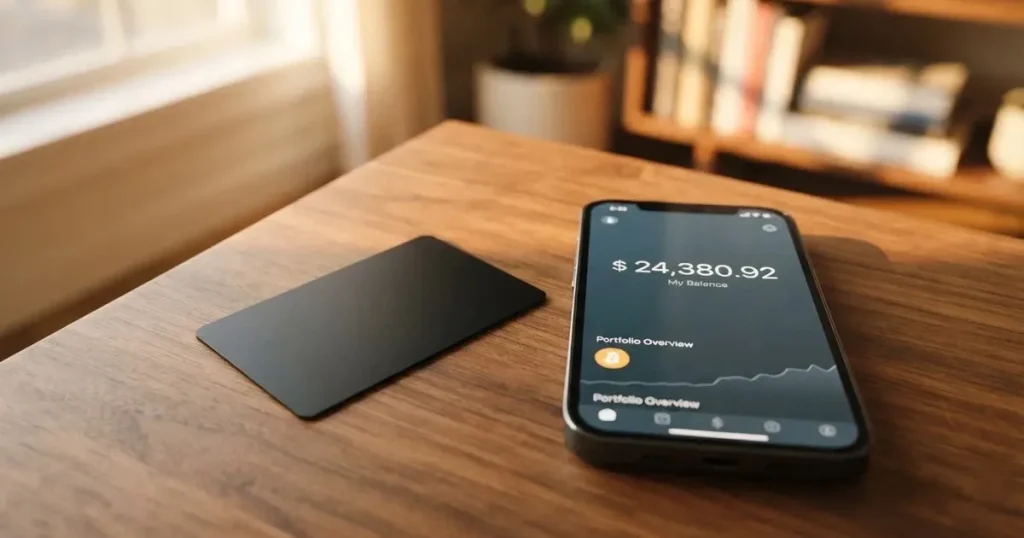
Bix is a Visa debit card that spends out of a crypto wallet you hold yourself. The idea is clean: your USDT or USDC stays in your own wallet, the card converts and pays, and the provider never takes custody of the assets. In practice, in late 2026, the card is a virtual Visa only, open to residents of 29 US states, with a plastic version on the roadmap and no named issuer on its public pages. I score it 5.2 out of 10. That is not a verdict on the idea, which is genuinely good for people who cannot get an ordinary bank card. It is a verdict on how much of that idea you can actually use today, and on how much of the fine print is still missing.
The conditions described here are current as of October 28, 2026.
Verdict: a good wallet card for a narrow set of US users
Bix suits people who already hold stablecoins in a self-custody wallet, live in one of the states the card covers, and want a virtual Visa to turn that balance into everyday spending without handing the keys to anyone. It suits people who are comfortable reading a network list before they tap “send”, because a wrong network is how funds disappear in this category.
Bix does not suit anyone outside the United States as things stand, and does not suit anyone who wants cash from an ATM, a physical card in the post, or a fee schedule they can predict to the cent. It also does not suit someone looking for a bank, because the company says plainly that it is not one.
Here is how the marks add up, criterion by criterion.
| Criterion | Mark | Why |
|---|---|---|
| Who can get it | 2 / 10 | The issuer names residents of 29 US states, with 49 targeted; there is no country list at all |
| Cost | 5 / 10 | Virtual Visa $9.99, membership free; 3% on purchase, 1% on conversion, and the press release claims no funding fee and 1% FX |
| Top-up options | 8 / 10 | USDT and USDC as collateral in a wallet on Ethereum, BNB Smart Chain, Base, Solana, Optimism; fiat “soon” |
| Reliability and complaints | 6 / 10 | Bix Ltd in the Cayman Islands, offices in Dubai, issuer not named, no complaints found, iOS 4.4 out of 5 from 7 ratings |
| Everyday use | 7 / 10 | Virtual now, plastic and metal “soon”; Apple Pay and Google Pay work; ATM costs $1 + 0.6% |
| Total | 5.2 / 10 | A working idea, a narrow footprint, and a fee page that disagrees with its own press release |
The single biggest weight in that column is eligibility. A card that only some of the US population can hold is not a general answer to banking problems, and the company’s own wording — service availability depends on your location, eligibility and the relevant provider’s terms — leaves the door open to change without much notice.
Will they give you the card?
Short answer: if you live in one of 29 US states and can pass identity verification, possibly. Anywhere else, the site does not say you can, and there is no country list to check.
The Bix site states only that “Service availability depends on your location, eligibility and the relevant provider’s terms”. No country list appears on the site. What we do have is a press release dated 25 September 2026, which names eligible residents of 29 US states and a target of 49 states within six to eight months. Treat the second number as a plan, not a service.
So the practical question for a reader outside the US is not “will this work for me” but “is anyone in my country eligible at all”. On present evidence, the honest answer is that Bix has not told you. The target of 49 states is also a moving number: if you are in one of the 20 states between 29 and 49, you are in a queue, not a customer.
There is a second gate before geography even matters. Eligibility runs through “identity verification and programme requirements” for eligible users. The documents needed, whether proof of address is required, and what the minimum age is are not stated on the public pages. If you have been turned down by a bank before, or you travel, or your documents are in more than one name, those gaps matter more than the state list.
How to get it
The route is: find the app, create the BIX Wallet, clear identity verification, and request the virtual Visa. Everything past that is thin on detail.
What is confirmed: you get a Visa debit card linked to the BIX Wallet, and it is virtual now. The physical card and a metal version are described as “coming soon”. The currency of the card is not stated, which quietly shapes the foreign-exchange cost later.
What is not stated: which documents you need, how long verification takes, how the virtual card is activated once issued, delivery times for the physical card, and how many verification levels exist. For a category where the norm is a tiered scheme, “not stated” leaves you unable to predict which tier you land in or what it unlocks.
My advice to you is narrow and practical: before you send a single document, write down what you will need and check the help centre yourself on the day you apply, because none of it is summarised anywhere I could find. Treat the virtual card as the only real deliverable in this year’s plan.
Fees: what a Bix payment actually costs you
Standard membership is free. The virtual Visa card is $9.99. A paid tier called BIX Plus is planned at $119 per year, and a physical card at $99. Beyond that, the per-transaction costs are where your attention is needed, because the card’s own help centre and its own press release do not agree.
The help-centre fee table lists a 3% fee on card purchase and a 1% fee on currency conversion, plus a $0.75 small-authorization charge on purchases under $50 and a $0.65 declined-transaction fee. It warns that “fees may vary depending on the transaction type or payment network”. The press release, by contrast, describes the US programme as having no funding fees and a 1% FX fee. Those two statements cannot both describe the same purchase in the same currency, and I would not resolve the ambiguity in the company’s favour.
Here are the confirmed figures, and where each came from.
| Item | What the card states |
|---|---|
| Standard membership | Free |
| Virtual Visa card | $9.99 |
| BIX Plus membership | $119/year, planned |
| Physical card | $99, planned |
| Card purchase | 3% (help centre); the press release instead says no fees on funding |
| Currency conversion | 1% (help centre); 1% FX stated for the US programme in the press release |
| Small authorization | $0.75 on charges under $50 |
| Declined transaction | $0.65 |
| ATM withdrawal | $1 + 0.6% |
| Physical-card ATM fee | 0.6%, planned |
| Monthly spend limits | “Configurable”, amounts not stated |
| FX free allowance | Not stated |
Now three everyday payments, run through that table, because percentages look abstract until you spend money.
A $40 supermarket shop in your local currency, paid from a USD-pegged balance on a card that treats your balance as foreign currency: the 3% purchase fee is $1.20. If the payment also triggers a currency conversion, the 1% is another $0.40. So roughly $1.60 on a $40 shop, before any network cost. If the amount had been $30 rather than $40, you would also cross the small-authorization threshold and the $0.75 charge would appear on top.
A $200 flight paid in euros on a dollar card: the $200 purchase costs $6 at 3%, and the conversion adds $2 at 1%. That $8 is the price of a holiday booked with a card whose currency is not stated and whose issuer is not named. Compare that with the same purchase on a conventional card with no foreign-exchange fee, and the difference is not small.
A $60 ATM withdrawal: $1 plus 0.6% of $60 is $1.36, before your bank’s own charge, if the ATM adds one. And a free allowance, which some cards offer, is not stated here.
Two limits sit underneath all of it, both unquantified: monthly spend limits are described as “configurable”, and spending is described as “flexible and customizable based on the user’s deposited collateral”. Neither tells you the ceiling. That is the practical limit on how much you could keep on this card for everyday use.
Top up: sending stablecoins to the right network
You fund Bix by putting USDT or USDC into your self-custody wallet as collateral. Fiat on-ramping is “coming soon”.
The supported side is specific and good: Ethereum, BNB Smart Chain, Base, Solana and Optimism, in supported combinations. That covers most of the networks a self-custody user would plausibly hold assets on. The company states no funding fees.
What is missing is everything around the transfer. No minimum top-up is stated, and — this is the one that matters — it is not stated who pays the network fee for your deposit. On-chain fees are charged by the blockchain, not by the card company, so a transfer from a wallet with no native gas token cannot move at all. A wallet holding USDT on Ethereum but no ETH is a wallet that cannot send. If you hold on Tron or on a network outside the five listed, this card cannot help you, and sending anyway risks funds that are simply gone.
The irreversibility deserves its own paragraph because it is the failure mode that ends conversations. Blockchain transfers cannot be undone. A deposit sent on a network the provider does not support, or to an address belonging to a different network, can be lost or need manual support recovery with no guarantee of the outcome. Before your first transfer, compare the network in your wallet against the network the app shows, character by character, and keep a small balance to test with.
Withdrawals are not stated at all, which is its own kind of answer. Plan on the assumption that you move funds in, not out, and check the help centre yourself on the point where you need it.
Paying with it every day
Apple Pay and Google Pay are both supported, and that is how most people will actually use a virtual card. Whether blocked categories exist — gambling, adult content, fuel stations, ticket resellers — is not stated, which is worth knowing before you are mid-purchase and find out.
Rewards are not live: BIX Rewards is “coming soon”, with no rate attached. What is listed instead are Visa Signature benefits: lounge access, travel and rental car insurance, hotel discounts up to 65%, and a concierge. Read those as marketing copy on a planned product until the card is in your hand and the terms are readable.
The app is thin evidence. BixPay on the iOS App Store sits at 4.4 out of 5 from 7 ratings. Seven ratings is not a track record; it is barely a sample, and it tells you nothing about how the product behaves when a payment fails at midnight. The Google Play listing was not read, so I make no claim about Android.
Two things that shape daily use are unstated: what happens when a transaction is disputed, and what the dispute process is. In the United States, debit card reversal rights come from Regulation E; prepaid coverage varies and should not be assumed. If you are using this card for groceries rather than holidays, that gap is unlikely to bite. If you put a large monthly bill on it, ask first.
There is one structural habit worth building. A declined authorization can leave a hold on your funds that persists for several days, sometimes up to seven. On a card with a 3% purchase fee and configurable limits, several declined attempts at a hotel or a car rental desk is an expensive way to find out your limit.
What can go wrong
No complaints surfaced. Within the search budget I found no official incident notice and no user-report source, and no Trustpilot page for Bix. Read that as thin evidence rather than as a clean bill of health: a young product with a small rating count is exactly what a quiet complaint record looks like before volume arrives.
The company details are where I would slow down. Bix Ltd is incorporated in the Cayman Islands with operating offices in Dubai. It states that “BIX is a technology company, not a bank”, and that regulated services are provided by third-party partners. The issuer is not named. The app is listed under Bit One Ventures Inc.
Not naming the issuer matters more than it sounds. A card is not just software: a payment network licenses an institution to issue, and that institution holds the card programme and the money behind it. When you ask this card who stands behind it, the pages do not answer. If you want the regulated entity named, this is the first question to put to support in writing, and the answer is worth more to you than any fee percentage.
Two categories of risk sit underneath all of this. First, self-custody risk: your keys are never stored in complete form, the design uses Shamir’s Secret Sharing with AWS Nitro TEEs, and Bix claims SOC2 Type II with audits by Cure53, Zellic and Doyensec plus 24/7 monitoring, and that it “does not hold or control assets in your wallet”. Those are claims to note, not guarantees. What they do not cover is the ordinary losses: a lost seed phrase, a phishing page, or malware on the device that swaps a copied address. With a self-custody-linked card the funds stay in your wallet until the moment of payment, and so does the responsibility.
Second, counterparty risk. Even when your crypto is yours, the fiat side runs through partners. A programme closure typically means a notice period, then spending and loading stop, then you are asked to withdraw remaining balances. That has happened in this category before: Visa terminated its agreements with FTX on 13 November 2022 and the FTX US debit card was wound down, and WaveCrest, a card issuer that supplied several crypto brands, was suspended by Visa in Europe in 2018, closing all its Visa programmes. I am not predicting a closure here. I am telling you what the failure looks like, because a card you depend on every week deserves the question.
Two more things the pages do not answer: how to close your account and what happens to your balance. If you plan to try this card, open a support ticket now and ask, so the answer is on your record rather than in your head on the day you need it.
What to take instead
If Bix is not right for you, the alternatives below are different products solving overlapping problems, and the honest comparison is against your own state of residence, not against a leaderboard.
TokenPocket scores 5.8. It offers a Visa debit card for a list of European countries and territories such as Germany, France, Spain and Switzerland, and a Mastercard debit for Australia, Canada, Hong Kong, Japan, Taiwan, New Zealand, Singapore, South Korea and the UK among others, with the Americas planned. Cards run on Arbitrum, Fiat24 cards are virtual, and balances sit in EUR24 and USD24. On cost: an NFT creation fee is partly covered by TokenPocket while the user pays “a small portion”, and apart from that “TP Card does not charge any additional fees”. A 1% fee is charged when depositing cryptocurrency into the card, to be refunded later via rewards or reduced transaction fees. No cashback is stated.
| Bix | TokenPocket | MetaMask | KAST | |
|---|---|---|---|---|
| Score | 5.2 / 10 | 5.8 / 10 | 7.1 / 10 | 6.1 / 10 |
| Who can get it | Residents of 29 US states | Named lists of European countries, plus a separate Mastercard list | Sign-up open in 45 listed countries and territories; US and UK temporarily closed per FAQ | Residence-based list shown at KYC, not published |
| Card | Visa debit, virtual now | Visa or Mastercard debit, virtual (Fiat24) | Mastercard; virtual first, metal pre-orderable | Visa Platinum, Visa Infinite metal or gold, up to 10 cards |
| Main cost | $9.99 virtual card, 3% purchase, 1% conversion | Small portion of an NFT fee, 1% crypto deposit fee, “no additional fees” | Virtual free; metal $199/year | Standard 0 USD/year; Premium 1,000 USD/year; Private 10,000 USD/year |
| Cashback | Rewards “coming soon” | None stated; the 1% deposit fee refunded later | Virtual 1%; metal headline 3%, footnote 3% to the first $10,000 then 1% | 1.5% / 2% / 3% USD, tier-dependent, capped monthly |
| Where it hurts | Only 29 states; 3% on every purchase | Only listed countries; Americas planned | Metal costs $199 a year | Premium and Private tiers cost thousands |
MetaMask scores 7.1, the highest here, and the difference is mostly transparency. Sign-up is open in 45 listed countries and territories, with proof of residency required, and the honest line is that “ineligible regions limit sign-ups, not spending”. The card is Mastercard, virtual first and instant, with metal pre-orderable in the app after approval, one card per user, issued by Monovate with Crypto Life as card provider. Virtual is free with no annual or maintenance fee; metal is $199 a year. Fees are described as a “minimal fee for each transaction” with no amount stated on the pages read, no additional MetaMask fees, and no foreign transaction fee, using the Mastercard rate. It spends directly from the connected wallet on Linea, Base, Monad and Solana, naming mUSD, wETH, EURe, GBPe, USDC and USDT. Cashback is paid in mUSD into the Money Account at 1% on Virtual; the Metal headline rate is 3%, with a footnote limiting 3% to the first $10,000 spent and 1% after.
KAST scores 6.1 and is the most explicit about who cannot use it. Availability is residence-based and shown at KYC; if your country is not listed, KAST is not available there. Citizenship matters separately: living in a supported country with only an ID from a restricted region may still fail KYC, and dual citizens with an ID from a supported country may pass. Only the account holder’s own ID is accepted and a VPN does not bypass this. Cards are virtual and physical, up to 10 per user, in Visa Platinum, Visa Infinite metal or gold plated, with the balance in USD. Membership is 0 USD a year for Standard, 1,000 USD for Premium and 10,000 USD for Private, billed annually upfront with no monthly option. Fees are the friendliest in this group: stablecoin top-up 0%, card spend in USD 0%, transaction fee 0%, Apple and Google Pay 0%, with a non-USD FX fee of 0.5% to 1.75% depending on your residence and transaction countries, a 0.10 USD fee on non-USD transactions under 25 USD, and 0.50 USD for a declined transaction on insufficient balance. Cashback is 1.5% on the first 2,000 USD a month, 2% on the first 10,000, 3% on the first 40,000, depending on tier.
My read on the four: KAST is the most honest about eligibility and the cheapest to use, if you can pass its KYC and afford the tier you need. MetaMask is the most transparent about what it costs and where it works, but its US sign-ups are temporarily closed per its FAQ, which puts it out of reach for the reader Bix is actually built for. TokenPocket reaches the most countries but keeps its economics deliberately vague. Bix is the one with the smallest footprint and the highest per-purchase fee of the four.
Who I would recommend it to
I would recommend Bix to exactly three kinds of person.
If you live in one of the 29 US states, already hold USDT or USDC in a self-custody wallet across Ethereum, BNB Smart Chain, Base, Solana or Optimism, and you want a virtual Visa for online spending that keeps the keys with you — this is a reasonable card, and the self-custody design is the right default. Go in expecting a 3% purchase fee, a $0.75 charge under $50, and no cash, and treat it as one card among several.
If you are in a state between 29 and 49, or outside the US entirely, I would wait. Not because the product is bad, but because you would be funding a company on a promise, and the promise is a press release.
If banking is genuinely hard for you and an ordinary card is not available, Bix deserves a careful look — but in that case the questions in the risk section are your first task, not a footnote. Ask who the issuer is, ask how the account is closed, ask what happens to a balance at the end, and get the answers in writing before you transfer anything.
And what I would not do: put a stablecoin balance you cannot afford to lose onto a card whose issuer you cannot name, whose physical version does not exist yet, and whose help centre contradicts its own press release on fees.
Frequently asked questions
What is the Bix card?
Bix is a Visa debit card linked to the BIX Wallet, a self-custody crypto wallet. You keep USDT or USDC as collateral in your own wallet, and the card converts and spends from it. The virtual version exists today; a physical card and a metal version are described as “coming soon”. Bix Ltd states that it is a technology company, not a bank.
How does the Bix card work?
You top up with USDT or USDC in a self-custody wallet, holding them as collateral. When you pay, the balance is converted and the card spends it, with fees applied on the purchase and, if needed, on the currency conversion. Bix says your keys are never stored in complete form and that it does not hold or control assets in your wallet. Spending limits are described as configurable and tied to your collateral.
Is Bix a bank?
No, and the company says so itself: “BIX is a technology company, not a bank”. Regulated services are provided by third-party partners, and the issuing institution behind the Visa programme is not named on the public pages. If it matters to you which licensed institution holds your card programme, that is a question to put to support before you apply.
Who owns Bix?
Bix Ltd is incorporated in the Cayman Islands, with operating offices in Dubai. The app is listed under Bit One Ventures Inc. That structure is common in this category, where a technology company fronts a card programme issued by a licensed partner. It also means the entity you contract with is not a domestic bank, which is worth weighing before you rely on it.
Is the Bix card available outside the United States?
On the public evidence, no. The site only says service availability depends on your location, eligibility and the relevant provider’s terms, and no country list is published. A press release of 25 September 2026 names residents of 29 US states, with a target of 49 within six to eight months. There is no third-party reporting that contradicts this, but there is also no confirmation of anywhere else.
How do I get the Bix card?
Download the BixPay app, create the BIX Wallet, complete the identity verification the app requires, and request the virtual Visa, which is the version available now. The documents needed, the age requirement, how long verification takes and how the card is activated are not stated on the public pages, so check the help centre on the day you apply rather than assuming.
How do I top up the Bix card?
You send USDT or USDC to your self-custody wallet on one of the supported networks: Ethereum, BNB Smart Chain, Base, Solana or Optimism. Bix states there are no funding fees. No minimum is stated, and it is not stated who pays the network fee for the deposit, so keep a little native gas token in the wallet you are sending from.
Is Bix card safe?
There are two separate questions. On the crypto side, Bix describes a non-custodial design with Shamir’s Secret Sharing, AWS Nitro TEEs, SOC2 Type II and audits by Cure53, Zellic and Doyensec — credible design claims, though key loss and phishing remain your responsibility. On the money side, no complaints surfaced in my research, but that reflects a young product with few users, not a track record.
What are the fees on the Bix card?
Standard membership is free and the virtual Visa costs $9.99. The help centre lists 3% on card purchase and 1% on currency conversion, plus $0.75 on charges under $50 and $0.65 for a declined transaction. ATM withdrawals are $1 plus 0.6%. The press release instead says there are no funding fees and 1% FX in the US programme, so the two official sources disagree on what a purchase costs.
Can I use the Bix card in my country?
Ask the help centre directly, because the site does not list countries. If you are outside the United States, the published eligibility is US residents of 29 states only. If you are inside those states, you also need to pass identity verification, and the location of a card issued in one country can look unusual to some merchants, which is a general property of cross-border card numbers rather than anything specific to Bix.
Wallet cards: your questions answered – cryptocardanswers
Content created by the «cryptocardanswers» team