
A virtual card in Telegram, one funding route, and a company that publishes almost no numbers
 Available in US
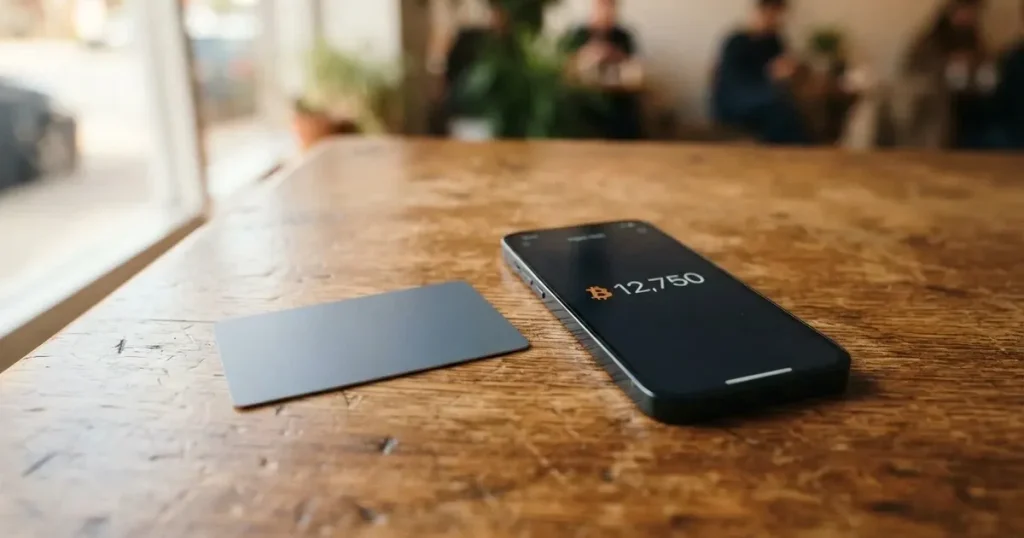
OnCards is a virtual card that lives inside Telegram and is topped up with USDT on the BEP20 network. That is genuinely the whole pitch: launch a bot, get a virtual Mastercard or Visa, load crypto into it, and pay for goods and services — or add it to Apple Pay or Google Pay. There is no physical card, no ATM access, and no bank transfer option. For someone who already holds USDT and spends online, that is a complete, workable product. For anyone who wants to know what a purchase costs in fee terms, who issued the card, and which countries can open one, this is the opposite: the card’s own pages answer almost none of it.
I scored it 4.6 out of 10. That is not a verdict on whether the card works when you tap it. It is a verdict on how much you can find out before you trust it with money.
The conditions described here are current as of October 28, 2026.
Verdict: 4.6 out of 10, and the gap is transparency, not speed
The score breaks down into six criteria, and the shape of the table matters more than the total. Nothing here is a scandal. It is a card with three genuinely good qualities and four large holes.
| Criterion | Mark | Why |
|---|---|---|
| Who can get it | 5 / 10 | The list of countries is not disclosed on the site |
| Cost | 5 / 10 | “Simple and clear fees — no hidden charges”, with no amounts shown |
| Top-up options | 4 / 10 | USDT BEP20 only, bank transfers not accepted |
| Reliability and complaints | 3 / 10 | No legal entity, issuer or licences named, only “© 2026 OnCard”; no reviews found |
| Everyday use | 6 / 10 | Virtual Mastercard / Visa in Telegram, Apple Pay and Google Pay; goods and services only, no plastic, no ATM |
| Total | 4.6 / 10 | Fast virtual card in Telegram funded with USDT BEP20 |
Who it suits. You already hold USDT on BEP20. You pay for things online, possibly by subscription. You do not want a bank to ask questions about where the money came from. You are comfortable sending an irreversible blockchain transfer to an address and then discovering that no one is there when you have a problem. You will not be surprised that the card is invisible plastic.
Who it does not suit. Anyone who needs a card to get through a shop that only takes physical cards. Anyone who needs cash from a machine. Anyone who pays in a currency other than the card’s and wants to know the markup in advance. Anyone who keeps a budget, because you cannot build one from a fee schedule that does not exist. And anyone who is choosing between a card whose provider names itself and one that does not — that is not a close call for me.
The 6 out of 10 for everyday use is the highest mark here, and it is deserved on a narrow axis: the card is added to Apple Pay and Google Pay, which is how most spending actually happens now. But that mark is borrowed from the two lines about wallets, and everything around them — rewards, blocked merchant categories, dispute handling — is unstated.
Will they give you the card?
The honest answer is: I could not determine this from the card’s public pages. There is no country list, and no mention of Russian or Belarusian citizens or residents anywhere in what I could read. That is not the same as saying they are turned down — it is saying the card does not say. If you are in one of those countries, or anywhere else where the answer matters to you, you will have to open the bot and find out for yourself, and I would do that before sending anything.
What is more broadly useful is the general shape of the rule, because it applies to almost every card in this category, OnCards included. Identity checks are not a formality bolted on at the end; they are a legal obligation. In the EU, customer due diligence covers your name, address, date of birth, nationality and identity documents, plus a sanctions check, the purpose of the relationship, and whether you are a politically exposed person. In the US, the customer identification programme requires your name, date of birth, address and an identification number. Nationality is recorded and screened separately from residence, because sanctions screening usually applies to citizenship and country of birth as well as to your address.
That last point matters more for a crypto-funded card than for an ordinary bank card. Your funding source is on-chain and pseudonymous; your KYC identity is not. If those two ever get compared, that is a conversation with the provider, and you want to know the provider exists.
What I would check first: open the bot, see what it asks for, and see whether it asks before or after you send anything.
How to get it
Getting the card is described in one line on the site: “Launch the Telegram Bot”. Activation is automatic — there is no waiting period, no manual approval step mentioned, no plastic to wait for. The card is issued as a virtual Mastercard or Visa directly inside Telegram; the network is not fixed between the two, so which one you get is not something the page commits to. The card currency is not stated, which quietly matters for everything in the costs section below.
There is no standalone app. Everything happens in the Telegram bot, and there are no store ratings because there is no app to rate. There is no physical card — the fact simply does not apply — and no mention of one being planned.
On identity verification levels, the card’s public pages are not stated: nothing about whether documents are collected, which ones, or whether checks happen per transaction or once.
So the whole flow is: bot, card, auto-activation. The friction is minimal, and that cuts both ways. A fast sign-up is convenient right up until you want to ask a question three months later.
Fees: what a payment really costs you
Here is where the card is weakest, and I want to be precise about why rather than dramatic. The site says “Simple and clear fees — no hidden charges”. No amounts accompany that sentence. Every figure in the table below is not stated on the card’s public pages.
| Fee or limit | Value |
|---|---|
| Issuance fee | not stated |
| Monthly fee | not stated |
| Conversion fee (crypto to balance) | not stated |
| FX / currency conversion fee | not stated |
| ATM withdrawal | not stated; the card is “intended for payments of goods and services only” |
| Daily limit | “High daily limits up to $250,000” |
| Monthly limit | “no monthly restrictions” |
| Tier structure | not stated; a single product is shown |
| Card currency | not stated |
Now let me walk you through three everyday payments and tell you which fees each one runs into — not what I would pay, but which of the missing numbers actually bites.
Paying 20 dollars’ worth of groceries in your local currency. This is the payment where the missing card currency and the missing FX fee matter most. The card spends a balance; the balance has a currency; the shop charges a currency; and somewhere between them a conversion happens at a rate and a markup the card does not publish. On top of that, the USDT-to-balance conversion at funding time has its own unpublished fee. You can end up paying twice on hidden spreads and have no way to check either. If you spend a lot, this is the fee that matters and it is the one you cannot see.
A 12-dollar subscription, say a streaming service or a design tool. Here the direct cost is small enough that a percentage fee would be negligible even if it were high. What matters instead is whether the purchase clears at all. A small foreign-issued or prepaid card can be declined by a merchant that checks the card type before authorising, and the issuer can restrict a card number for specific channels. Neither the card nor its pages tell you which merchants or categories are blocked. That is not stated.
Paying a contractor or a friend. This is where the large limits become relevant and where I would slow down for a different reason. “High daily limits up to $250,000 and no monthly restrictions” is a genuine feature and, for someone who runs payments out of crypto, it is probably the reason to look at this card at all. But a high limit with no published fee schedule and no published chargeback terms is not flexibility; it is exposure with no visible ceiling on the downside. Ask yourself before you do it: what happens when a payment goes through that I did not intend, and who do I call?
The rule I would apply: never route money through a card whose cost per payment you cannot compute before you make it. If you cannot calculate the amount that will leave your balance for a 100-dollar purchase, you do not have a fee schedule; you have a relationship.
Top up: one network, one coin, no bank wire
The card is funded with USDT on BEP20, topped up from a crypto wallet. Bank transfers are not accepted — not “not yet”, not “coming soon” as far as the site says. That single line is the whole top-up story, and it is worth understanding rather than just noting.
The minimum is not stated. The top-up fee is not stated. Withdrawal from the card back out is not stated. There is one product, no tiers.
Three practical consequences follow from “USDT BEP20 only”, and you should weigh them before you commit.
First, you need a wallet that can send USDT on the BEP20 network. If your USDT sits on Tron or on Ethereum, moving it is not a copy-and-paste job — BEP20 and TRC-20 are different networks, and a token sent to a wallet on the wrong chain does not arrive. Some services will convert between them for a fee that is theirs, not the card’s.
Second, on-chain transfers are irreversible. There is no built-in recovery: the network cannot freeze or return funds. If a deposit lands on a network the provider does not support, or at an address of another network, it can be lost, or it can need manual support recovery with no guarantee. Send a small test amount before a large one — that is not a trick to avoid the rules, it is just how irreversible transfers work.
Third, the network fee on your deposit is charged by the blockchain, not by the card. That is one small cost that is at least visible and outside the provider’s control.
Paying with it every day
The card is virtual only, and it is meant for spending, not for holding or withdrawing. The site says it is “intended for payments of goods and services only” and there is no ATM provision. You add the card to Apple Pay or Google Pay, and that is the normal way to pay in person as well as online.
That works better than it sounds, because a tokenised mobile wallet number is not your card number: it is a device-specific number held in the phone’s secure hardware, and each payment carries a one-time dynamic code. So using it in a shop by tapping a phone is a reasonably ordinary experience.
Where it gets ordinary in the wrong way:
- Declines. Some merchants refuse prepaid or foreign-issued cards because the card-type lookup shows them what they are dealing with. A foreign issuer country on a card used at a domestic billing address is exactly the situation that invites extra scrutiny. You are told none of this in advance.
- Holds. A declined authorisation can leave a hold on your money that sits for several days, commonly up to seven. On a balance-funded card, that is your money frozen, not a bank’s float.
- Verification steps. Online payments may be challenged with a one-time code or a biometric check. If your balance is low at the moment a subscription renews, that is a problem.
- Address checks. The address verification that many merchants run is mainly a US, Canadian and UK thing and is generally unavailable for foreign-issued cards — which is another way to get declined, quietly.
Rewards are not stated. There is no cashback, no points, no referral scheme mentioned, and no mention either way of what spending earns you. If someone pitches this card to you on a rewards basis, they are describing a different product.
What can go wrong
This is the section where I have the least to work from, and the emptiness itself is the finding.
Nobody will tell you who is behind it. The only company detail on the site is “© 2026 OnCard” — a copyright line. There is no legal entity named, no issuing bank or e-money institution named, and no licence named. That is the single biggest risk on this page, and it deserves to be said plainly. A card payment is handled by at least three parties: the network routes the messages, a licensed issuer holds the actual card programme and your balance, and the brand you are talking to is often only a front-end or programme manager. When something goes wrong, you need to know which of those three you are dealing with, and here you cannot tell them apart.
No safety net is described. Dispute handling is not stated — what happens when goods do not arrive, or a charge is fraudulent, is simply not covered by anything I could read. Whether you have any statutory protection at all depends on whether this is a prepaid instrument, a debit card, or something else, and those differ by country. Do not assume that because Visa or Mastercard is on the front of the card, the protections you have with a normal bank card follow you here.
Nobody is on call. No support channel is listed. There are Instagram and X accounts, and those are not support. If your deposit does not arrive, a chargeback is the kind of problem that needs a human being who can pull a transaction record, and I cannot find evidence that such a person exists here.
History is short or unrecorded. No official incidents were found, and no third-party reviews were found either — I searched for the domain together with the card’s funding method and what came back were generic guides to USDT cards, one of which advised against Telegram-only providers that do not operate publicly. That is not evidence of a problem. It is also not evidence of a good record, because there is no record either way. The card’s Trustpilot page could not be read, and no reviews were found.
There is no security information. Whether the provider holds funds, in what kind of account, with what segregation or insurance, is not stated. If the balance sits in a custodial account — which a Telegram-bot card almost certainly implies — then your money depends entirely on that company’s internal controls. Seed phrases, hardware wallets and self-custody are the alternative end of this spectrum, and this card tells you nothing about where it sits.
And the category has a track record. Card programmes do close. One recent closure had new loads end in July 2026 and spending stop in August 2026, with users then asked to withdraw what remained. Visa terminated its global agreements with FTX in November 2022 and the FTX US debit card was wound down. A Visa issuer that supplied crypto card brands was suspended by Visa in Europe in 2018, closing every programme it had issued. When that happens, the network brand on your card is not protection — it is the person winding you down.
What to take instead
If the shape of what you want is the same — a virtual card, crypto-funded, usable for online spending — there are three alternatives I looked at closely. All three are more transparent than this one, and all three have their own catch.
Azul Card — 5.3 out of 10. Virtual only, works wherever Mastercard is accepted, balance in USD. It publishes its numbers: $20 to create the card, refunded after $2,000 of spending, $5 a month, 4% on crypto top-up, $0.25 per transaction, no monthly fee for holding it. It is available worldwide except a specific list of countries and regions — Russia, Belarus, North Korea, Iran, Syria, Cuba, Sudan, Venezuela, Ukraine and the Crimea, Donetsk, Luhansk, Zaporizhzhia and Kherson regions — and the card states that these restrictions apply regardless of the user’s nationality. That is a real advantage over OnCards: even if you cannot use it, you know that in advance. It also has a referral programme paying up to 40% of fees from your referrals’ transactions, which is worth noting if you bring people in. Its catch is that FX costs are not stated.
Telecard — 6.1 out of 10, the strongest of the four. Virtual Mastercard, instant, USD. Identity check available in most major regions; terms bar only users blocked or sanctioned by the United States, including under OFAC. It publishes more fees than any of these: 1.5% currency conversion on non-USD payments, 0.5 USDT gas fee per successful transaction, FX and cross-border fees up to 3% each. Funding is USDT on Tron or Ethereum, USDC on Ethereum, with Polygon not supported. $99 minimum deposit to activate, stated as not a fee because it stays in your wallet. Its catch is the plan structure: $5 one-time standard, or $49 setup plus $19 a month for VIP, with $15 to reissue a VIP card. Check the current terms before choosing, since the main page advertises free sign-up.
Balance Pay — 5.7 out of 10. Virtual Visa now, with physical cards planned. No monthly fee and free registration. Funding covers USDT on Tron, Polygon and Base, with more networks promised. Interface in English and Russian. Its catch is that it simply has not finished: “full tariffs and legal documents will appear later”. No country restrictions are published either. So Balance Pay is transparent about being unfinished, which is a different thing from quiet.
My honest comparison: OnCards is cheaper to start, in the sense that nothing about it is priced, and faster to set up than any of the three. But “cheap” is not a fact I can establish — it is the absence of one. If you want to know what you are paying, take Azul or Telecard. If you want to know who you are trusting, none of these fully answers that either, and you should treat that as the real question behind your choice.
Who I would recommend it to
I would recommend OnCards to exactly one kind of person: someone who already lives in USDT on BEP20, spends online rather than in shops, does not need a physical card, and treats this as a convenience tool rather than as financial infrastructure. For that person the card does its job, quickly, and the Telegram-only nature is not a bug — it is the feature.
For everyone else, I would not, and the reasons are not exotic. If you are comparing cards, the absence of a fee schedule means you cannot predict the cost of a purchase, and that alone disqualifies it from serious financial use. If you are worried about what happens to your balance, there is no named legal entity, no named issuer, no named licence, no security information and no listed support channel — five separate reasons not to, each sufficient on its own. If you are in a country where the answer matters, the card does not tell you, and you would be finding out by trying.
Before you put real money in, here is my short list. Ask who issued the card and under whose licence, and see whether you get an answer. Ask what a payment costs, and ask what it costs when the shop’s currency is not the card’s. Ask who you email when a charge is wrong. If none of those three produces a clear answer, then whatever the card does well — and it does have a fast, clean Telegram flow — it is not something to depend on.
Frequently asked questions
What is OnCards?
OnCards is a virtual payment card that you obtain and control through a Telegram bot, with no app and no physical card. It is intended for paying for goods and services, funded by transferring USDT on the BEP20 network to the card. The card is described as a virtual Mastercard or Visa, though the network is not fixed between the two. Its public pages name no legal entity, issuer or licence, only a copyright line reading OnCard 2026.
How does OnCards work?
You launch the Telegram bot, receive a virtual card, and activation happens automatically with no approval step mentioned. You fund the card by sending USDT BEP20 from your own crypto wallet; bank transfers are not accepted. When you pay, the card spends the balance you loaded. You can add the card to Apple Pay or Google Pay, which replaces the card number with a device-specific token. There is no ATM function and the card is for purchases only.
Is OnCards a bank?
Not on the evidence available. The site names no bank, e-money institution or other licensed entity, and no licence of any kind — only a copyright notice. A card payment normally involves a network, a licensed issuer holding the programme and your balance, and a brand that may be only a front-end. Without knowing which of those OnCards is, you cannot tell who is legally responsible for your money or which deposit protections might apply to you.
Does OnCards require KYC?
The card’s public pages do not say. No identity verification levels are described, and no documents are mentioned anywhere in what is published. What is true more generally is that regulated businesses are obliged to verify customers as part of anti-money-laundering law, which usually covers name, address, date of birth, nationality, identity documentation and a sanctions check, with nationality screened separately from residence. So the absence of stated rules on the site is not evidence that no checks exist.
How do I top up the OnCards card?
By sending USDT on the BEP20 network from a crypto wallet to the card. That is the only funding route the card publishes, and bank transfers are not accepted. The minimum top-up amount and any top-up fee are not stated, as is whether you can withdraw a balance back out. Note that blockchain transfers are irreversible, and the network fee for your deposit is charged by the blockchain rather than by the card.
Is OnCards card free?
That is genuinely not stated. The site says “Simple and clear fees — no hidden charges” but publishes no amounts: not the issuance fee, not a monthly fee, not a conversion fee, not an FX fee. What it does publish is a limit — daily spending up to $250,000 and no monthly restrictions. Treat the card’s silence on price as a fact about the card, not as evidence that the price is zero.
Can I add the card to Apple Wallet?
The card states you can add it to Apple Pay or Google Pay, and that is the practical way to pay in person as well as online. A mobile wallet stores a device-specific token rather than your actual card number and uses a one-time code per payment, which is a genuine security advantage. Worth knowing: the issuer can still restrict the token, and a foreign-issued card can be declined at the terminal for reasons that have nothing to do with you.
Is OnCards safe?
I would not call it safe, because safety depends on information that is missing. No legal entity, issuer or licence is named; no security or custody arrangements are described; no support channel is listed beyond social media accounts; and dispute handling is not stated. No official incidents and no third-party reviews were found, which is not reassuring — it is an absence of track record in both directions. Treat any balance as money you could lose outright.
Which countries can use OnCards?
The card’s public pages do not say. There is no country list and no mention of Russian or Belarusian citizens or residents anywhere in what is published. That is different from saying they are turned down — it means you would find out by trying. Compare that with a competitor that names the excluded countries explicitly, so you know where you stand before you send anything.
Is OnCards worth it?
For someone already holding USDT on BEP20 who pays online and does not need plastic, it is a fast and tidy convenience tool. For anyone else, the missing pieces matter more than the convenience: you cannot predict what a payment will cost, you cannot verify who holds your balance, and you cannot find anyone to call if a charge is wrong. My test is simple — if you cannot compute the cost of a 100-dollar purchase before making it, the card has not told you enough to be worth relying on.
Virtual cards: your questions answered – cryptocardanswers
Content created by the «cryptocardanswers» team