
A self-custody card wrapped around USDT, with more unknowns than answers
 Available in US
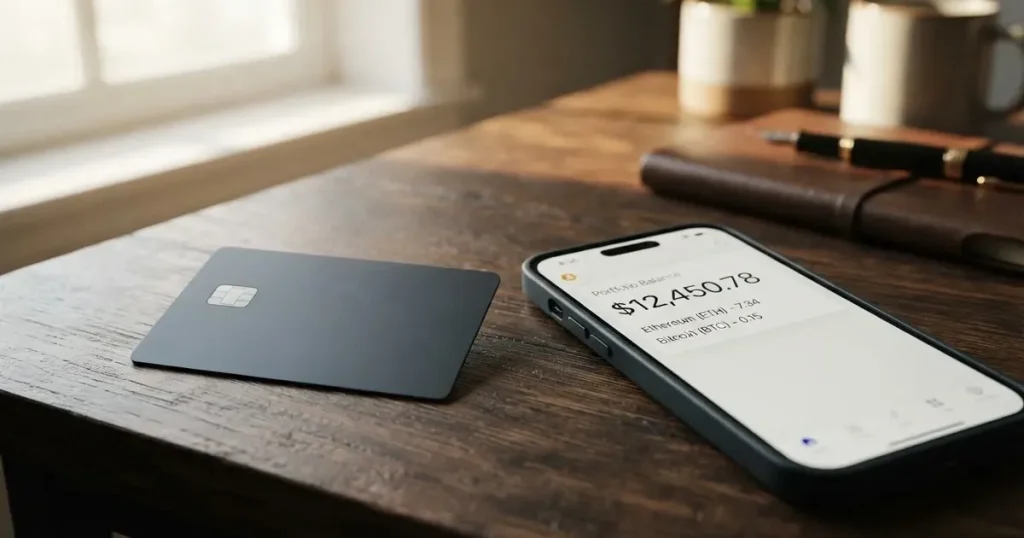
The Jam card is pitched as a payment card spent from a non-custodial crypto wallet. You sign up with an email and a phone, fund a USD balance with USDT, and spend that balance wherever Apple Pay or Google Pay is accepted. The product sits inside an app called Jam, and the company behind it, JAM Platform LLC, is registered in Delaware. That much is on the public record. The longer you look, the more details are simply not on the site, and the unofficial reports from early users raise familiar questions about cost, withdrawal and whether a physical card exists at all.
This review walks through eligibility, sign-up, costs, top-up options, daily spending, and the risks a reader should think about before loading any meaningful amount of money. It is written from public information as of 2026-10-21, and where Jam has not published a number, the page says so rather than guessing.
The conditions described here are current as of October 28, 2026.
Verdict
Jam’s score out of 10 is 4.4. The headline is that the product leans hard on the appeal of a non-custodial wallet, but the practical experience is held back by missing information: no published country list, no fees page, no card-network disclosure, and an absence of named licences. The self-custody angle is real, the conversion cost is reportedly high, and Trustpilot at the time of writing is built on only five reviews, all five stars, with one detailed complaint about fees and being unable to withdraw loaded funds. The verdict reflects those trade-offs.
Jam is at its best for a self-custody wallet user who already holds USDT, is comfortable paying an unofficial 4.2% on top-ups plus gas, only needs Apple Pay or Google Pay for spending, and treats the card as a small on-ramp from crypto into day-to-day purchases rather than a primary bank account. It is the wrong fit if you need a known network and issuer, a physical card, transparent fees, or a country list that you can check before signing up.
| Criterion | Mark | Why |
|---|---|---|
| Who can get it | 5 / 10 | Country list not published; Russia, Belarus, Iran, North Korea, Syria, Cuba, Ukraine and US persons excluded; on/off-ramp operates in 200+ countries |
| Cost | 3 / 10 | No fees disclosed officially; unofficial reports cite around 4.2% on stablecoin top-ups plus gas, and 0.2% on Apple Pay |
| Top-up options | 4 / 10 | Officially USDT only, with “No TRX required” for TRC20; unofficial reports say only USDT and BSC-USD are supported |
| Reliability and complaints | 6 / 10 | Non-custodial, company in Delaware, but no issuer, no licence, no public incident log; Trustpilot 4.1/5 from five reviews, one complaint about costs and withdrawal |
| Everyday use | 4 / 10 | Card type and network not stated, no physical card in the unofficial reports, Apple Pay and Google Pay available, ATM policy not stated |
| Total | 4.4 / 10 | The product is interesting on paper but too under-documented to recommend for significant balances |
Who can get the Jam card
Jam does not publish a card country list. The marketing page says the on/off-ramp part of the product works in 200+ countries, but the card and financial-services side of the product is “categorically forbidden in specific jurisdictions,” with Russia and Belarus named and Iran, North Korea, Syria, Cuba and Ukraine listed alongside. Sanctioned persons are barred. The terms are explicit that the card is “strictly not intended for use by United States Persons” and that US IP access is blocked; Jam may also restrict access by IP or jurisdiction at any time.
The crucial detail for a reader evaluating this is that the list is not exhaustive — “including but not limited to” — so the absence of your country from the named list is not a guarantee you can sign up. Whether the rule is applied by citizenship, residence or both is also not stated. If your situation depends on a specific nationality or residency status, the only safe reading is that you should test sign-up carefully before loading funds, and not assume that a country not named is open.
Eligibility rules are tighter than the on/off-ramp coverage suggests. Treat the on/off-ramp statement as a ceiling and the named jurisdictions as the confirmed floor.
How to sign up
The sign-up flow is short on paper: an email, a phone number and what the site calls “30-second onboarding.” KYC is delegated to independent third-party compliance partners whose names are not given. The site does not state a minimum age, and does not state whether proof of address is required — both of which are normally disclosed somewhere, and the absence here is part of the broader pattern of undocumented detail.
One unofficial data point, a Trustpilot reviewer from May 2026, calls Jam a “No KYC” first card. That contradicts the site’s own statement that KYC is done by compliance partners, and the safest interpretation is that the reviewer skipped a step or used a partner that didn’t require documents for their particular case. Don’t take it as a general promise.
Once you are in, the app converts your deposit to a starting USD balance, and the card is built around that. The terms refer to “20+ card types in the future” but today the site only describes one. Whether that means a single card product with a single network, or just a single configuration, is not stated. The result is a card whose brand, network, currency wallet and physical form are all left for the user to discover at sign-up.
Fees: what it really costs
The most expensive unknown on this product is the cost. Jam has no linked fees page, and the official line on costs is essentially silent. What is on the record is a referral reward — “$5 for each friend” — and a marketing line about spending “Up to $250,000 Daily Worldwide.” Everything else on the cost side is unofficial.
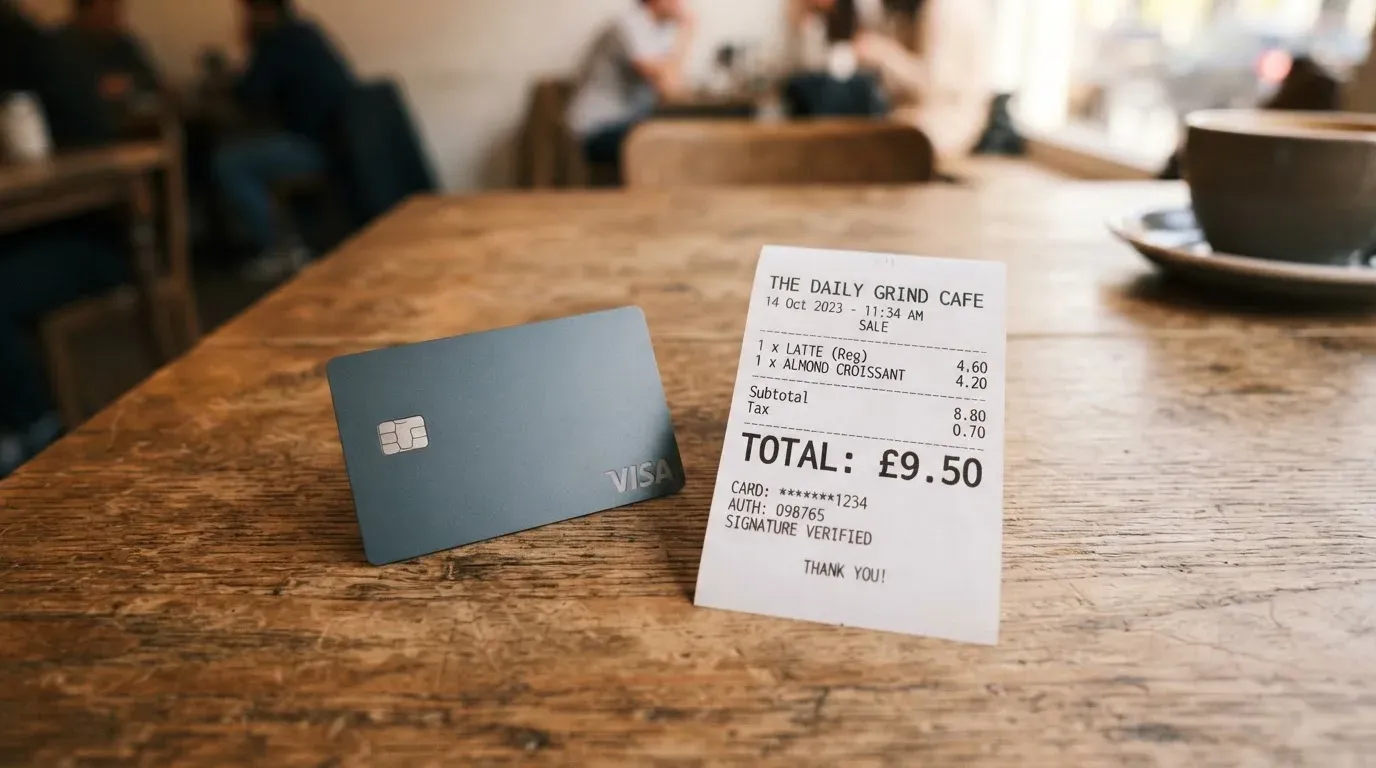
The unofficial picture, from Trustpilot users in May 2026, is that stablecoin top-ups cost around 4.2% plus network gas, and that Apple Pay carries a separate 0.2% fee. If both apply to the same transaction, the effective cost of converting USDT to a paid-for coffee is the sum of the 4.2% top-up and 0.2% Apple Pay fees, plus the network gas cost for the on-chain transfer. For a reader used to a 1% FX margin or a flat ATM fee, that is a lot. For a reader used to 0% crypto-card FX, it is a different product class entirely.
The starting balance is a USD balance. Whether you can hold or convert in other currencies, and at what spread, is not stated. There are no fee tiers; the so-called “JAM VIP Club” is a private Telegram community for special rewards and a personal manager, not a published fee schedule. ATM fees and withdrawal fees are not disclosed.
The costs below are taken from research: official values where Jam has published them, and unofficial values clearly labelled where they come from a third-party reviewer rather than Jam itself.
| Fee or limit | What is on the record | Note |
|---|---|---|
| Card issuance | Not stated | No fees page linked |
| Monthly / annual fee | Not stated | “JAM VIP Club” is a Telegram group, not a fee tier |
| Stablecoin top-up | ~4.2% + gas (UNOFFICIAL) | Per Trustpilot reviewer, May 2026 |
| Apple Pay fee | 0.2% (UNOFFICIAL) | Per Trustpilot reviewer, May 2026 |
| FX fee | Not stated | Starting balance is USD |
| ATM fee | Not stated | |
| Daily spend limit | Up to $250,000 | Page title, no per-level detail |
| Monthly spend limit | Not stated | |
| Referral reward | $5 per friend | Officially published |
The two costs that will hit a typical user — top-up and Apple Pay — are not on Jam’s site. Treat them as plausible, not guaranteed. Two everyday examples make the trade-off concrete.
A $100 top-up from USDT, then a $100 Apple Pay payment at a shop. On the unofficial numbers, you pay about 4.2% on the way in and 0.2% on the way out, plus the on-chain gas fee for the top-up itself. If gas is low, the round trip cost is noticeable; if gas is high, it can be higher still. A reader who pays with the card several times a week can expect to give up several percent of every deposit, which is well above what most non-custodial alternatives charge.
A $1,000 top-up followed by a week of $50–$100 Apple Pay payments. The top-up alone is roughly $42 on the unofficial rate, before gas. By the end of the week the user has spent $1,000 of card balance to buy $1,000 of goods, but has paid for the privilege of doing so. This is the realistic shape of the cost, not a marketing figure.
If your priority is paying a known total cost for a payment, the first thing to check is whether the unofficial numbers still hold at the time you read this. The fact that they are unofficial is itself the answer: there is no published number to compare against.
Top up: how to fund the card
The starting data is USDT, and the official line is “No TRX required” — that refers to GasFree-style TRC-20 top-ups, where the user does not need to hold Tron to pay network fees. A Trustpilot reviewer from May 2026 reports that, in practice, only USDT and BSC-USD (BEP-20) are supported. That is the most useful unofficial detail, because it tells you which networks are likely to work when you try to top up.
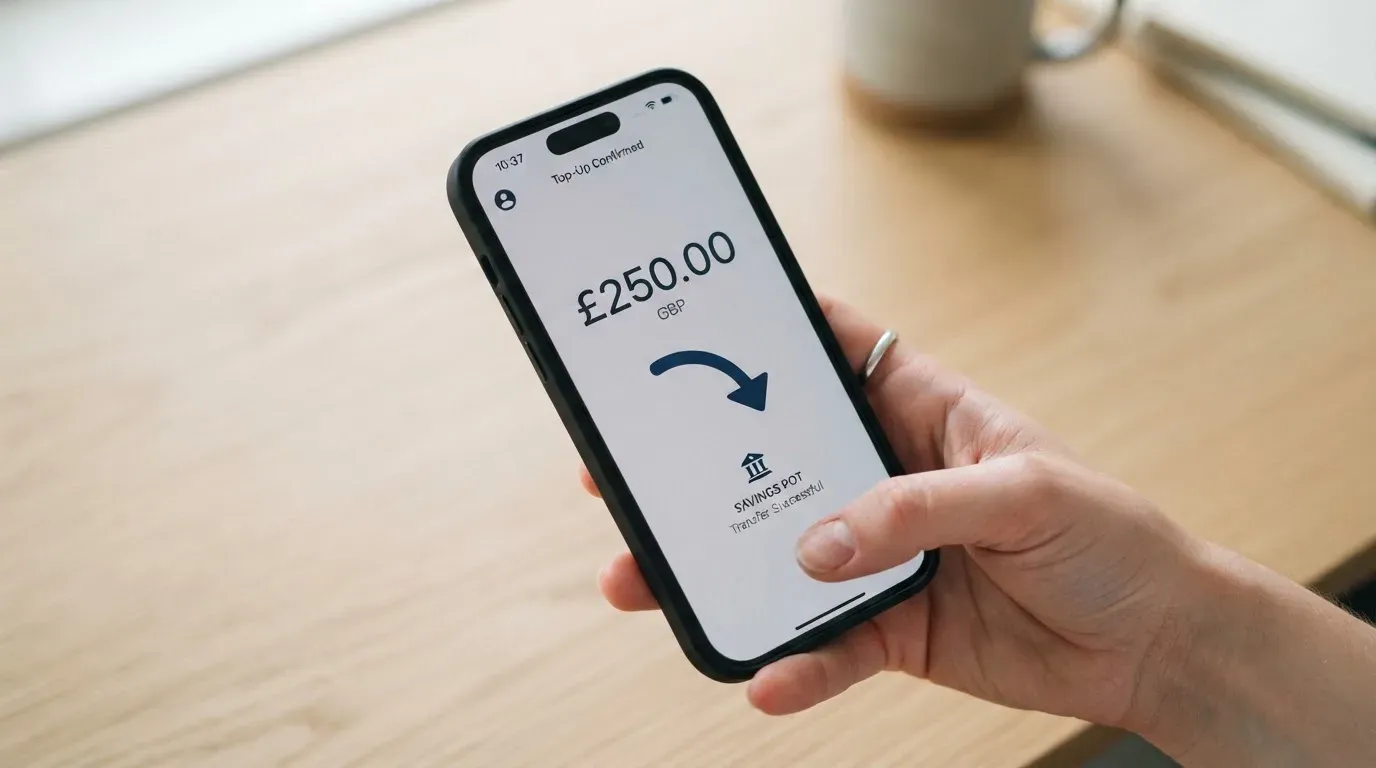
The official site does not list supported coins or networks, and does not publish any documentation about how to top up beyond the USDT starting point. Withdrawals, in the conventional sense, are not described. Whether you can move a balance back to your own self-custody wallet, or only spend it through the card, is not stated. Given that the service is positioned as non-custodial, the natural expectation is that funds remain under your control, but “under your control” and “withdrawable in the way you want” are not the same thing. A reviewer explicitly says they could not withdraw funds once they were loaded.
If you plan to use Jam, fund only what you intend to spend in the near term. Do not treat the card balance as a flexible savings account, because there is no published withdrawal path.
The crypto-card category itself, in case it is useful, runs on a few well-known stablecoin rails. Tether’s USDT and Circle’s USDC account for the majority of stablecoin market capitalisation, and the ERC-20 standard requires gas to be paid in ETH, so a wallet holding only USDT with no ETH cannot send. Tron uses bandwidth and energy for fees, often burning TRX. These are network-level rules; Jam’s layer on top adds its own, currently undocumented, conditions.
Paying with it every day
The daily-use story is mobile wallets. Jam supports Apple Pay and Google Pay, and the site says you can “Pay instantly” with either. That is enough to pay at most contactless terminals, in apps, and on websites that take mobile-wallet payments, provided the merchant’s payment processor accepts the card’s network. Which network that is, is not stated.
The Apple Pay flow uses a tokenised device number stored in the phone’s Secure Element, not the card’s real PAN, which means a leak from a merchant does not give an attacker the card number itself. The card issuer can also lock a tokenised number to a specific channel — for example, only the wallet — but Jam has not published whether such restrictions apply.
There is no physical card in the unofficial reports. The card is virtual, and the only spending channel that is documented is mobile-wallet-based. ATM access is not addressed, and the absence of an ATM policy is its own answer: do not plan to take cash out unless Jam has told you it works, in writing.
A few other points round out the daily-use picture:
- No cashback programme is published; the only reward on the official side is the $5 referral bonus per friend.
- Blocked merchant categories are not stated. Some issuers block gambling (MCC 7995) or other categories by policy, but Jam has not listed its policy.
- App: iOS “Crypto Wallet & Web3 Jam App” requires iOS 17.6 or later; the App Store page does not show a rating (not enough ratings). Android: io.jamcard.app, rating not retrievable at the time of writing.
- Online checkout typically involves 3-D Secure (Visa Secure or Mastercard Identity Check), which adds an extra confirmation step on top of Apple Pay in some merchants. Whether Jam supports 3-D Secure, and in which form, is not stated.
- Disputes are not addressed. The terms are clear that blockchain transactions cannot be reversed, and that disputes with third-party providers fall under those providers’ own terms.
The honest answer to “where can I use it” is “anywhere Apple Pay or Google Pay is accepted, with no published list of restrictions, and with a card whose network and issuer are not on the record.”
What can go wrong
There are three buckets of risk here: company-level, payment-level and user-level.
At the company level, JAM Platform LLC is registered in Delaware at 8 The Green, Suite A, Dover, DE 19901. Card issuance is by unnamed third-party providers, surfaced only inside the app. No licences are listed. An unofficial source (GetApp) describes the operator as UAB Jam, registered in Lithuania; that conflicts with the Delaware registration and is the kind of detail a reader should not have to triangulate. The point is not that either entry is necessarily wrong; the point is that the public record is inconsistent, and that makes it harder to know which regulator, if any, oversees which part of the product.
At the payment level, the issues are familiar across the category. Authorisations can be declined, and a declined authorisation can leave a hold on funds for several days. Merchants that use Address Verification Service (AVS) — mostly US, Canadian and UK — sometimes decline foreign-issued cards because the AVS data is not comparable. Tokenisation through Apple Pay or Google Pay reduces, but does not eliminate, the chance of merchant-side declines. None of this is unique to Jam, but with no published card network and no published issuer, the user has no way to predict where the card will work and where it will not.
At the user level, the non-custody claim is the most important feature and also the most important responsibility. The terms describe the services as “strictly non-custodial,” meaning Jam never holds the user’s funds, keys or seed phrases. The App Store page also lists a live AML address check, which is a positive sign for transaction screening. The flip side is the standard one: if you lose your seed phrase, you lose access; if a clipboard-hijacker swaps an address at the moment of top-up, the funds are not coming back; if you top up on the wrong network, recovery is not guaranteed and is at the support team’s discretion. Crypto transfers are typically irreversible, and a stolen private key has no built-in recovery path on the chain.
Complaints data is thin but worth describing. Trustpilot shows 4.1/5 across five reviews, all five stars, read 2026-10-21. The most substantive critical comment, dated May 2026, raises three points: the cost of top-ups, the lack of a physical card, and the inability to withdraw loaded funds. A wider web search did not surface Reddit threads about Jam. The Help Centre is at help.jamcard.io, available in Arabic, English, Portuguese, Russian, Spanish, Turkish and Ukrainian; the app supports Russian; Telegram is at t.me/jamcards; Instagram, X, TikTok and LinkedIn accounts are live. Support hours are not stated.
The risks in summary:
- Unnamed card issuer and no published licences; an inconsistent corporate footprint between Delaware and Lithuania in third-party listings.
- Unpublished fees; unofficial top-up cost of about 4.2% plus gas and a 0.2% Apple Pay fee.
- No published withdrawal path; a user report of being unable to withdraw after loading.
- Non-custodial design means the user carries the seed-phrase and address-verification burden themselves.
What to take instead
Jam is a product for a specific reader, and there are several cards in the same general space with more published detail. The ones below are alternatives that come up in the same conversation about non-custody and self-funded spending. None is presented as a direct replacement; they are points of comparison so a reader can decide which trade-off they prefer.
| Card | Score | Country model | Card type | Cost highlights | Top-up |
|---|---|---|---|---|---|
| TokenPocket (TP Card) | 5.8 / 10 | Visa debit for a list of European countries/territories; Mastercard debit for Australia, Canada, Hong Kong, Japan, Taiwan, New Zealand, Singapore, South Korea, UK; Americas “planned for Q2 2025” | Mastercard or Visa debit, virtual, on Arbitrum; balances in EUR24 and USD24 | NFT creation fee partly covered by TokenPocket, user pays “a small portion”; “Apart from these, TP Card does not charge any additional fees”; 1% deposit fee, “to be refunded later via rewards” | Crypto from the TokenPocket wallet; specific coins/networks not listed in the FAQ |
| MetaMask Card | 7.1 / 10 | Sign-up open in 45 listed countries/territories (Andorra, Argentina, Brazil, Canada, Mexico, Germany, France, Spain, Uruguay, among others); others join a waitlist; US/UK sign-ups temporarily closed | Mastercard; virtual first (instant), Metal pre-orderable in app; one card per user; issuer Monovate, provider Crypto Life | Virtual free, no annual fee; Metal $199/year; “Minimal fee for each transaction” with a fee table linked; no MetaMask FX fee, Mastercard rate used | Spends directly from connected wallet; networks Linea, Base, Monad, Solana; tokens mUSD, wETH, EURe, GBPe, USDC, USDT (page says nine); cashback 1% virtual, headline 3% Metal (footnote limits 3% to first $10,000 then 1%) plus $FLY 5X/7X via Blackbird |
| KAST | 6.1 / 10 | Country list shown at KYC; “If your country isn’t listed, KAST is not available there”; citizenship/ID matters; VPN does not bypass | Virtual and physical, up to 10 cards per user; Visa Platinum (Standard), Visa Infinite metal (Premium), Visa Infinite gold (Private); account in USD; stablecoins 1:1, 0% spread | Standard 0 USD/yr; Premium 1,000 USD/yr; Private 10,000 USD/yr; extra virtual 2 USD; Standard physical 0 USD + 40 USD delivery; inactivity 1 USD/month after 12 months; stablecoin top-up 0%; non-USD FX 0.5%–1.75%; non-USD under 25 USD: 0.10 USD; declined 0.50 USD | Stablecoins USDT, USDC, PYUSD, RLUSD on Ethereum, Solana, Polygon, Arbitrum, TRON; no bank account needed; spending from own balance, not credit; USD cashback 1.5%/2%/3% by tier |
The contrast that matters is transparency. TokenPocket says openly that a 1% fee exists, even if it promises to refund it. MetaMask publishes a fee table, a cashback structure and a list of supported networks. KAST publishes tier pricing in dollars. Jam publishes none of these. If the deciding factor is “can I see the price before I sign up”, the three alternatives above are easier to evaluate.
If the deciding factor is “I want the funds to stay in my own wallet until the moment I pay”, all four are in the same broad family, and the choice comes down to the fees, the country list and the network. The networks Jam is most likely to use, based on the unofficial reports, are TRC-20 (USDT) and BEP-20 (BSC-USD). TokenPocket sits on Arbitrum. MetaMask supports Linea, Base, Monad and Solana. KAST supports Ethereum, Solana, Polygon, Arbitrum and TRON. The network you already hold assets on, and the gas you already pay, will matter as much as any fee schedule.
Who I would recommend Jam to
I would recommend Jam to a reader who already keeps a self-custody wallet, holds USDT on TRC-20 or BEP-20, and wants a small mobile-wallet-funded spend line — paying for a coffee, splitting a bill, occasionally paying for an online subscription — without moving funds to a centralised exchange. The non-custody framing is consistent with the terms, and for low-value, high-frequency spending where the unofficial top-up cost is acceptable, the product does what it says. The reader who fits this profile is also the one most likely to manage the seed phrase carefully, top up in small amounts, and treat the balance as spending money rather than savings.
I would not recommend Jam to a reader who needs a known card network and issuer before signing up, a physical card, a published fee schedule, a country list they can check in advance, or a way to withdraw funds that is documented in writing. I would also not recommend loading a balance that you would not be comfortable losing access to, given the unofficial report of a user being unable to withdraw after loading.
The honest summary is that Jam is more interesting on paper than it is reassuring in practice. The score of 4.4 out of 10 reflects the gap between the non-custody promise and the everyday details that have not been published. If Jam publishes a fees page, a country list, the card network and the issuer, the score will move quickly; until then, treat the card as a small-balance tool, not a primary account.
Frequently asked questions
What is the Jam card?
The Jam card is a payment card built into a non-custodial crypto app, where the starting balance is a USD wallet funded by USDT. Card spending is through Apple Pay or Google Pay, and the company behind it, JAM Platform LLC, is registered in Delaware.
How does the Jam card work?
You sign up with an email and phone, complete KYC through an unnamed compliance partner, top up with USDT on a supported network, and spend the resulting USD balance through Apple Pay or Google Pay. The wallet is non-custodial, which means your seed phrase stays with you.
Is Jam a bank?
No. Jam is a technology company. The card is issued by an unnamed third-party provider surfaced in the app, and no banking or e-money licence is named on the public site.
Who owns Jam?
JAM Platform LLC, registered in Delaware, USA (8 The Green, Suite A, Dover, DE 19901). A third-party listing (GetApp) describes the operator as UAB Jam in Lithuania; the public record is inconsistent and the difference is not explained on Jam’s own pages.
Is the Jam card available in my country?
The site does not publish a card country list. Named exclusions include Russia, Belarus, Iran, North Korea, Syria, Cuba, Ukraine and US persons, and Jam may restrict access by IP or jurisdiction. The on/off-ramp part of the product is described as operating in 200+ countries, but the card side is narrower.
How do I get the Jam card?
Download the iOS or Android app, sign up with an email and phone, complete the KYC step run by an unnamed compliance partner, and fund a USD balance with USDT. The card is virtual in the unofficial reports and no physical card has been confirmed.
Does the Jam card require KYC?
The site says KYC is done by independent third-party compliance partners whose names are not given. A Trustpilot reviewer in May 2026 called it a “No KYC” first card; that contradicts the official position and should not be relied on as a general rule.
How do I top up the Jam card?
The official starting point is USDT, with “No TRX required” for TRC-20 transfers. Unofficial reports say only USDT and BSC-USD are supported in practice. The full coin and network list is not published on the site.
Can I withdraw money from Jam?
The site does not describe a withdrawal path. One Trustpilot reviewer reports being unable to withdraw funds once loaded. Until Jam publishes a documented way to move a balance back to your own wallet, fund only what you intend to spend.
Is the Jam card safe?
The product is non-custodial, the App Store page lists a live AML address check, and Trustpilot shows 4.1/5 across five reviews, all five stars, as of 2026-10-21. The risks are the standard ones for a self-custody wallet — seed phrase, address verification, network choice — plus the lack of a published issuer, licence and fees, which is unusual for a card product.
Wallet cards: your questions answered – cryptocardanswers
Content created by the «cryptocardanswers» team