
DigiFinex's virtual Mastercard works from USDT — but the paperwork behind it is thin
 Available in US
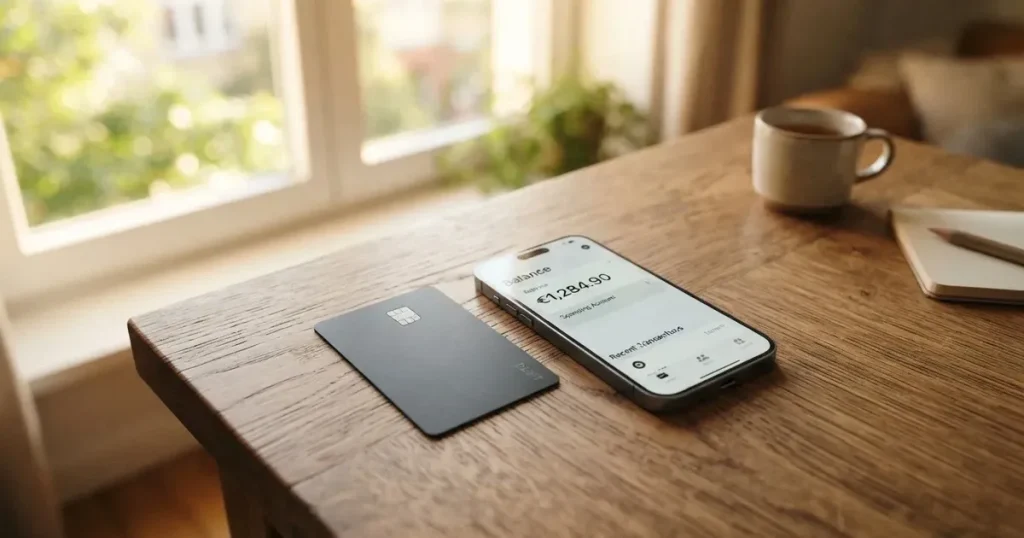
DiCard is a virtual Mastercard you load with USDT and spend like an ordinary payment card, offered by the DigiFinex exchange. The idea is simple and the card works — the virtual card appears right after you apply, Apple Pay and Alipay are supported, and a $5 application fee with no annual fee is a low entry point. The trouble is everything around that card. The public pages I could read do not name the card issuer, do not publish the country list, do not state which networks the USDT arrives on, and lean on a blocklist that would rule out a surprising share of ordinary spending. Add an exchange whose TrustScore sits at 2.1 out of 5 from 121 reviews, and you have a card that is technically usable and practically narrow.
I scored it 4.7 out of 10. That is a low score for a card that does one thing clearly. Below I walk through what I checked, what I found, and where I would steer you instead.
Conditions described here are current as of October 28, 2026.
Verdict: 4.7 out of 10
Let me put the score on the table first, with the parts that produced it.
| Criterion | Mark | Why |
|---|---|---|
| Who can get it | 7 / 10 | The card’s own pages do not publish a country list; unofficial DigiFinex material lists United States, Singapore, Canada and China as restricted |
| Cost | 4 / 10 | $5 per card, $0 annual, 1.3% top-up fee (0.3% for the first five), $0.25 fixed fee per transaction on Lite, $1.5% FX |
| Top-up options | 4 / 10 | USDT only, 15 USDT minimum and 5000 USDT maximum per transaction, networks not named |
| Reliability and complaints | 3 / 10 | Issuer and licences not named; DigiFinex TrustScore 2.1 out of 121 reviews, reports of stuck withdrawals and a card that stopped working with funds held |
| Everyday use | 5 / 10 | Instant virtual card, Apple Pay and Alipay; physical card, Google Pay and ATM are not stated |
That last row is where the whole card sits. Who it suits: someone already inside DigiFinex who holds USDT, wants to spend it at merchants that accept a Mastercard, and does not care that the balance sits inside an exchange account. Who it does not suit: anyone who needs a card that works everywhere, in two currencies at once, at an ATM, or without reading a restricted-category list first. If the reason you are looking at a crypto card is that ordinary bank cards are hard to get where you live, you need this section read carefully — because “does the merchant accept Mastercard” is the easy half, and the blocklist is where the real limits are.
I also want to say plainly what a low score here does not mean. This is not a scam warning. DiCard is a live product on a live exchange with published fees and limits. It scored 4.7 because the paperwork is thin and the user reports are bad, not because the card does not work.
Who will they give you the card?
The card’s public pages do not publish a country list. I could not read one. That is not the same as “everyone is allowed” — it means I cannot tell you, and neither can you, from the pages that exist.
What I did find is unofficial and dated. Older DigiFinex pages — between two and six years old, and about credit-card top-ups for crypto rather than DiCard itself — exclude citizens of the United States and Singapore. DigiFinex’s terms, as a secondary source reports them, list United States, Singapore, Canada and China as restricted areas. None of this is confirmed by the card’s own pages, so treat it as a warning sign rather than a rule.
Here is how to think about it. If you live in one of those four places, read the terms yourself before you apply. If you do not, you still need to know why the country list is missing, and the honest answer is that the exchange’s compliance team decides case by case, the same way it does for exchange accounts. KYC happens at the exchange level, not at the card level — your DigiFinex account is the gate, and the card rides on it. So the practical question is not “does DiCard serve my country” but “does DigiFinex open accounts where I am, and will my account stay open.” Those are different risks, and the second one is bigger.
One more thing worth knowing generally: prepaid and debit cards are normally for adults, 18 and over, and some issuers set higher limits. Beyond that, this card’s own age requirements are not stated in the pages I could read.
How to get it
You apply through the card page and you need a DigiFinex account first. The card is not standalone — it is a product attached to an exchange account you already hold or will open.
What is stated:
- Virtual card issued instantly once approved.
- A USD-based Mastercard. The launch announcement calls it a credit card; the card currency is USD.
- Physical card not stated. Shipping, if a physical card exists, not stated.
What is not stated anywhere I could read:
- Which documents you need.
- Whether proof of address is required.
- Age requirement.
- The actual steps, beyond “apply on the page”.
- Any KYC tier system.
That last group matters more than it looks. Normally a card page tells you what to upload and how long approval takes. Here the identity requirements are simply the exchange’s, whatever they turn out to be, and you find out at the moment you try. If you are someone who has been turned away by banks before, you already know what that uncertainty feels like — I would say budget more time and keep more documents ready than a normal card application asks for.
Read the restricted-category list before you apply, not after. It is the one piece of card documentation that is published, and it tells you more about where this card will actually work than anything else on the site.
Fees: what a DiCard payment really costs
The entry cost is low, but every ordinary payment carries a fixed fee and anything not in USD costs 1.5%. Here is the full picture as stated, for both tiers.
| Fee or limit | Lite | Premier |
|---|---|---|
| Application fee, per card | $5 | $5 |
| Annual fee | $0 | $0 |
| Monthly fee | not stated | not stated |
| Top-up fee | 1.3% | 1.3% |
| Top-up fee, first five deposits | 0.3% | 0.3% |
| Fixed fee per transaction | $0.25 | $0.5 |
| FX conversion fee | 1.5% | 1.5% |
| Currency conversion fee on USD transactions | $0 | $0 |
| ATM availability and fee | not stated | not stated |
| Per transaction limit | $5,000 | $25,000 |
| Daily limit | $20,000 | $50,000 |
| Monthly limit | $100,000 | $400,000 |
| Annual limit | $500,000 | $1,000,000 |
Two conflicts I should not paper over. The card page, as reported from a snapshot of it, lists a 1 USDT application fee and a 2% currency conversion fee, against the $5 and 1.5% above. Both numbers are unofficial and undated, and they disagree with each other as well as with the official lines. Check the fee screen in your own account before you commit money, because that is the one place the live numbers will be.

Now three everyday payments, so you can feel what this adds up to.
Coffee, $5, in your local currency. Say you are somewhere the dollar is not the unit. $5 becomes whatever the terminal charges, then 1.5% on top, then $0.25 fixed on Lite. That means the fixed fee takes a larger bite out of your purchase than a simple percentage would. The fixed fee is what bites small purchases: it is 5% of a five-dollar transaction.
Groceries, $60, in dollars. Cleanest case. $0.25 fixed, no conversion fee, nothing else. This is where the card is at its best and I would not expect trouble.
A $200 online purchase priced in euros. $200 plus 1.5% is $203, plus $0.25. And if the merchant applies its own scheme fee on a foreign-currency transaction, that is on top and not in my table. The 1.5% is the stated conversion fee; it is not a promise about what the shop adds.
The pattern to hold onto: USD spending on Lite costs about $0.25 per payment, and everything else costs you more. On Premier the fixed fee doubles to $0.5 while the top-up fee stays the same. Premium is not a cheaper card; it is a card with bigger limits and the ability to withdraw back to the spot account.
Top up: how money gets onto the card
USDT only, between 15 and 5000 USDT per transaction, and the pages do not name the networks. That is the whole of the official picture, and it is thinner than it should be.
- Top-up asset: USDT, both tiers.
- Minimum 15 USDT per transaction, maximum 5000 USDT per transaction, both tiers.
- Fee 1.3%, or 0.3% for the first five deposits.
- The balance comes from the DigiFinex spot account, per the starting data.
- Networks: not stated.
- Who pays the on-chain network fee: not stated.
- Fiat on-ramp to buy the USDT in the first place: not stated.
That first five deposits at 0.3% is the single best deal in this whole fee table. If you are going to use this card, the maths rewards small regular top-ups early.
The missing network list is the part that should make you pause. Stablecoins exist on many chains, and sending USDT to an address on a network your provider does not expect can mean a deposit that never appears. Blockchain transfers are irreversible. If the page does not tell you which network to pick, you are finding that out from a support agent, or the hard way. On-chain network fees for your deposit are charged by the blockchain, not by the card company — so there is a second cost there that also is not in the fee table above.
One card-specific wrinkle for Premier: you can withdraw the card balance back to the DigiFinex spot account, minimum 1 USD, maximum 5000 USD per day. Lite does not apply. The support article does not state the withdrawal fee, though the card page reportedly lists $0.50 — unofficial and conflicting again. What happens to a remaining balance if you close the card is not stated either, and that is worth asking about in writing before you close anything.
Paying with it every day
The card works in shops and online, and stops working in a specific and fairly long list of places. That second half is the story here.
What works:
- Online and in-store Mastercard payments.
- Apple Pay and Alipay, per the announcement. There is a “How to Add Your DiCard to Apple Pay” guide, updated 2026-08-19.
- Payments in other currencies — the announcement says so, at the 1.5% conversion fee above.
- Google Pay: not stated.
What does not:
- Lite tier, restricted categories: crypto exchanges, gambling, gaming, lending and payment platforms, gift-card sellers, charities, adult and dating sites, takeaway and delivery services. It also flags Apple, YouTube, Telegram Premium and TikTok as high-failure — which is the category of purchase I would expect most people to make first.
- Premier tier, blocked merchant category codes: weapons, drugs, tobacco, pawn and jewellery, direct marketing, financial institutions and cash or money transfers, securities brokers, escort and dating, gambling, unions and political or religious organisations, bail.
Read that Lite list again and think about what it means for an ordinary week. A crypto exchange payment is blocked on Lite — so is the obvious thing many people would want the card for. Charities are blocked. A delivery app is blocked. Four named mainstream services are flagged as likely to fail. Premier is more permissive in some respects and stricter in others, so switching tier does not solve this; it changes which set of rules applies.
A general fact worth holding onto: merchants can look up the issuing institution and country from the first six or eight digits of the card number, and some apply extra scrutiny when the issuer country differs from the billing address. That is why a card issued in one country can look foreign to a shop in another, and it is a plausible reason for the declines people describe.
Two more everyday details. Three consecutive low-amount transactions lock the card — that is a stated rule, so do not test it. And declined authorisations can leave a hold on your funds that stays for several days, sometimes up to seven. Points exist: 100 points convert to 1 USDT and are redeemable against card top-ups, earned through activities. Deposit and spending cashback was announced as “coming soon” back in August 2025, and the points article still does not cover spending cashback.
App quality is worth a glance. The DigiFinex app is the exchange app, not a card app, and its App Store rating was 3.2 out of 5 from 59 ratings when I read it on 2026-10-21. It is available in English and eleven other languages, including Russian, Arabic, Indonesian, Japanese, Korean, Portuguese, Serbian, Simplified and Traditional Chinese, Spanish, Thai, Turkish and Vietnamese. Dispute handling is not stated anywhere.
What can go wrong
The biggest risk is not the card, it is that the balance sits inside an exchange account, and the exchange’s own reputation is poor. Take these one at a time.
The card issuer is not named. DigiFinex is the app-store seller and the face of the product — DIGIFINEX PTE. LTD. — but the pages I could read do not name the institution that actually issues the card or holds the balance, and do not name any licence. Under the usual structure for a card like this, an institution licensed by the card network holds the programme while the crypto brand manages and markets it, and you are dealing with two entities rather than one. Here you can only see one of them. If you want to know who stands behind the money, you have to ask, and the answer should be in writing.
Custody is the quiet risk. Your money is inside a DigiFinex account. Nobody here states the custody model, so the default is the obvious one: you must trust the provider completely. Custodial platforms have a real record of failure — Mt. Gox, about US$350 million reported stolen between 2011 and 2014; Coincheck, about US$400 million in 2018; Ronin Network, US$625 million in 2022. And crypto transfers are typically irreversible with no built-in recovery. General background, not specific to DiCard, but it is the frame this card sits in.
The complaints are concrete. DigiFinex’s TrustScore is 2.1 out of 5 from 121 reviews, read 2026-10-21 — note this is the exchange, not the card specifically. Themes include withdrawals stuck for weeks or months during compliance review, generic or slow support, and a report from December 2024 of a card that stopped working with funds held; DigiFinex replied that supplier issues led to refunds to spot accounts. That is the story I would tell a friend: your balance went back to the exchange, not to you. Separately, the card’s own documentation warns that transactions tied to virtual currency, gambling or gaming may lead to a freeze or cancellation.
Frozen cards. High-risk transactions can lead to the card being frozen or permanently deactivated. Two-factor authentication and in-app freezing are not stated as features.
Sanctions screening reaches your citizenship, not just your address. Nationality is recorded and screened separately from residence, because sanctions screening is often applied to citizenship and country of birth as well as to country of address. Stablecoins are not censorship-proof either — Tether says it disables tokens in wallets on the sanctions list and has frozen funds tied to illicit activity. This is not a loophole; there is no card that screens you less because its parent company is offshore.
Programmes can close. Visa and Mastercard do not issue crypto cards to consumers themselves — they license issuers and can suspend a programme. In November 2022 Visa said it had terminated its global agreements with FTX, and WaveCrest, a Visa issuer that supplied several crypto card brands, was suspended in Europe in 2018, closing all its programmes. Closures typically mean a notice period, then loading and spending stop, then you are asked to withdraw what is left. If you keep money on this card, keep it as money you can lose.
Fees that appear only on the unofficial page. The 1 USDT application fee and the 2% conversion fee, both undated, both contradicting the official lines. Assume the higher number until your own account screen says otherwise.
No dispute process is described. A chargeback is a refund the issuer orders to settle a dispute, with reason codes for fraud, duplicate billing or goods not received. In the US, debit card reversal rights come from Regulation E, credit card rights from Regulation Z, and prepaid-card coverage varies and should not be assumed. With nothing stated here, treat a disputed payment as money you may not get back.
One last thing, since fees and crypto meet: the IRS treats digital assets as property, so exchanging them for goods, services or dollars generally produces a taxable gain or loss, measured in local currency at the value on the date of the transaction. Each card payment funded from crypto may be its own taxable event. That is a fact about how these are treated, not advice — take it to an accountant in your own country.
What to take instead
I compared this against three cards that state their terms more clearly. None is perfect, and none is available everywhere, but each is easier to read than DiCard.
| Card | Score | Who | Card and cost | Funding and fees | Rewards |
|---|---|---|---|---|---|
| Young Card | 5.7 / 10 | not stated | not stated officially | not stated for the card itself | Cashback in YNG tokens by Club tier: Essential 0.1%, Gold 1.8%, Platinum 3.6% (Bronze and Silver not stated) |
| Coinbase Card | 6.4 / 10 | All US states except Hawaii; no other countries; account opening follows USA PATRIOT Act identity rules | Visa prepaid debit, virtual or physical; zero spending fees, no annual fees | Link a bank account or deposit part of a paycheck (zero fees); crypto balance converted to USD; no Coinbase transaction fees, but a spread applies when crypto is bought, sold or traded | Optional crypto rewards on every purchase, US Card users only, rate variable and shown in the app |
| OKX | 6.2 / 10 | EU plus Norway, launched 28 January 2026; Iceland and Liechtenstein excluded; rule by EEA user of OKX Europe Ltd., the MiCAR-licensed entity | Mastercard euro-denominated virtual debit card linked to OKX Pay; card fee none | USDC or USDG held in OKX Pay; other coins converted first; no auto top-up, payment declined if balance short; no transaction fee and no OKX FX fee; conversion spread 0.1% per the explainer (May 2026) vs 0.4% in the launch release | Cashback only on USDG purchases, none on USDC; monthly caps in EUR: Regular 2% cap 10, VIP1 4% cap 300, VIP2 4.5% cap 450, VIP3 5% cap 1,000, VIP4+ 10% cap 1,000; promos vary |
The OKX spread figure is subject to conflicting data: an explainer states 0.1% as of May 2026, while the launch press release cited 0.4%. Young Card’s price, card type, funding and eligibility are not published.
How I would read this table for your own case:
- If you are in the United States and can pass identity checks, the Coinbase Card is the strongest of the three on documented clarity: a named network, a named card type, zero spending fees and no annual fee, US-only rewards, and a funding route that does not require holding crypto at all. Its catch is the spread at the moment of conversion, and the country restriction.
- If you are in the EU or Norway, OKX is the one to look at. A euro-denominated Mastercard avoids the 1.5% FX problem that shapes DiCard costs, and it comes with a named MiCAR-licensed entity. The catch: USDC and USDG only, and a declined payment if your balance is short — no auto top-up.
- If you hold YNG or want token cashback, Young Card’s tier rates are the most generous on paper, up to 3.6% at Platinum. The catch: almost nothing about the card’s basics is published.
- If you need physical plastic, an ATM, or Google Pay, none of these three is confirmed to give you that either, and DiCard does not state it. That is the category where a crypto card is simply the wrong tool.
Who I would recommend it to
Recommend it if you already hold USDT on DigiFinex, you spend mostly in dollars, and you mostly shop at merchants outside the restricted list — which, on the Lite tier, is narrower than it sounds. Keep balances small. Use the first five deposits at 0.3%. If you are choosing Premier, you want the higher limits or the ability to pull the balance back to the spot account, not cheaper payments, because the fixed fee is double.
Do not recommend it if you are outside DigiFinex’s existing user base, if you cannot get a USDT balance cheaply and reliably, if you spend in a currency other than the dollar regularly, if you need a physical card or an ATM, or if the reason you need a card is stability. This card’s balance lives inside an exchange with a 2.1 TrustScore and a documented history of frozen funds and slow withdrawals. That is not a small thing to accept politely.
And the wider point, for anyone reading this because an ordinary bank card is hard to get where you are: MiCA requires that e-money tokens may be issued only by a credit institution or an electronic money institution, and EMIs must safeguard customer funds — segregated in dedicated accounts or insured — though those funds are not bank deposits and may not be covered by a deposit guarantee scheme. A card is regulated as a payment service, separately from the crypto side, so a card like this normally depends on two licences. DiCard’s pages name neither. Before you put real money on it, ask three questions in writing: who is the issuing institution and what licence does it hold, which networks do I send USDT on, and what happens to my balance if the card programme ends. If you get straight answers, you are informed. If you do not, you are not.
Frequently asked questions
What is DiCard card?
DiCard is a virtual Mastercard offered by the DigiFinex exchange that you load with USDT and spend like an ordinary payment card. The card is USD-denominated and appears instantly after approval, and you add it to Apple Pay. There is no physical card mentioned in the pages I could read. It is a product attached to an exchange account, not a standalone card, so you need a DigiFinex account first.
How does DiCard card work?
You apply on the card page, the virtual card is issued instantly, and you top it up from your DigiFinex spot account with USDT between 15 and 5000 USDT per transaction. The card then spends that stored balance like a prepaid card, in dollars or other currencies. A $5 application fee applies per card, and there is no annual fee.
Is DiCard a bank?
Not as far as the published pages show. The pages I could read name DigiFinex — DIGIFINEX PTE. LTD., listed as the app-store seller — but do not name the institution that actually issues the card, and do not name any licence. Your balance sits inside an exchange account, not a bank account, so I would not treat card funds as bank deposits.
Who owns DiCard card?
DigiFinex runs it as part of its exchange platform; the card is marketed through the exchange’s own card page. The card issuer itself is not named in the readable pages, which is the part that matters for your protection. I would ask in writing who the issuing entity and its licence are before you fund it.
Can I use DiCard card in my country?
The card’s public pages do not publish a country list — I could not read one. Unofficial material is contradictory: older DigiFinex pages exclude United States and Singapore citizens, while DigiFinex terms reportedly list United States, Singapore, Canada and China as restricted areas. Check the terms yourself, and remember that access is decided by the exchange’s compliance team, not by the card.
How do I get DiCard card?
You need a DigiFinex account first, then you apply through the card page and a virtual Mastercard is issued instantly. The pages do not state which documents you need, whether proof of address is required, what the age requirement is, or how long approval takes. Expect those questions to be answered by the exchange’s standard verification, not by a card-specific process.
Does DiCard card require KYC?
Yes, in practice, because the card sits on top of a DigiFinex account, which is a regulated exchange subject to identity checks. The card’s own pages do not state a separate KYC level system for the card. If you cannot complete identity verification, you will not get an exchange account, and without an account there is no card.
How do I top up DiCard card?
With USDT, from the DigiFinex spot account, minimum 15 USDT and maximum 5000 USDT per transaction. The fee is 1.3%, or 0.3% for your first five deposits — the best deal in this card’s fee table. The pages do not name which networks to use, which is the detail to confirm before sending anything.
Can I withdraw money from DiCard?
On Premier, yes: you can withdraw the card balance to the DigiFinex spot account, minimum 1 USD and maximum 5000 USD per day. Lite does not offer this. The withdrawal fee is not stated in the support article, though the card page reportedly lists $0.50, and what happens to a remaining balance if you close the card is not stated either.
Is DiCard card safe?
Honestly, I would say the unknowns outweigh the safeguards. The issuer and licences are not named, the custody model is not stated, and DigiFinex’s TrustScore is 2.1 out of 5 from 121 reviews, with reports of stuck withdrawals and a card that stopped working with funds held in December 2024. Stated protections include an instant freeze on high-risk transactions and card lock after three consecutive low-amount payments; two-factor authentication is not stated.
Exchange cards: your questions answered – cryptocardanswers
Content created by the «cryptocardanswers» team