
A virtual card in Telegram that converts and spends crypto, priced high and thin on detail
 Available in US

Flowbit is a virtual card that lives inside Telegram. You register, get a card number, load it with crypto — USDT is the coin the card’s own starting data names — and spend the resulting balance online. There is no plastic in the post, no branch, and no banking relationship: Flowbit says outright that it is not a bank and not a card issuer, and that the cards come from third-party issuers and BIN sponsors whose bank it does not name. That single sentence shapes almost everything else on this page, including the score.
I gave it 5.2 out of 10. That is not a dismissive number; it is what you get when the access is genuinely easy and the costs are legible, but the documentation is thin, the fee load is real, and the counterparties behind the card are unnamed. If your problem is “I cannot get an ordinary bank card, or I want to spend USDT without converting it into anything first”, Flowbit answers that problem directly. If your problem is “I want a cheap card for everyday spending”, it is priced above the category and it charges per transaction on top of the top-up fee.
The conditions described here are current as of October 28, 2026.
The score, criterion by criterion
| Criterion | Mark | Why |
|---|---|---|
| Who can get it | 7 / 10 | The Online card “works worldwide” and supported regions are described as “growing”; restricted countries live in a separate rules document I did not read |
| Cost | 3 / 10 | Issuance is 9.99 USD (Online), the transaction fee is 0.25 USD, and topping up with Tether starts at 3% — 4.5% at base rate; unofficial figures put NFC at 19.99 USD and Plus at 4.99 USD per month |
| Top-up options | 5 / 10 | Crypto deposits in USDT, but the network is not named on the site; unofficial sources say USDT on TRC-20 and SBP |
| Reliability and complaints | 6 / 10 | Flowbit Finance LLC-FZ in the UAE; it is neither bank nor issuer, the issuing bank is unnamed, and what happens to a balance at closure depends on the Terms — and no Trustpilot reviews could be found |
| Everyday use | 5 / 10 | Virtual only, issued instantly; Apple Pay and Google Pay work on the Flowbit NFC card, but there is no plastic and no ATM |
| Total | 5.2 / 10 | Strong on access, weak on price and on how little the public pages explain |
The audience the card is really built for is narrow and specific: people inside Telegram who want a usable virtual card in minutes, funded with USDT. If that is you, the rest of this page is worth reading carefully, because the details that matter are not on the card’s own site. If you are outside that circle, read the cost and risk sections and you will probably decide against it.
Will they give you the card
The short answer is: probably yes, unless you are in one of the places the card has decided not to serve. Flowbit’s Online card “works worldwide”, and the company describes its supported regions as “growing” — which is a word that tells you both that the coverage is broad and that the company is still expanding it. The catch is that restricted countries are not listed on the card’s main pages. They sit in a separate document, the “Restricted Countries and Prohibited Use Rules”, which I did not read. That absence matters more than it first appears: if your country is restricted and you only find out after sending crypto, you have sent it before you knew the terms applied.
So the honest answer to “can I get it where I live?” is that you cannot confirm it from the marketing pages alone. The country list exists; it is simply not in the summary. Read the restricted-countries document before you load anything, especially if you are in a place where providers are cautious.
There is also a structural point about who you are dealing with. Flowbit is Flowbit Finance LLC-FZ, a company registered in the UAE with an address in Meydan, Dubai. It states in its Terms that it is not a bank and not a card issuer, and that the cards are issued by third-party issuers and BIN sponsors. The site adds that a partner bank processes transactions. That means your card’s behaviour in a dispute, and the fate of your balance, run on rules set by companies the page never names to you.
How to get it
You register, and the card is issued instantly. There are two products: Flowbit Online and Flowbit NFC. The site does not state which card network either one runs on, and both are issued by third-party issuers and BIN sponsors. There is no physical version and no shipping to wait for — that is the entire point of the product.
Verification is the part people ask about most, and here Flowbit’s own pages say two slightly different things. The site describes “a simple verification process” used for stability and higher limits, and elsewhere says “no extra documents”. The Terms are more careful: basic use does not require full identity verification in most cases, but extra checks — identity, device, source of funds — may be requested to raise limits or to review a dispute. There are no published verification tiers; the card does not describe levels, it describes a default and the possibility of being asked for more.
Unofficial sources put the light verification as usually phone and email. The card itself does not confirm that, so treat it as a reasonable expectation rather than a promise.
The practical sequence is short: register, complete whatever verification you are shown, receive a card number immediately, and add money. If you came for a physical card in an envelope, stop here — this is not that product.
Fees: what it really costs
This is where Flowbit’s score drops hardest, and where the difference between the site’s numbers and the unofficial ones is largest. The published figures are these: the Online card costs 9.99 USD, each transaction costs 0.25 USD, and topping up with Tether starts at 3% — 4.5% at the base rate, with 3.0% shown as the Plus rate in the starting data. Transfers from another card by card number cost 1 USD plus 1%; FlowID transfers cost 1 USD. Cash withdrawal fees, and the card’s currency, are not stated on the site.
The unofficial figures, which I could not confirm with the card, add three more numbers: NFC at 19.99 USD, a Plus subscription at 4.99 USD per month, and Plus lowering the top-up fee from 4.5% to 3% while also improving the exchange rate. That last set is plausible but unconfirmed — treat it as a reason to check the price in your own account rather than as a number to plan around.
| Fee or limit | Online card |
|---|---|
| Issuance | 9.99 USD (NFC: 19.99 USD, unofficial) |
| Monthly fee | Plus subscription lowers fees; price not on the site (4.99 USD per month, unofficial) |
| Top-up, Tether | from 3% (4.5% base, 3.0% with Plus per starting data) |
| Per transaction | 0.25 USD |
| Transfer by card number | 1 USD + 1% |
| Transfer by FlowID | 1 USD |
| FX / conversion | not stated on the site |
| ATM | not stated; no ATM is described |
| Monthly spending limit | 100,000 USD |
| Single payment limit | 20,000 USD |
| Higher limits | with verification and Plus |
Now let the fees touch three ordinary payments, because a per-transaction charge behaves very differently depending on how much you spend.
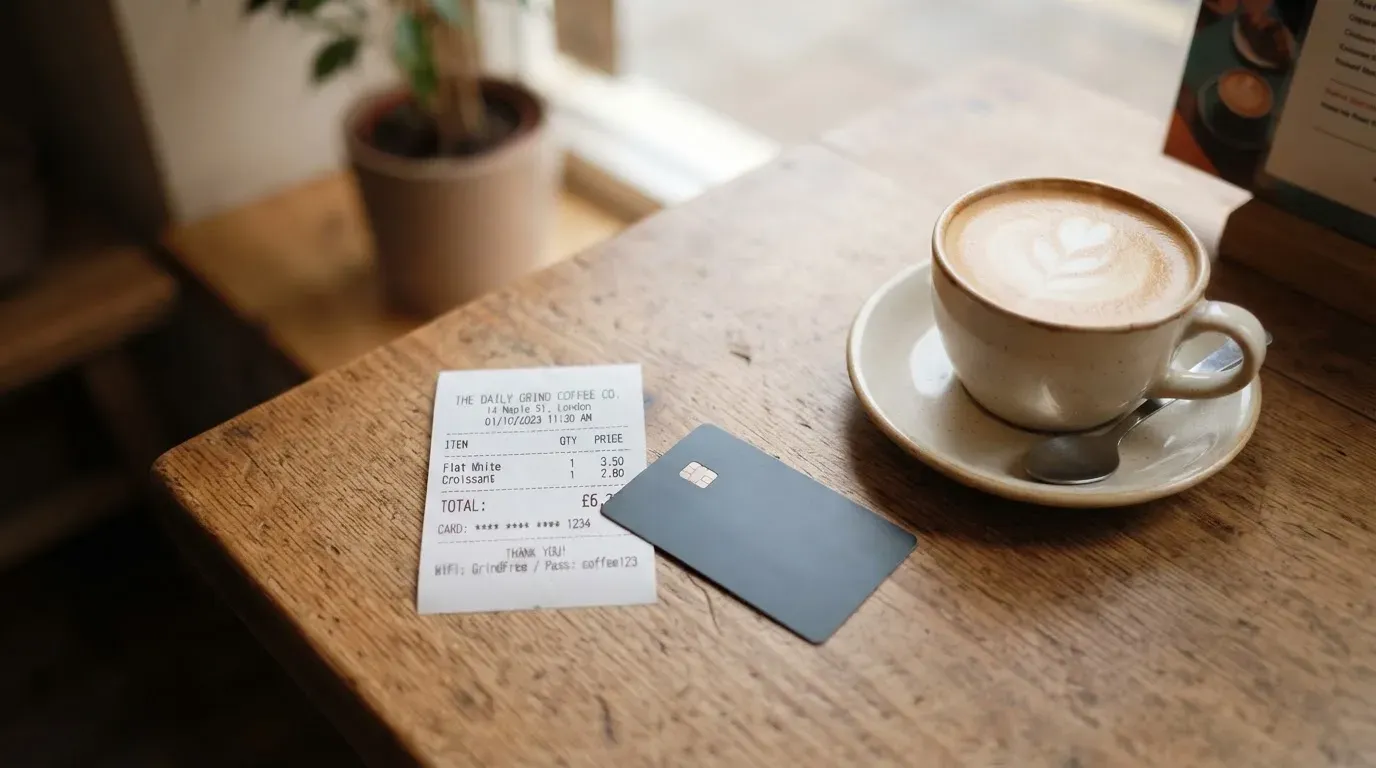
A 4 USD coffee. The 0.25 USD transaction fee is a flat charge that forms a large part of such a small purchase. Add a top-up at 4.5% and the small payment has cost you a significant percentage before the coffee exists. This is the card’s structural weakness: a flat per-transaction fee punishes small purchases, and no tier in the published data removes it.
A 60 USD grocery run. The 0.25 USD fee is a much smaller share of a larger purchase. With a 4.5% top-up on the money you loaded to cover it, the effective cost is moderate — tolerable, if not cheap. The Plus rate of 3% is where the subscription starts to look like it might pay for itself, though the unofficial figures for its price are not confirmed.
A 300 USD flight or a 900 USD laptop. The 0.25 USD becomes negligible and the top-up percentage dominates. Here the card is at its best, and the limits stop being a problem: 100,000 USD a month and 20,000 USD per payment cover either comfortably. A larger-ticket buyer with the verification to raise limits is the reader the economics fit best.
Two limits deserve a flag. The monthly spending figure of 100,000 USD on the site conflicts sharply with unofficial figures of 2,500 USD per month for the Online card, with NFC at 50,000 USD and NFC Plus at 100,000 USD, and payments up to 25,000 USD. Since the unofficial source disagrees with the site, I would plan against the smaller number until the card tells you otherwise in your own account. Also note the shape of the limits: they rise with verification and with Plus, which means the highest ceilings sit behind both a document check and a subscription.
Top up: how the money gets in
Two routes, and only two. You can deposit cryptocurrency — USDT, according to the card’s starting data — or you can receive money from another Flowbit user by card number or by FlowID. The minimum top-up is 10 USD and the fee starts at 3%. Who pays the network fee is not stated.
The network question is the one to sit with. The site does not name the network it expects, and unofficial sources say USDT on TRC-20 and SBP. This matters more than it looks, because a transfer sent on the wrong network is an expensive mistake: blockchain transfers are irreversible, so funds sent to an address on a network the provider does not support can be lost entirely or need manual support recovery with no guarantee. If you are new to this, copy the deposit address and network from inside the app rather than from a guide, and check the network field every time — the same address can exist on several chains and the wrong one does not warn you.
There is a second route to your balance that deserves attention because it is the one people forget to ask about: getting it out. The site does not describe withdrawals at all. The Terms say that closure and return of a remaining balance are subject to the Terms, to obligations, to risk review and to the law, and they say plainly that the Virtual Balance is not a bank deposit. Read that as what it is: money you have loaded is not the same as money in a savings account, and there is no deposit guarantee behind it.
Paying with it every day
Day to day, the card is a virtual card with one useful extra: Apple Pay and Google Pay are supported on Flowbit NFC. That matters because a virtual card number typed into a checkout is an easy thing for a merchant to decline, while a tokenised wallet number behaves like any other contactless card. Adding it to your phone’s wallet is the most reliable way to pay in person.
The rewards are modest and simple: 0.25% cashback on every purchase, higher with Plus, plus a referral programme. There is no more elaborate scheme to learn.
Everything runs inside the Flowbit app in Telegram. Store ratings could not be found, and one unofficial source reported the Google Play listing unavailable while the App Store listing worked — worth knowing if you are on Android, though again, unconfirmed by the card.
Two day-to-day constraints deserve their own attention. First, unofficial reporting suggests the provider may restrict particular merchants, category codes, countries, and whole categories such as gaming, subscriptions, marketplaces and crypto services. That is a policy the issuer can change, and it is the kind of thing that only reveals itself when a payment fails. Second, disputes are expensive: the fee is 45 USD per disputed transaction, there is no automatic refund, refunds are not guaranteed and may be reduced by fees, and the liability cap is the lesser of three months’ fees or the available balance. Read that cap carefully if you are a heavy spender. Three months of fees is a small number against a large balance, which means the practical protection on a big balance is thin.
What can go wrong
The failure modes here are mostly not about fraud. They are about dependencies.
You do not know who stands behind the card. Flowbit says a partner bank processes transactions, and that a partner bank does the custody work, but it does not name the issuing bank and it does not clearly state custody. The card is issued by third-party issuers and BIN sponsors whose names are not on the pages I read. When you load money, you are extending credit to a chain of unnamed companies in an unnamed jurisdiction.
The country list is not on the main pages. Restricted countries and prohibited uses are in a separate document. If you are in one of them and discover it late, the money is already gone.
Wrong network, irreversible loss. Sent on an unsupported network, a crypto transfer does not bounce back. There is no chargeback mechanism for a blockchain transaction.
Balances are not deposits. The Terms are explicit that the Virtual Balance is not a bank deposit, and that what you get back on closure depends on obligations, risk review and the law.
Merchant-side declines. Address verification is mostly offered in the US, Canada and the UK and is generally unavailable for foreign-issued cards, which causes declines. Some merchants decline prepaid or foreign-issued cards outright, because the BIN lookup reveals the card type and the issuing country — which is also why a card issued in one country can look “foreign” to a shop in another. A failed authorisation can leave a hold on your funds for several days, sometimes up to seven.
No complaints record to check. No Trustpilot or Reddit page for Flowbit Finance could be found in a search run on 2026-10-21, and no official incident surfaced. That cuts both ways: there is no documented disaster, and there is also nothing reassuring to read. An absence of reviews usually means the service is young or small, not that it is clean.
Support is a Telegram bot. Plus members are promised priority and advertised 24/7 support; the language is not stated. If you are dealing with a lost balance or a blocked payment, a bot is what you are dealing with.
Set against all that, what the card does say: it says it does not store funds, card details or sensitive personal data, and that a partner bank processes transactions. That is a real reassurance about its own systems, and it is not the same as a guarantee about your money.
What to take instead
If Flowbit’s shape is right but its specifics are wrong, there are three other Telegram-first cards worth comparing. I have kept the same fields so you can see where each one is clearer or cheaper than Flowbit.
| Flowbit | Azul Card | Telecard | OnCards | |
|---|---|---|---|---|
| My score | 5.2 / 10 | 5.3 / 10 | 6.1 / 10 | 4.6 / 10 |
| Card | Virtual Online and NFC; network not stated | Virtual only; works anywhere Mastercard is accepted | Virtual Mastercard, instant; no physical or metal | Virtual Mastercard / Visa in Telegram; network not fixed |
| Issuance | 9.99 USD | 20 USD, refunded after 2,000 USD of spending | Standard 5 USD; VIP 49 USD then 19 USD per month | Not stated |
| Monthly fee | Plus lowers fees; price not on the site (4.99 USD per month, unofficial) | 5 USD | None on the basic plan, per the main page; VIP 19 USD | Not stated |
| Top-up fee | From 3% (4.5% base) | 4% | Deposit fee advertised as 0% | Not stated |
| Per transaction | 0.25 USD | 0.25 USD | Gas fee 0.5 USDT per successful card transaction | Not stated |
| FX | Not stated on the site | Not stated | 1.5% on non-USD payments; FX and cross-border fees “up to 3% each” | Not stated |
| Funding | USDT; network not stated on the site | Crypto sent to the card in Telegram; coins and networks not named | USDT on TRC-20 or ERC-20; USDC on ERC-20; Polygon not supported | USDT BEP20 only; bank transfers not accepted |
| Cashback | 0.25% per purchase, higher with Plus | Not stated | Cashback via referrals; rate not specified | Not stated |
| Countries | “Works worldwide”; regions “growing”; restricted list in separate rules | Worldwide except Russia, Belarus, North Korea, Iran, Syria, Cuba, Sudan, Venezuela, Ukraine and the Crimea, Donetsk, Luhansk, Zaporizhzhia and Kherson regions | Over 150 countries; only US-sanctioned users barred | Not stated |
Azul Card scores a hair above Flowbit and is more transparent in the places Flowbit is vague: it names the network, names the maintenance fee, and publishes the excluded countries, including the note that restrictions apply regardless of nationality. Its virtual card costs 20 USD but that is refunded after 2,000 USD of spending, which changes the maths considerably for an active user. Its top-up fee, 4%, is higher than Flowbit’s stated floor, and it still has the same flat 0.25 USD per transaction.
Telecard is the strongest of the four on documentation and the only one that names its networks: USDT on Tron or Ethereum, USDC on Ethereum, with Polygon explicitly not supported. Its costs are layered differently — 5 USD standard, a VIP tier, 1.5% currency conversion on non-USD payments, up to 3% FX and cross-border fees each, and a gas fee of 0.5 USDT per successful transaction. There is also a 99 USD minimum deposit to activate, which the site states is “NOT a fee” because it stays in the wallet — but it is money you cannot withdraw while it sits there. Telecard is also the vaguest on countries: over 150 where Mastercard is accepted, no published exclusion list, and only US-sanctioned users barred in the Terms.
OnCards is the thinnest of the four. It says fees are simple with no hidden charges and gives no amounts at all, it takes USDT on BEP20 only with no bank transfers, and it publishes no country list. I scored it 4.6 because “not stated” repeated often enough stops being a neutral answer and becomes a risk you are carrying yourself.
The pattern across all four is worth naming: none of them is a bank, all four rely on the card networks rather than issuing directly, and each one makes you deposit rather than linking an account. The real differentiators are which networks they support, whether they name their country restrictions, and what the all-in fee looks like at your spending level. Flowbit wins on immediate Telegram-native access and loses on named detail.
Who I would recommend it to
I would recommend Flowbit to someone specific: a Telegram user with USDT already in hand, who needs a virtual card number today, who is comfortable that the issuing bank and the restricted-country list are not published, and who mostly spends either very small amounts knowing the 0.25 USD will bite, or large amounts where it will not.
I would not recommend it to someone planning it as their everyday card. A flat 0.25 USD per transaction plus a 4.5% base top-up is a real drag on ordinary spending, the Plus subscription exists precisely because the base rate is thin, and its price is not published. I would also not recommend it to anyone whose country might be on the restricted list and who has not read that document, or to anyone whose balance is large enough that the 45 USD dispute fee and the liability cap — the lesser of three months’ fees or your balance — would matter. And if the reason you want this card is that a bank card has been refused to you, weigh it against Telecard, which publishes its networks and its exclusion bar more plainly, at the cost of a more complicated fee stack.
One background point applies to all of these and is worth holding in mind. Visa and Mastercard do not issue crypto cards to consumers; they license issuers, and they can suspend a programme. Visa terminated its global agreements with FTX on 13 November 2022 and the FTX US debit card programme was wound down by its issuer. WaveCrest, a Visa issuer that supplied crypto card brands, was suspended by Visa in Europe in 2018, closing all WaveCrest-issued Visa programmes. When you hold one of these cards, you are holding a programme, not just an account — and programmes end. How that typically goes: a notice period, then loading and spending stop, then users are asked to withdraw remaining balances.
On taxes, one thing only: if you are charged on your crypto gains where you live, spending from a crypto-funded card can be treated as a disposal at the value on the transaction date, so each payment may be a separate taxable event. That is a question for a professional in your jurisdiction, not for me.
Frequently asked questions
What is the Flowbit card?
Flowbit is a virtual payment card delivered inside a Telegram app. You register, receive a card number immediately, load it with cryptocurrency — USDT by the card’s own starting data — and spend the resulting balance online. There is no physical card and no shipping. Two products exist: Flowbit Online and Flowbit NFC, the latter supporting Apple Pay and Google Pay. The card is issued by third-party issuers and BIN sponsors.
Is Flowbit a bank?
No, and it says so itself. Flowbit Finance LLC-FZ is a UAE company, and its Terms state that it is neither a bank nor a card issuer. It says a partner bank processes transactions, but it does not name the issuing bank. Its app is the front end of someone else’s card programme, which matters most in a dispute and at closure, when your balance is not a bank deposit.
Does the Flowbit card require KYC?
Usually not for basic use. The site speaks of a simple verification process and separately of no extra documents, and the Terms say basic use does not require full identity verification in most cases. Extra checks on identity, device or source of funds may still be requested to raise limits or to review a dispute. There are no published verification tiers.
Is the Flowbit card free?
No. The Online card costs 9.99 USD to issue. Unofficial figures put the NFC card at 19.99 USD and the Plus subscription at 4.99 USD per month, though the card’s own pages do not publish the Plus price — they only say it lowers fees. Every transaction also costs 0.25 USD, which is where small purchases get expensive.
How do I top up the Flowbit card?
Two ways: deposit cryptocurrency, USDT per the starting data, or receive money from another Flowbit user by card number or by FlowID. The minimum top-up is 10 USD and the fee starts at 3%, against a 4.5% base rate. The site does not name the network; unofficial sources say USDT on TRC-20. Check the network every time — a transfer on the wrong chain is irreversible.
Can I use the Flowbit card in my country?
Probably, but do not take “works worldwide” as the whole answer. The Online card is described as working worldwide with regions “growing”, while restricted countries and prohibited uses are set out in a separate rules document that the main pages do not reproduce. Find and read that document before you load any money, because by the time a transfer is rejected the funds are already gone.
Where can I use the Flowbit card?
Anywhere the card network is accepted online, plus contactless payments if you add Flowbit NFC to Apple Pay or Google Wallet. Two caveats: the issuing network is not stated on the site, and unofficial reporting says the provider may restrict certain merchants, category codes, countries, and categories such as gaming, subscriptions, marketplaces and crypto services. Declines are part of the day-to-day experience.
How do I withdraw money from Flowbit?
The site does not describe withdrawals at all, which is the honest answer. The Terms say that closure and return of a remaining balance depend on the Terms, your obligations, risk review and the law, and that the Virtual Balance is not a bank deposit. If being able to pull your money back out is important to you, find out how before you load, because the published pages do not tell you.
Is the Flowbit card safe?
Judge it as a programme, not a bank account. Flowbit says it does not store funds, card details or sensitive personal data, and a partner bank processes transactions. But custody is not clearly stated, the issuing bank is unnamed, and no Trustpilot or Reddit page for Flowbit Finance could be found in a 21 October 2026 search. Disputes cost 45 USD each with no automatic refund, and liability is capped at the lesser of three months’ fees or your balance.
Is the Flowbit card worth it?
For large payments, yes, marginally: the 0.25 USD fee becomes negligible against a 100,000 USD monthly limit. For small everyday purchases, no — 0.25 USD on a 4 USD coffee is over six percent, before the top-up fee. It is worth it if you already hold USDT and want to spend it without a conversion step. If you want cheap everyday spending, compare Telecard or Azul Card before committing.
Virtual cards: your questions answered – cryptocardanswers
Content created by the «cryptocardanswers» team