
A mining-linked card with a cashback twist and a lot of unstated numbers
 Available in US
GoMining is best known as a bitcoin mining company, and the card it offers sits alongside that business rather than beside it: a virtual card you load with crypto and spend like an ordinary payment card, with cashback that arrives as mining power instead of money in your account. That one feature explains both what is attractive here and what is hard to judge. On my scale the card comes out at 6.6 out of 10 — a middle-of-the-road score, not a warning and not an endorsement. It is a reasonable fit for someone already inside the GoMining ecosystem who wants their everyday spending to feed the mining side of the account. For anyone choosing a card because they need a reliable way to pay, the card’s own pages leave too much unsaid for me to recommend it without caveats.
The conditions described below are current as of October 28, 2026.
The score, and who the card is actually for
| Criterion | Mark | Why I gave it that |
|---|---|---|
| Who can get it | 8 / 10 | The card states that products may not be available in your jurisdiction and that eligibility and regional availability apply; the country list itself is not published |
| Cost | 5 / 10 | Issuance and fees are not disclosed; opening a card grants a free 1 TH miner, and cashback of up to 5% is paid in mining power |
| Top-up options | 7 / 10 | Top up with BTC, USDT, GOMINING and other coins; an earlier check found funding from the GoMining wallet, and networks are not named |
| Reliability and complaints | 6 / 10 | Issued by Unlimit under e-money licence No. 115.1.3.7 of the Central Bank of Cyprus, funds on a segregated account, deposits not insured; one outside reviewer has called the wider GoMining model a possible Ponzi scheme |
| Everyday use | 7 / 10 | Virtual card now, physical card described as coming soon; Apple Pay and Google Pay work, cash withdrawals on the virtual card, no plastic in hand yet |
Total: 6.6 / 10.
Who this suits: GoMining users who want cashback paid in mining power. If your money is already in that ecosystem and you like the idea that spending earns you hash rate rather than a bank rebate, the fit is real, and the free miner on opening is a genuine sweetener. Who it does not suit: anyone who needs published fees, published limits, or a plastic card they can hand over at a till. The physical card is still described as coming soon, so if paying in person at a shop that wants to swipe something is part of your week, you are waiting on a promise.
I want to be clear about what that 6.6 is measuring. It is a score for the card, not for the mining business or for the wider platform, and the two are entangled in how the card is marketed. Where an outside opinion touches the company rather than the card, I note it and keep it separate.
Will they give you the card?
The short answer is: probably, but the card does not tell you the list. Eligibility and regional availability are stated as conditions, and the products may not be available in your jurisdiction. There is no published country list, so I cannot tell you from the card’s own pages whether your country is one of the open ones. An earlier check of the same material recorded the position as worldwide except prohibited jurisdictions — that is useful context, but it is not what the card currently publishes, so treat it as background rather than as a promise.
The practical consequence for you is this: you will not find your answer by reading. You will find out by applying and seeing. That is a weaker position than you would be in with a card that prints its eligibility rules, and it is the single biggest reason I held the score down. If your country has a history of being restricted by card issuers, or if you travel and need the card to work in several places, the absence of a list is a practical problem, not a technicality.
Identity checks are the other half of this question. The card pages do not state what KYC is required, and an earlier check recorded Basic and Advanced levels. I am not going to fill that gap with guesses. What I can tell you is what applies generally, because it applies to any regulated issuer: due diligence covers your identity, your address, your date of birth and nationality, a sanctions check, and a judgement about whether you are a politically exposed person. Nationality is screened separately from address, because sanctions screening is often applied to citizenship and country of birth as well as where you live. Where due diligence cannot be completed, the institution is expected to hold off, and accounts can be frozen pending documents. Cards of this kind are generally for adults aged 18 and over.
None of that is a warning about GoMining specifically. It is the shape of the process you are entering when an e-money institution issues a card, and knowing it in advance saves you from being surprised by a document request.
How to get it
You apply at the GoMining banking card portal. That is the route the card publishes, and it runs through the GoMining app rather than a separate card website — which tells you something about how the card sits inside the wider platform.
Three things you should know before you start, all of them from the card’s own pages and none of them glossed over. First, you get a virtual card now; the physical card is described as coming soon. Second, the card network is not stated, and neither is the card currency, so I cannot tell you whether it runs on Visa or Mastercard or which currency it settles in. Third, delivery terms are not stated, and they cannot be while there is no plastic to deliver. Identity-check levels are not stated either.
What that leaves is a fairly thin picture, and I would rather show it to you than fill it in. You are applying for a virtual card inside a mining platform, with terms that the platform has not spelled out. If the fee schedule matters to you, ask before you apply. If the network matters to you — because of a merchant you use that accepts one network and not the other — that is a question to ask too.
What it really costs: Fees, limits and the numbers that are missing
I want to be blunt about this section, because it is the weakest part of the card and the part that most affects your money. The card does not publish what it charges. Not the issuance fee, not the monthly fee, not the conversion rate, not the foreign-exchange spread, not the ATM fee, not the limits. That is not a formatting gap; those are the numbers that decide whether a card is cheap or expensive for how you actually spend.
So instead of a fee table with invented entries, here is the honest version — what is stated and what is not:
| Fee or limit | What the card states |
|---|---|
| Issuance | Not stated. Opening a card grants a free 1 TH miner |
| Monthly fee | Not stated |
| Conversion | Not stated |
| Foreign exchange | Not stated |
| ATM withdrawals | Cash withdrawals available on the virtual card; worldwide on the physical card when it arrives. Fee and allowance not stated |
| Daily limits | Not stated |
| Monthly limits | Not stated |
| VIP tiers | VIP levels raise cashback; thresholds not stated |
| Card currency | Not stated |
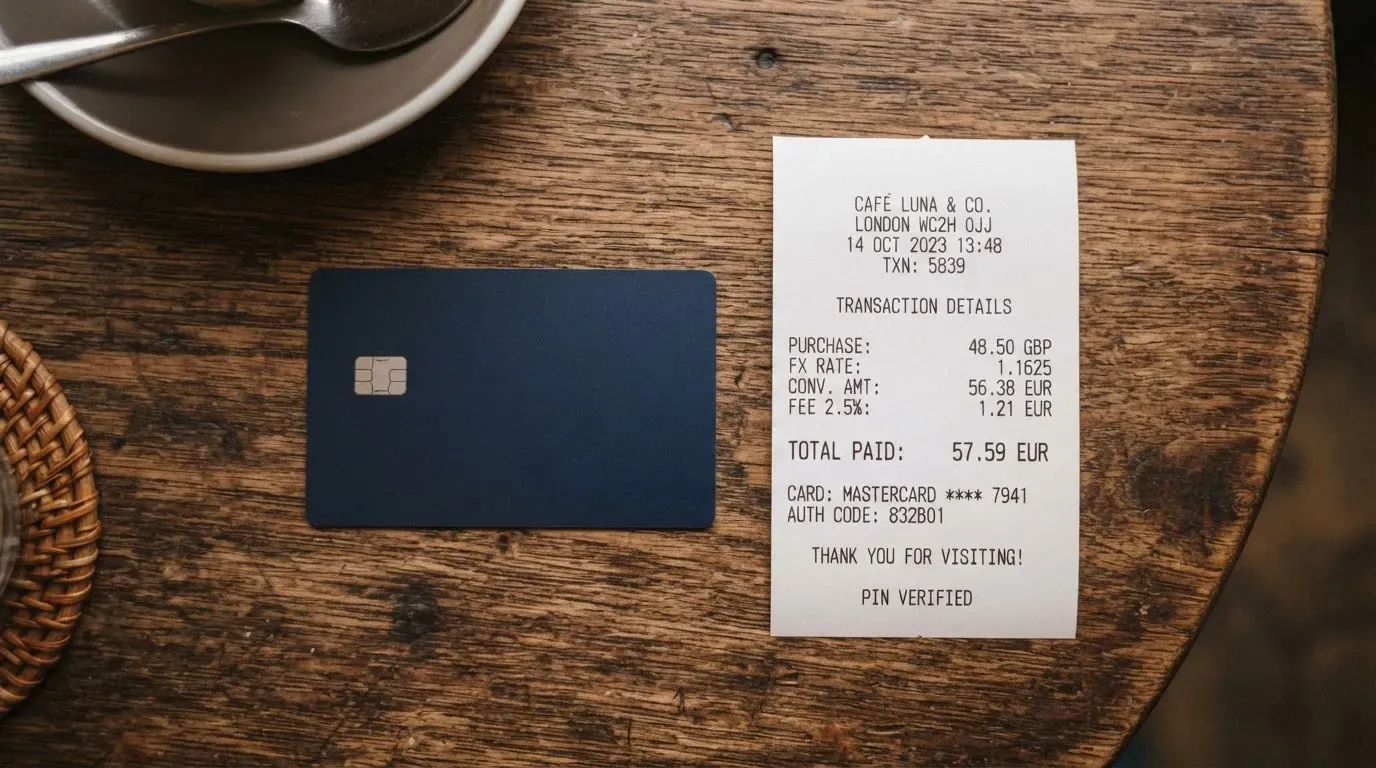
Three everyday payments, so you can see how the missing numbers would bite. Pay for a coffee: the merchant charges you a price in their local currency, your card converts what is left into that currency, and you eat both a conversion cost and possibly an FX spread — neither of which the card quantifies. Pay for something priced in dollars while your balance sits in another currency: same problem, and on a card whose currency is not even published you cannot predict the direction. Withdraw cash from an ATM: possible on the virtual card, but the fee and the allowance are unstated, so you do not know what one withdrawal costs or how many you get.
None of this means the card is expensive. It means you cannot find out from the card. For a spend of a few hundred a month the difference matters less than for someone paying rent or wages, and for the heavier spender the missing conversion and FX numbers are the ones to chase before committing.
There is a category-level point that is not the card’s fault. On-chain network fees — gas, or bandwidth on networks that price it that way — are charged by the blockchain for your deposit, not by the card provider. So even a card with a zero conversion fee can still cost you something to get money in, and that cost is invisible in the card’s own pricing.
The rewards side deserves its own paragraph, because it is where the card is most unusual. Cashback is paid in mining power, not in money, and the rate rises with your VIP level; the card quotes up to 5% cashback. So when you spend, what returns to you is hashing capability, which only means something to you if you value mining output. If you wanted a rebate you could spend again, this is not it. And “up to” is doing real work in that sentence — the rate you actually get depends on a VIP tier whose thresholds the card does not publish.
How to top it up
Top up with BTC, USDT, GOMINING and other coins. An earlier check recorded funding from the GoMining wallet, and the card’s current pages do not say more than that. Top-up fees and limits are not stated, and neither are withdrawal terms.
The unstated part here is the part that costs people money: the network. When you send USDT you choose a chain, and the choice is not cosmetic. USDT exists on networks including Ethereum, Tron, Solana, Polygon and Avalanche. Send on one network to an address meant for another and the transfer does not bounce politely — it can be lost or need manual recovery, with no guarantee. Ethereum charges gas paid only in ETH, so a wallet holding USDT with no ETH cannot send it at all. Tron prices its fees through bandwidth and energy and often burns TRX. And not every combination exists: Circle stopped supporting USDC on Tron in February 2024, so USDC over TRC20 is not a native option.
Before your first transfer, check three things: which networks the card names for the coin you are sending, whether you hold the network’s own fee token, and whether the address you are copying matches the network. The card does not publish the networks, so you are relying on the app or support to tell you — and that is worth a conversation before, not after, you send.
Paying with it every day
Day to day, the virtual card works like this: Apple Pay and Google Pay on the virtual card, cash withdrawals at ATMs, and spending from the balance you loaded. Blocked merchant categories are not stated. If you spend at a gambling site or somewhere else issuers commonly restrict, you do not know in advance whether this card will decline it — the merchant category code system classifies businesses into four-digit categories, and restriction lists differ from issuer to issuer.
The GoMining app for iOS is where you manage this (App Store id1622100275). I did not read the app store ratings, and app store reviews are undated and mixed: one Russian-language reviewer calls returns poor while others praise payouts. Treat that as a user report, not a measurement.
Two things about everyday use that are worth your attention beyond convenience. First, a card from one country can look foreign to a shop in another. The first six or eight digits of a card number identify the issuing institution, and merchants can look that up; if the issuer’s country differs from your billing address, the payment may attract extra scrutiny or simply be declined. This is a general property of cross-border cards, not a complaint about this one, but it is the most common reason a perfectly good card fails at a till. Second, a declined authorisation can leave a hold on your balance for several days, in practice up to seven, which can be confusing if you are living off a small loaded balance.
Apple Pay itself is well built: it replaces the card number with a device-specific number kept in the phone’s secure hardware, never on Apple’s servers, and each payment carries a one-time code. The issuer can also restrict a tokenised number — blocking it on magnetic stripe or phone use, for instance. None of that weakens; it is just how mobile card payment works.
What can go wrong
Start with the structure, because it decides who answers you when something breaks. The card is issued by Unlimit under electronic money institution licence No. 115.1.3.7 of the Central Bank of Cyprus, with the services tied to GoMining (Cyprus) Limited. Funds are said to be held in a segregated account protected from Unlimit’s creditors in insolvency, and the card describes its protections as advanced security measures. Two-factor authentication and instant card freeze are not stated. Importantly, the funds are not covered by the Cyprus Deposit Insurance System — this is e-money, not a bank deposit, and an e-money institution must safeguard customer funds by segregating or insuring them, which is a different thing from a deposit guarantee scheme.
That distinction is worth a moment’s thought. A deposit guarantee scheme pays you a defined amount if a bank fails. A segregated account at an e-money institution means your funds are set aside rather than commingled with the firm’s own money. It is a real protection and it is not the same promise. You should hold the difference loosely rather than tightly.
Support exists as an FAQ and a contact page. Languages and opening hours are not stated.
On complaints, I found no official card incidents and no Trustpilot page for the GoMining website. What I did find is a February 2026 ScamMinder review that questions GoMining’s transparency and sustainability and calls the model a possible Ponzi scheme. That is a single outside opinion about the wider business, not about the card, and opinions like that are not evidence. But it belongs here, because the card is an interface into that business, and you should decide with it in view rather than discover it later. A 2025-era announcement about 5% cashback on purchases with GOMINING on TON was a past promotion, not something on offer now.
Finally, the card-programme risk that belongs to this whole category. Card networks do not issue crypto cards themselves; they license issuers, and they can suspend a programme. Visa terminated its global agreements with FTX in November 2022 and the FTX US debit card was wound down. Visa suspended WaveCrest in Europe in 2018, closing all WaveCrest-issued Visa programmes. Closures generally follow a pattern: notice, then spending and loading stop, then you are asked to withdraw what is left. One 2026 closure reported by a secondary source ended new loads on 8 July 2026 and spending on 8 August 2026 — a single unconfirmed source, and I include it as a shape rather than a fact. If a crypto card programme is wound down, the inconvenience falls on you, not on the company.
And the counterparty risk behind all of it. Custodial platforms have a history: Mt. Gox reported about US$350 million stolen across 2011 to 2014, Coincheck about US$400 million in 2018, Ronin Network US$625 million in 2022. Crypto transfers are typically irreversible and a stolen key has no recovery, because the network cannot freeze or return funds. Tether also says it disables tokens in wallets on the OFAC sanctions list and has frozen funds tied to illicit activity — so stablecoins are not censorship-proof in either direction.
What to take instead
I looked at three other cards in this space, and none of them is a clear upgrade — they trade the same unknowns for different ones. Here is the comparison as published:
| GoMining | Greencart | Kinesis Virtual | Young Card | |
|---|---|---|---|---|
| Score | 6.6 / 10 | 6.9 / 10 | 4.8 / 10 | 5.7 / 10 |
| Who can get it | Country list not stated; availability by jurisdiction | EEA countries plus Argentina, Bolivia, Brazil, Colombia, Mexico per Gnosis Pay’s eligible-countries list; 18+; sanctions screens apply | Not stated on the page read; starting data says United States, Latin America and the Caribbean | Not stated |
| Card | Virtual now, physical coming soon; network and currency not stated | Visa card powered by Gnosis Pay; virtual cards free, physical may carry a one-off admin fee | Virtual card; network not stated officially | Not stated officially |
| Cost | Not stated; free 1 TH miner on opening | No hidden, monthly or annual fees; optional Greencart+ at USD $7.99 monthly or USD $79.99 yearly, $4.99 for the first two months; App Store lists Greencart Max at $350.00 | Not stated | Not stated |
| Fees | Not stated | Site states no fees for withdrawals, transfers, deposits or FX | Not stated; site links a general fees page that was not read | Not stated |
| Top-up | BTC, USDT, GOMINING, other coins | Bank account or crypto wallet, fiat or crypto; spends from a self-custodial Gnosis Pay Safe | Instant conversion of gold, silver, crypto and C1USD at the point of sale from the Kinesis account | Not stated for the card itself |
| Rewards | Up to 5% cashback paid in mining power; rate rises with VIP level | Floor of 0.5% in B3TR per purchase, rising with staked B3TR and GreenCart+ up to a 4% ceiling; caps of $40 per transaction and $40 per month; 48 categories earn none | 2% cashback in gold; access to the cashback plan six months free from launch | Paid in YNG tokens by Club tier: Essential 0.1%, Gold 1.8%, Platinum 3.6% |
What jumps out. Greencart is the only one of the four that publishes its prices and its country list, and the only one that spends from a self-custodial wallet, meaning the crypto stays under your control until the moment of payment. Its catch is the self-custody itself — you bear the risk of losing your key or pasting a hijacked address — and the reward caps are modest and category-limited. Its own numbers also disagree between the site and the App Store listing, which is worth noting as a general caution about cashback advertising: the site describes a 4% ceiling, the App Store text says up to 8% and partner purchases up to 15%.
Kinesis pays you in gold rather than mining power, which is a more conventional reward but still not cash. Young Card pays in its own token across Club tiers. Neither publishes enough for a confident comparison on fees.
My honest read: if the reason you are here is that mining-linked rewards appeal to you, GoMining is coherent and the free miner on opening is a real, specific benefit. If the reason is a dependable way to pay, Greencart publishes more and costs you more attention to custody. And if your priority is a card you understand, none of these is fully transparent — which is the nature of this category in 2026.
Who I would recommend it to
I would recommend the GoMining card to someone already holding a GoMining balance who wants their ordinary spending to convert into mining power, and who is comfortable that the reward is hashing capability rather than money, and who can live with a virtual-only card for now.
I would not recommend it as your primary everyday card. Three reasons, in order of weight. The price of using it is not published — no fee, no conversion rate, no FX spread, no limits — so you cannot predict your own cost. The physical card does not exist yet, which matters if you pay anywhere that wants plastic. And the platform behind it has drawn a public accusation of being a possible Ponzi scheme from a third-party reviewer; I am not treating that as established, but I also would not tell a reader to put their everyday money behind a business that has been characterised that way without seeing it themselves.
If you read one thing from this review, read this: the missing numbers are not a formatting problem, they are the product. A card can be excellent and unpublished, but then you are trusting a company’s silence rather than its disclosure. Ask for the fee schedule and the limits before you load it with anything you would miss.
Frequently asked questions
What is the GoMining card?
It is a payment card issued by Unlimit and tied to GoMining’s mining platform, currently virtual, with a physical version described as coming soon. You load it with BTC, USDT, GOMINING and other coins and spend the resulting balance like an ordinary card. Its distinguishing feature is that cashback — quoted as up to 5% — is paid in mining power rather than money, so spending earns you hashing capability.
Does the GoMining card require KYC?
The card’s pages do not state its identity-check requirements, though an earlier check recorded Basic and Advanced levels. Any licensed e-money issuer must verify identity under anti-money-laundering rules, covering name, address, date of birth, nationality, documents, a sanctions check and politically-exposed-person screening. If checks cannot be completed, the issuer is expected to hold off.
Is GoMining a bank?
No, and the difference matters. The card is issued under an electronic money institution licence, No. 115.1.3.7 of the Central Bank of Cyprus, with services tied to GoMining (Cyprus) Limited. Funds are said to sit in a segregated account protected from the issuer’s creditors in insolvency, but they are not covered by the Cyprus Deposit Insurance System.
Is the GoMining card free, and what does it cost?
Opening a card grants a free 1 TH miner, which is a real benefit. Everything financial is unpublished: no issuance fee, monthly fee, conversion rate, foreign-exchange spread, ATM fee, or daily and monthly limits are stated. On-chain network fees for your deposit are also charged by the blockchain, separately from the card provider.
How do I top up the GoMining card?
You top up with BTC, USDT, GOMINING and other coins; an earlier check recorded funding from the GoMining wallet. Top-up fees, limits and withdrawal terms are not stated. Check which network to use before sending, because sending on the wrong chain can mean lost funds that only manual support might recover.
Which networks can I use to deposit?
The card does not name them, which is the problem. USDT exists on Ethereum, Tron, Solana, Polygon, Avalanche and others, and Ethereum fees are paid only in ETH. Circle stopped supporting USDC on Tron in February 2024. Confirm the network and the address with support before your first transfer.
Is the GoMining card safe?
There are real protections and real gaps. Funds are said to be held in a segregated account, and the card cites advanced security measures, but two-factor authentication and instant freeze are not stated, and deposits are not insured. A February 2026 third-party review calls the wider GoMining model a possible Ponzi scheme — an opinion, not a finding, but worth weighing.
Where can I use the GoMining card?
On the virtual card, anywhere a card is accepted in the currencies your balance covers, with Apple Pay and Google Pay supported, and at ATMs. Blocked merchant categories are not stated. Note that a card issued in one country can look foreign to a shop in another, and some merchants decline foreign or prepaid BINs.
Is the GoMining card worth it?
For someone already in the GoMining ecosystem who values mining-power rewards, the free miner and up to 5% cashback make it coherent. As a primary everyday card, the unpublished fees, the absence of plastic and the platform’s contested reputation make it hard to recommend. Decide by asking for the fee schedule first.
Does the GoMining card have physical or Apple Pay?
The virtual card works with Apple Pay and Google Pay today. The physical card is described as coming soon, with delivery terms not stated, so if paying in person with a physical card matters to you, you are waiting on that launch. Apple Pay itself stores a device-specific number in the phone’s secure hardware rather than on Apple’s servers.
Credit and cashback cards: your questions answered – cryptocardanswers
Content created by the «cryptocardanswers» team