
A USDC card that arrives as a number, not plastic
 Available in US
Immersve is not a bank and does not try to be one. It is a card programme: a Mastercard you add to your phone’s wallet, backed by USDC you send to a smart contract yourself rather than hand over to a custodian. That distinction decides almost everything else on this page — who it suits, what it quietly does not do, and why the fee schedule is so short.
I give it 7.1 out of 10. It is a clean, low-cost instrument for one specific person: someone who already keeps their own crypto wallet, holds USDC, and wants to spend it in Europe or Australasia without giving up control of the keys. If that is you, there is little here to argue with. If you are looking for an ordinary debit card with a plastic card in the post, spend caps you can see, and a support number, you will finish this page disappointed — and rightly so.
The conditions below are current as of October 28, 2026.
| Criterion | Mark | Why |
|---|---|---|
| Who can get it | 7 / 10 | Onboarding supported in 38 countries: EU, Switzerland, UK, Australia, New Zealand, Argentina, Brazil, Mexico, Chile, Colombia, Peru, Guatemala; United States listed as a Q1 2026 plan |
| Cost | 8 / 10 | No charges for application or issuance, and the pricing page says the service comes at no cost to cardholders; blockchain fees on top-up and a possible FX conversion fee still apply |
| Top-up options | 8 / 10 | USDC into a smart contract on Algorand, Arbitrum, Base, Ethereum, Polygon PoS, with conversion at authorisation; no other coin is named |
| Reliability and complaints | 7 / 10 | AFSL 545925 in Australia, NZ FSP1003031, contract audits by Hashlock, Red4Sec and Coinspect, Pera Card issued via Monavate UAB; no complaints found; the issuing bank is not named on the site |
| Everyday use | 5 / 10 | Digital Mastercard with Apple Pay and Google Pay; the app, physical card and ATM situation are not disclosed |
| Total | 7.1 / 10 | A specialist tool that does its specialist job well, and stops there |
A word on who wrote this. I did not apply for this card or hold USDC on any of these networks, so treat every figure below as something the card’s own public pages state — not as my own experience of paying with it. Where those pages are silent, I say so rather than filling the gap.
Will they give you the card
Yes, if you live in one of 38 countries, and no if you do not. That is the whole eligibility answer, and it is longer than most card pages.
Onboarding is supported in Argentina, Australia, Austria, Belgium, Brazil, Bulgaria, Chile, Colombia, Croatia, Cyprus, Czech Republic, Denmark, Estonia, Finland, France, Germany, Greece, Guatemala, Hungary, Ireland, Italy, Latvia, Lithuania, Luxembourg, Malta, Mexico, Netherlands, New Zealand, Peru, Poland, Portugal, Romania, Slovakia, Slovenia, Spain, Sweden, Switzerland and the UK. The page adds the United States in Q1 2026 and the MENA region “shortly after” — that is a plan, not a live opening, and I would not build a plan around it.
Before any of that, you pass identity verification. The card states plainly that “Verify your identity” is part of card creation, and it names its compliance partners: FrankieOne, Sumsub, Chainalysis. What it does not say is which documents you need, whether proof of address is required, what age applies, or whether there are verification tiers. On an electronic money licence in Europe, the pattern is usually name, address, date of birth, nationality, identity document, a sanctions check and a politically-exposed-person determination — but that is the general rule, not a promise about this card’s flow.
Citizenship is not the same question as residence, and that trips people up. Regulators screen nationality and country of birth separately from address, because sanctions lists and issuer risk policies follow the person, not the postcode. A card that supports 38 countries for residents may still refuse someone whose document comes from a restricted region. Nothing on the Immersve pages spells this out, so if your situation is unusual — a residence permit in one country with a passport from another — ask them before you invest an evening in onboarding.
| Question | What the card says |
|---|---|
| Where can I onboard? | 38 countries listed above |
| United States | Q1 2026 plan, not confirmed as open |
| MENA region | “shortly after”, not confirmed |
| Documents needed | Not stated |
| Proof of address | Not stated |
| Minimum age | Not stated; prepaid and debit cards are generally 18+ in this category |
| Citizenship rules | Not stated |
| Verification tiers | Not stated |
What this means for you. If you are in Germany, Spain, Australia or New Zealand with documents to match, the path is short. If you are in a country not on that list, nothing you do will help. If you hold a passport from elsewhere, treat that as an open question rather than a solved one.
How to get it
You do not apply to a bank; you create the card inside a partner app, verify your identity, and get a digital Mastercard number.
Immersve does not run a consumer app of its own for cardholders. Cards are surfaced through partner apps and dApps — Pera Wallet is the most visible example, with the Pera Card announced on Algorand in May 2025 and launched in Immersve’s licensed jurisdictions starting with the UK, Germany, Italy, Spain and New Zealand. Your route in runs through one of those partners, not through a website.
The card you get is a multi-use digital Mastercard. You add it to Apple Pay or Google Pay, and from there it works online and in stores. There is no physical or metal card mentioned for cardholders, and the currency the card is denominated in is not stated.
A practical sequence, roughly as the pieces fit together:
- Install a partner wallet that carries Immersve cards, such as Pera Wallet.
- Start card creation inside it and complete the identity check when prompted.
- Receive the digital Mastercard details and add them to Apple Pay or Google Pay.
- Fund the card by sending USDC to the smart contract on a supported network.
That last step is where most of the friction lives, and I would rather you saw it now than after you have bought something.
On activation: the pages do not describe a separate activation step, because adding a digital card to a wallet tends to be the activation. If you are unsure whether your card is live, the wallet’s card screen is the place to look rather than an email inbox. Two further gaps worth naming plainly. First, card delivery is not stated for cardholders — which only makes sense because there is no physical card, but I would not invent a posting timeline for you. Second, activation and verification levels are not stated, so do not assume a quick pass means your limits are set.
Fees: what it really costs
Free to open, free to hold, and then the small print arrives at the moment you spend.
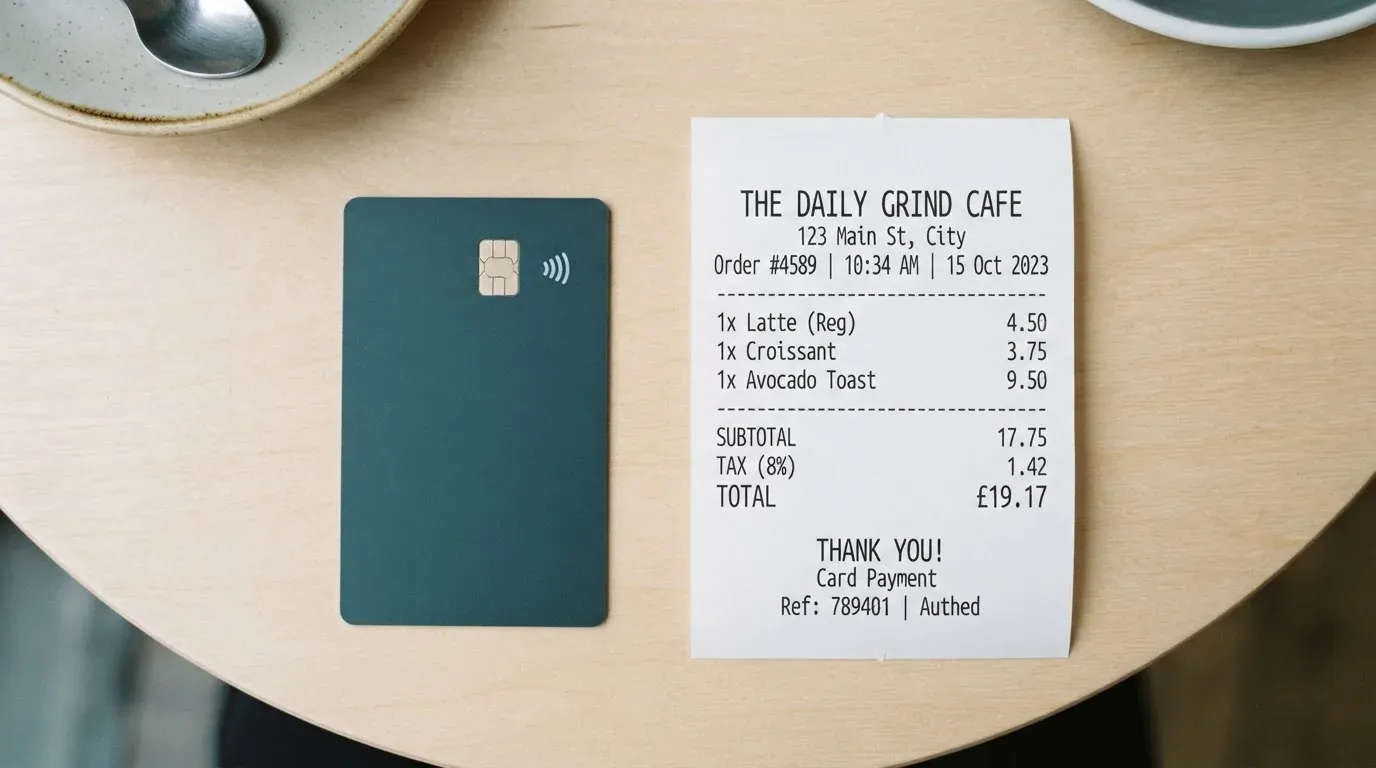
The costs page says there are no charges for application or issuance. The pricing page goes further: “The service is provided at no cost to either integrated dApps or to cardholders.” No monthly or annual fee is stated, and none is announced. That is genuinely better than most crypto cards, several of which either charge a large membership or bury the cost in NFT minting.
What is not free:
- Funding. Sending USDC to the smart contract is an on-chain transaction, and blockchain transaction fees apply. The network charges them, not the card provider — but they come out of your wallet.
- Currency conversion. “A foreign currency conversion fee may apply to foreign currency transactions.” The rate is not stated. Note the wording: *may*, not *will*, and not *is X%*. You cannot price this from the public pages.
| Fee or limit | Amount |
|---|---|
| Application | No charge |
| Issuance | No charge |
| Monthly or annual fee | Not stated |
| Service cost to cardholders | None, per the pricing page |
| Top-up | Blockchain transaction fees apply |
| Foreign currency conversion | May apply; rate not stated |
| ATM | Not stated |
| Spending limits | Not stated |
| Tiers | Not stated |
| Card currency | Not stated |
Now, three everyday payments, and which of those lines actually bites.
Buying coffee in your own country, card denominated locally. Nothing in the fee table applies. There is no monthly fee to begin with, no conversion if you are paying in your home currency, and no card-issuance cost. The only fee you have already paid is the network cost of the USDC transfer that funded the card. This is the case the card is built for, and it is cheap.
A subscription or an online service billed in dollars while you think in euros. The conversion fee may apply, and you cannot compute it from the public pages. What you can do is watch it once, note the rate in your own banking app, and then decide whether the subscription is worth moving elsewhere. Two further things may happen that are not fees at all: a declined payment can leave a hold on the balance for several days, and online merchants may apply extra checks to a card whose issuing country looks unfamiliar.
Spending in a third currency, or a payment you have to reverse later. Same conversion uncertainty, plus the dispute layer. Your complaint route depends on where you live: there are separate procedures for Australia, the EEA, the UK, and New Zealand, Latin America and other countries. Chargeback time frames are not stated, so if a dispute is likely — a large purchase, a deposit you might want back — do not assume the money returns quickly.
One thing I want to be straight about: I have left three cells reading “not stated” rather than guessing. ATM fees, spending limits and card currency are exactly the details a person needs to plan a budget, and their absence is a real weakness of the disclosure, not a formatting slip.
Top up: how the money gets in
One coin, five networks, and you do the transfer yourself.
You deposit USDC into a smart contract on Algorand, Arbitrum, Base, Ethereum or Polygon PoS. The USDC is converted to fiat at the moment the transaction is authorised — not when you top up. That timing matters more than it sounds: your exposure runs from the moment of funding until the payment goes through, not after.
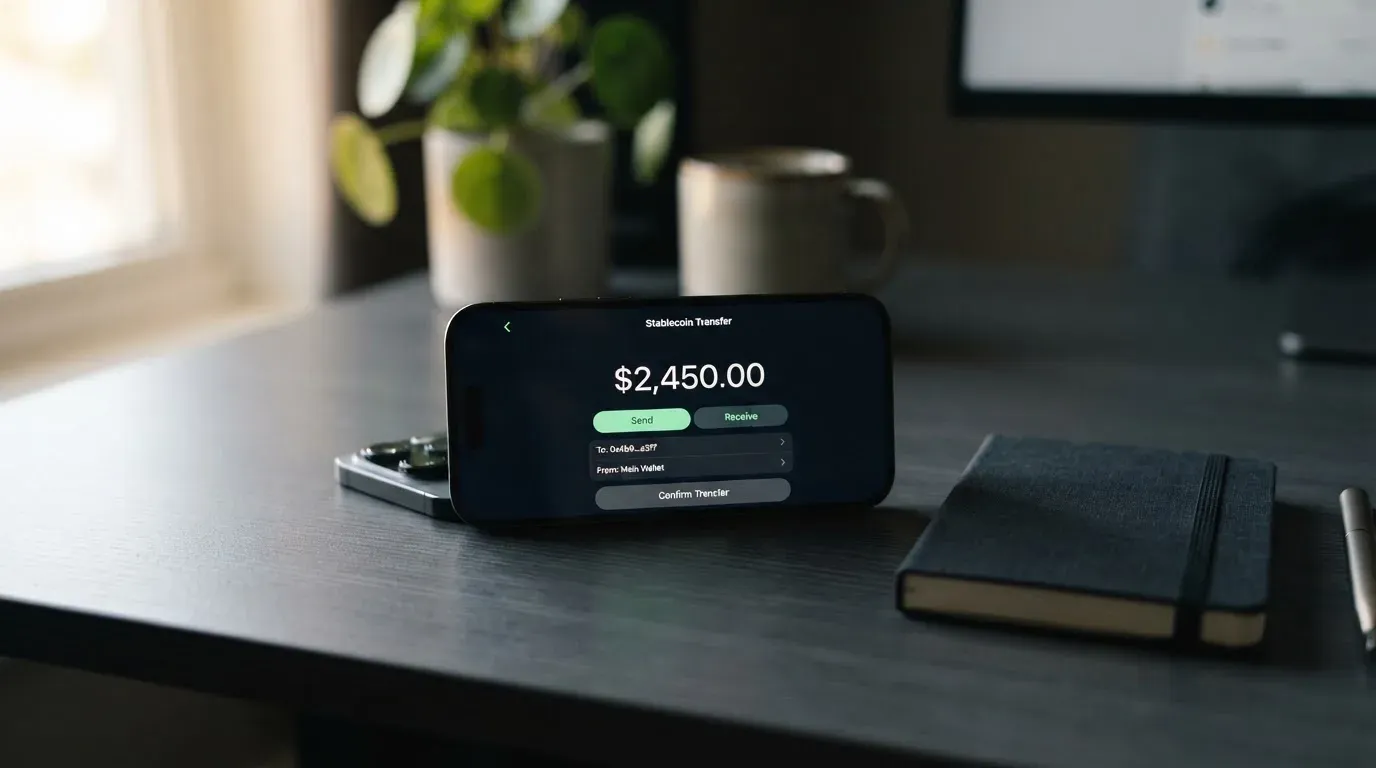
No other coin is named. There is no bank transfer route described, no card-to-card top-up, no minimum amount stated, no fiat top-up described, and cash-out is not stated. If you do not already hold USDC, or you would rather not touch a blockchain to buy groceries, this is where you stop reading and start looking at something else.
| Option | Detail |
|---|---|
| Coin | USDC |
| Networks | Algorand, Arbitrum, Base, Ethereum, Polygon PoS |
| Conversion point | At transaction authorisation |
| Blockchain fee | Applies |
| Minimum top-up | Not stated |
| Fiat top-up | Not stated |
| Other coins | Not named |
| Withdrawing money out | Not stated |
The fee to understand is the network one. Every network charges its own gas in its own coin, which means your wallet needs a small amount of that coin to make the transfer work at all. A wallet full of USDC on Ethereum with no ETH in it cannot send, no matter how much stablecoin is sitting there. That is a wallet-level constraint rather than an Immersve one, but it is where first-time users lose money and then write angry reviews about a card that did nothing wrong.
The second thing to internalise is that blockchain transfers are effectively one-way. If you send USDC on a network the card does not support, or to an address belonging to a different network, the funds can be lost outright or need manual recovery with no guarantee of success. Double-check the network and the address in your wallet before you confirm, every time.
A final asymmetry worth noticing: the card takes crypto in and gives you card spending out, but nothing on the public pages describes getting money back off the card. If you are planning around a stream of income paid to this card, ask about withdrawal first — it is the question most likely to change your mind.
Paying with it every day
It works wherever contactless and online card payments work, and it is entirely digital.
You add the card to Apple Pay or Google Pay and tap. Apple Pay replaces your card number with a device-specific number kept in the phone’s secure hardware, with a fresh security code on every payment, so the card number itself is not floating around. Inside that familiar mechanism, the money comes from the USDC you loaded through the smart contract, converted at authorisation.
Here is the honest part. The app is not stated — cards reach you through partner apps, so the software you will actually use is not Immersve’s own. Blocked merchant categories are not stated, and that is not a small thing: gambling, for example, is typically blocked by policy on cards like this, but the blocked list varies by issuer and I cannot tell you what Immersve’s policy is. Rewards are not stated, so assume there is no cashback unless you have seen otherwise in the app in front of you.
Everyday friction is otherwise ordinary card friction, and it is worth knowing about before it happens to you:
- Merchants can look up the BIN — the first six or eight digits of your card number — and see which institution and country issued it. If that differs from your billing address, some shops apply extra scrutiny.
- Address verification compares the numeric parts of your billing address with your issuer’s records. It is mainly offered in the US, Canada and the UK, and it often does not work for foreign-issued cards, which can cause declines.
- 3-D Secure adds an identity step to online payments: either frictionless approval, or a one-time code or biometric challenge.
- A declined payment can leave a hold on your balance for several days, commonly up to a week, even though no money moved.
None of that makes the card unusual. It makes it a foreign-issued digital card, which is a mild category of friction in a minority of transactions and invisible in the rest.
What can go wrong
The honest risk here is not a scandal — it is thin disclosure, plus the ordinary risks of self-custody.
I searched for complaints and found none: no Immersve results on Trustpilot, no Reddit thread, no official incident. Absence of complaints is weak evidence, particularly for a product that reaches people through partner wallets rather than its own storefront, but it is what the record shows. One relevant piece of news: the Pera support page, updated in October 2025, describes the Pera Card, issued via Immersve, as being in a Beta Phase in selected countries. A beta label is not a defect, but it does tell you the product is young.
The company itself is more solid than its marketing pages. Immersve (Immersve Pty Ltd) describes itself as a registered Financial Service Provider and reporting entity in New Zealand, and holds AFSL 545925 in Australia and NZ FSP1003031 in New Zealand. Regulation is stated as in progress in Europe, Hong Kong, Singapore, the UAE, the UK and the US. Offices are listed in Australia, New Zealand, the UAE, the UK and the US. The Pera Card is issued by Monavate UAB.
| Area | What is stated |
|---|---|
| Australia licence | AFSL 545925 |
| New Zealand licence | NZ FSP1003031 |
| Contract audits | Hashlock, Red4Sec, Coinspect |
| Card security processing | PCI via VGS |
| Issuing bank | Not named on the site |
| Safeguarding of funds | Not mentioned |
| Safeguards offered | “Same risk as a normal credit or debit card” |
| Support | Contact page only; languages and hours not stated |
| Complaints | No Trustpilot page found; no official incident found |
| Recent product news | Pera Card Beta Phase (support page, Oct 2025); no 2026 events found |
Three risk lines deserve real weight.
The issuer is not named. That is a genuine gap. You are being asked to trust a programme whose bank partner is not identified on the public pages. Whoever it is, someone has to hold your balance and honour disputes, and you should want to know who before you top up more than you can afford to lose. I would treat this as the first question to ask.
Self-custody moves risk to you, it does not remove it. Your funds stay in your own wallet until the moment of payment, which is the good part. The other side: control belongs to whoever holds the private key or seed phrase — typically twelve to twenty-four words that can restore the wallet and spend everything in it. Anyone who obtains that phrase can take the funds, and crypto transfers are generally irreversible; there is no customer service to reverse them and no network switch to freeze an address. Phishing sites that swap a copied address for their own, and clipboard malware that does the same thing silently, are the everyday attacks here.
Stablecoins are named stable, not guaranteed stable. Tether’s USDT and Circle’s USDC are dollar-pegged, and the BIS put a significant majority of stablecoin market capitalisation in those two as of July 2025. Circle says USDC is redeemable one-for-one and fully backed by cash and equivalents held mostly in an SEC-registered government money market fund, with monthly reserve attestations. But TerraUSD collapsed in May 2022, and USDC lost its peg temporarily in March 2023 during the US banking crisis. Also worth knowing: stablecoins are not censorship-proof — Tether states it disables tokens in wallets on the OFAC sanctions list and has frozen funds tied to illicit activity.
And the category carries its own scar tissue. Visa terminated its global agreements with FTX on 13 November 2022 and the FTX US debit card was wound down. Visa suspended WaveCrest in Europe in 2018, closing all WaveCrest-issued Visa programmes. Closures tend to follow a pattern: a notice period, then loading and spending stop, then you are asked to withdraw what is left. That is not a prediction about Immersve. It is the reason I would keep a working balance rather than a large one.
What to take instead
Three other cards, three different compromises — and the right choice depends on which thing you care about most.
| Immersve | MetaMask | KAST | TokenPocket | |
|---|---|---|---|---|
| Score | 7.1 / 10 | 7.1 / 10 | 6.1 / 10 | 5.8 / 10 |
| Card | Digital Mastercard | Mastercard, virtual then optional metal | Visa Platinum, Infinite metal and gold tiers, virtual and physical | Mastercard / Visa debit, virtual |
| Where | 38 countries incl. EU, UK, AU, NZ, LatAm | 45 listed countries/territories; US/UK sign-ups temporarily closed per FAQ | Residence list shown at KYC, not published; restricted-ID rules apply | EU countries for Visa; AU, CA, HK, JP, TW, NZ, SG, KR, UK for Mastercard |
| Funding | USDC on Algorand, Arbitrum, Base, Ethereum, Polygon PoS | Wallet balances on Linea, Base, Monad, Solana | USDT, USDC, PYUSD, RLUSD | Crypto from TokenPocket wallet; coins not listed |
| Cost to open | Free | Virtual free; metal $199/year | Standard 0, Premium 1,000/year, Private 10,000/year | NFT creation fee partly covered; small portion paid by user |
| Fees to watch | Network fee on top-up; FX “may apply” | “Minimal fee” per transaction, amount not stated | FX 0.5%–1.75%; declined transaction 0.50 USD; non-USD under 25 USD: 0.10 USD | 1% on depositing cryptocurrency into the card |
| Rewards | Not stated | Cashback in mUSD: virtual 1%, metal 3% to the first $10,000 then 1% | USD cashback 1.5% / 2% / 3% by tier, monthly caps; KAST Points on higher tiers | 1% deposit fee said to be refunded later via rewards |
| Drawback for you | No physical card, no app of its own, thin limits disclosure | Availability patchy; metal is expensive | Membership cost for anything above Standard | Highest score gap in the group; no rewards stated |
MetaMask is the closest rival, also scoring 7.1. It goes further in two ways: you get a real reward, cashback in mUSD into the Money Account at 1% on virtual and 3% on metal for the first $10,000 spent then 1%, plus a $FLY bonus; and it offers a physical card, though the metal version costs $199 a year and has to be pre-ordered in the app after the virtual card is approved, one card per user, issuer Monavate, card provider Crypto Life. Against that, its sign-up footprint is patchy — 45 listed countries and territories, other regions on a waitlist, and the FAQ says US and UK sign-ups are temporarily closed. The per-transaction fee is described only as “minimal”, with the amount not stated on the pages read.
KAST is the one with published numbers, which is either reassuring or a warning depending on your budget. Stablecoin top-up 0%, USD card spend 0%, transaction fee 0%, Apple and Google Pay 0%. Then the qualifiers: non-USD FX between 0.5% and 1.75% depending on where you live, where you spend and which card programme; 0.10 USD on non-USD transactions under 25 USD; 0.50 USD for a declined transaction; a 1 USD monthly inactivity fee after twelve months; and 40 USD delivery on the Standard physical card. Premium membership is 1,000 USD a year and Private is 10,000 USD, billed annually upfront. Its KYC gate is stricter in the ways that annoy people: the country list is shown at KYC rather than published, holding an ID from a restricted region can disqualify you even if you live in a supported country, and a VPN does not help.
TokenPocket scores 5.8, the lowest here, and I would only consider it if you already live inside the TokenPocket wallet. Its cards run on Arbitrum, Fiat24 cards are virtual with no physical option mentioned, balances sit in EUR24 and USD24, and a 1% fee is charged on depositing cryptocurrency into the card — which the provider says is refunded later through rewards or reduced transaction fees. No cashback is stated, so that refund is the reward, which makes it circular.
My read: Immersve wins on simplicity and cost. MetaMask wins if you want rewards and a physical card. KAST wins only if you spend heavily and mainly in USD, and can live with the membership ladder. If you want an ATM in Thailand next month, none of these four is a good answer.
Who I would recommend it to
Recommend it if you are already self-custody fluent. You hold your own wallet, you know what a bridge and a seed phrase are, you pay mostly in your home currency, and you live in one of the 38 supported countries. You will get a clean, low-cost Mastercard that costs nothing to open and nothing to hold, funded with USDC across five major networks.
Do not take it if you need any of the following, and I say this plainly rather than hedging:
- A physical card in the post.
- An app of its own with visible spending caps and limits you can check.
- A card you can top up with ordinary bank money.
- A named issuing bank you can read about.
- A published rewards programme.
- A reliable cash-out route back to your own account.
- Anything in a country outside that list of 38.
For you, this is a working tool and a sensible spend card — a good companion to a self-custody wallet for everyday purchases in Europe or Australasia, with USDC you control and a conversion that happens when you pay. It is not a bank account, not a replacement for one, and not a place to hold money you cannot afford to lose.
Before you start, do three things. Ask who the issuing bank is. Read the fee line on your own most common purchase and work out what it costs you. And fund it with an amount you would be relaxed about seeing halved. That is all the due diligence this card really asks for.
Frequently asked questions
What is the Immersve card?
The Immersve card is a digital Mastercard you add to Apple Pay or Google Pay and spend from a USDC balance you control. You send USDC into a smart contract on Algorand, Arbitrum, Base, Ethereum or Polygon PoS, and it converts to fiat when the transaction is authorised. It is a payment programme, not a bank account, and there is no physical card mentioned for cardholders.
How does the Immersve card work?
You create it inside a partner wallet app rather than on a standalone Immersve app, verify your identity, and receive digital card details you add to your phone wallet. Then you fund it by sending USDC to the smart contract on one of five supported networks. Every payment draws on that balance, converted at the moment of authorisation rather than at top-up.
Is Immersve a bank?
No. Immersve describes itself as a registered Financial Service Provider and reporting entity in New Zealand, holding AFSL 545925 in Australia and NZ FSP1003031 in New Zealand. It is a card programme manager, and the issuing bank behind the card is not named on its public pages. Regulation is stated as in progress in Europe, Hong Kong, Singapore, the UAE, the UK and the US.
Who owns Immersve, and where is it based?
Immersve is Immersve Pty Ltd, with locations listed in Australia, New Zealand, the UAE, the UK and the US. Its most visible product is the Pera Card, announced on Algorand in May 2025 and issued by Monavate UAB. The Pera Wallet support page, updated in October 2025, described that card as being in a Beta Phase in selected countries.
Which countries can use the Immersve card?
Onboarding is supported in 38 countries: the EU member states plus Switzerland and the UK, Australia, New Zealand, Argentina, Brazil, Chile, Colombia, Guatemala, Mexico and Peru. The page says the United States is coming in Q1 2026 and the MENA region shortly after, but that is a plan rather than a confirmed opening. Citizenship rules are not stated, and those are screened separately from residence.
Does the Immersve card require KYC, and what documents?
Yes. The card states that verifying your identity is part of card creation, and it names FrankieOne, Sumsub and Chainalysis as compliance partners. Which documents are required, whether proof of address is needed, the minimum age and any verification tiers are all not stated. On an EU electronic money licence the usual pattern includes identity document, address, date of birth, nationality and a sanctions check.
How much does the Immersve card cost?
Application and issuance carry no charge, and the pricing page says the service is provided at no cost to cardholders. No monthly or annual fee is stated. The costs come from the blockchain when you top up, and a foreign currency conversion fee may apply to foreign currency transactions — with no rate published. ATM fees, spending limits and the card’s own currency are not stated at all.
Can I add the Immersve card to Apple Wallet?
Yes. Adding the card to Apple Pay or Google Pay is the intended way to use it, and it works online and in stores. Apple Pay stores a device-specific number in the phone’s secure hardware rather than your actual card number, with a fresh security code for each payment. What the pages do not say is whether any merchant categories are blocked, which you would need to check in the wallet app.
How do I top up the Immersve card, and can I withdraw from it?
You send USDC to a smart contract on Algorand, Arbitrum, Base, Ethereum or Polygon PoS, and blockchain transaction fees apply — paid in that network’s own coin, so your wallet needs a little of it. No minimum, no fiat route, no other coin and no card-to-card option are described. Withdrawing money back out is not stated, so if you need a cash-out route, ask before funding.
Is the Immersve card safe, and what are the real risks?
There are no published safeguards details worth relying on beyond smart contract audits by Hashlock, Red4Sec and Coinspect, and PCI via VGS; fund safeguarding is not mentioned. I found no complaints and no official incident, but the issuing bank is unnamed and the Pera Card was in beta as of October 2025. The main risks are self-custody ones: losing your seed phrase, sending to a wrong network, and stablecoin depegs.
Wallet cards: your questions answered – cryptocardanswers
Content created by the «cryptocardanswers» team