
Is the Kontigo Card Worth It? An Honest Review of This USDC Spending Card
 Available in US

The Kontigo card is a crypto payment card that markets itself as a “first international credit and debit card in USDC that earns yield,” designed primarily for Latin American users who want to save and spend in USDC. On paper, that sounds appealing. In practice, the card leaves many critical questions unanswered: which countries can get it, what the actual fees are, how to top it up, and what happens when something goes wrong. I went through the card’s own terms, website, and app store listings to find out what is confirmed and what is not.
The conditions described here are current as of October 28, 2026.
The verdict: a 4.7 out of 10 card with too many gaps
The Kontigo card scores 4.7 out of 10 overall. That is not a score you should take lightly, and it reflects a card where the basic questions — who can get it, what it costs, how you fund it — are answered mostly with silence from the company’s own public pages.
Who this card suits: Latin American users who already hold USDC, understand crypto networks, and can navigate self-custody risks. If you are comfortable managing digital assets and do not need a traditional bank card, the self-custody model may appeal to you.
Who this card does not suit: Anyone who needs a predictable fee structure, clear country availability, or robust customer support. If you are comparing this to a mainstream prepaid card and want to know exactly what a coffee costs, the Kontigo card will frustrate you.
| Criterion | Score | Reason |
|---|---|---|
| Who can get it | 5 / 10 | Card countries not named; availability depends on country of residence; sanctioned and high-risk jurisdictions not allowed |
| Cost | 5 / 10 | Fees and spreads only visible in the app; site says send, receive and top up in USDC “without commissions” |
| Top-up options | 4 / 10 | Purchases drawn from USDC balance; app runs on Base; other coins and networks not named |
| Reliability and complaints | 4 / 10 | Kontigo, Inc. (Delaware); issuer and licences not named; assets in self-custody; unofficial reports of a hack affecting 1,005 accounts |
| Everyday use | 5 / 10 | Card form, wallets and ATM support not named; site mentions hybrid, credit and debit cards |
| Total | 4.7 / 10 | Too many unknowns for most people |
The core problem is transparency. You cannot make an informed decision about a payment card when the company does not tell you which countries issue it, what the exchange rate spread is, or who actually holds your money.
Will they give you the card?
Short answer: probably, if you live in a supported country — but the card’s own website does not tell you which ones.
The card’s terms state that availability depends on your country of residence, and that sanctioned and high-risk jurisdictions are not permitted. However, the specific countries where the card can be issued are not stated anywhere in the public documentation I could find.
What is confusing is that the site footer lists ten countries under “Paises”: Argentina, Bolivia, Brasil, Chile, Colombia, El Salvador, Espana, Estados Unidos, Mexico, Peru. These are listed as countries the platform operates in, but it is not clear whether this applies to card issuance specifically or just to the broader service.
What this means for you: If you live outside Latin America, you may still be able to use the platform, but your ability to get the card is unclear. Check the app directly when you sign up — that is the only way to know for certain.
How to get it
You will need to verify your identity before you can use the services, and then apply for the card through the app — though the exact steps are not published.
Here is what the terms say about getting started:
- Identity verification is mandatory. You must verify your identity before using the services. This typically includes your name, date of birth, address, nationality, and ID documents. Financial information may also be requested, and sanctions and credit checks are part of the process.
- One account per person. The terms are explicit that only one account is allowed per user.
- Card-specific steps are not stated. The company does not publish a straightforward “how to apply” walkthrough on its public pages.
The site describes the card as the “first international credit and debit card in USDC that earns yield” and the footer mentions hybrid, credit and debit card types, but it does not clarify which one you actually receive when you sign up.
Before you start: Have a government-issued ID ready, proof of your residential address, and your tax identification number or equivalent. The verification process is not instant in most cases, though the company does not state how long it takes or what causes rejections.
There is one piece of unofficial information worth mentioning with caution: a Spanish-language article suggests users can get “a stablecoin card with Bitcoin cashback” and a 10% USDC yield. This appears to be promotional content and was not confirmed by the card’s official materials.
Fees and costs: what you will actually pay
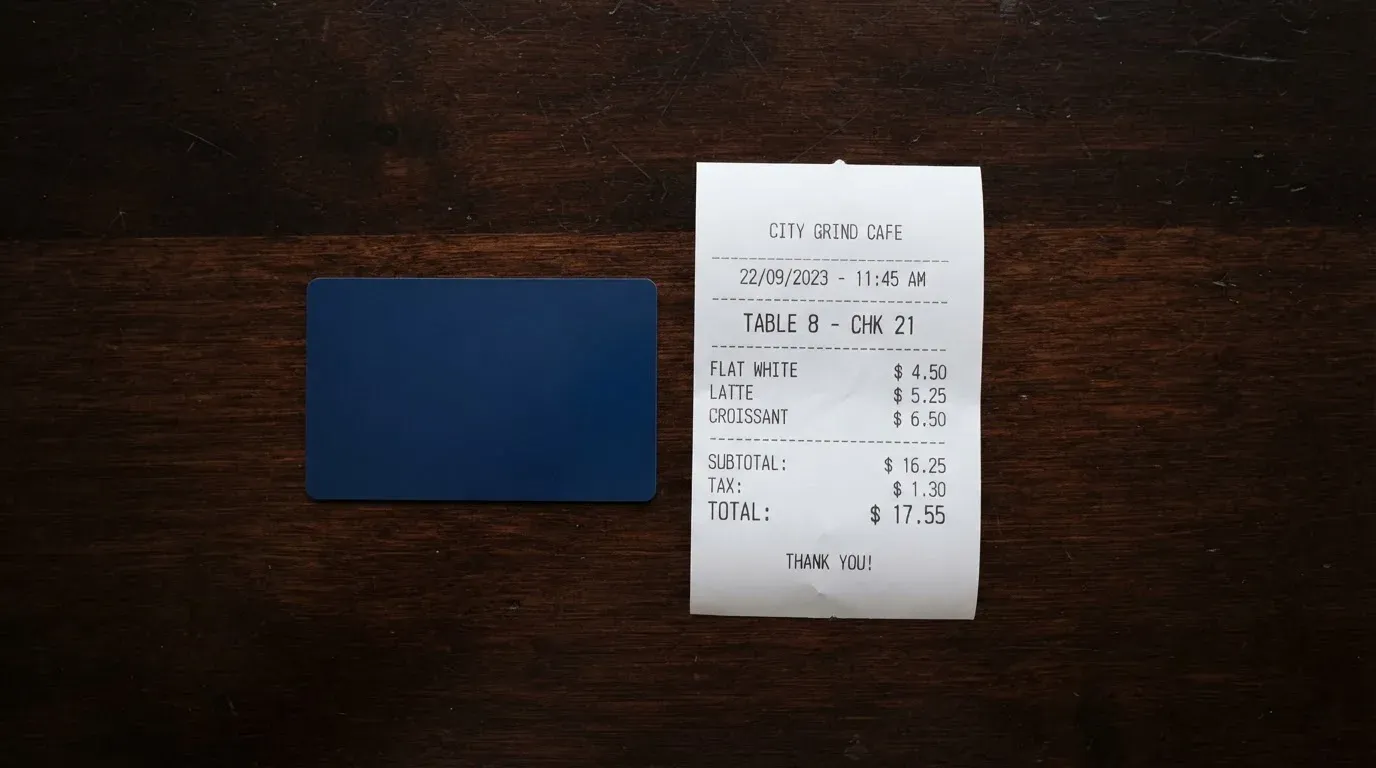
The card’s fees are not published. The company says they are shown in the app, which means you cannot compare costs before you sign up.
This is the biggest problem with the Kontigo card from a consumer standpoint. Here is what is and is not disclosed:
| Item | What the card says |
|---|---|
| Issuance fee | Not stated |
| Monthly fee | Not stated |
| Conversion fee | Not stated |
| Foreign exchange (FX) fee | Not stated |
| ATM withdrawal fee | Not stated |
| Daily spending limit | Not stated |
| Monthly spending limit | Not stated |
The terms confirm that fees, commissions, and spreads are shown in the app and may change. The home page says you can send, receive, and top up in USDC “without commissions,” but this likely refers to the crypto transfer functions, not to card spending fees.
Two everyday payments to think about:
- Buying coffee for $4.50. If the card applies a 2% conversion fee, that adds roughly $0.09. If the spread is 1% and there is a $0.50 monthly fee, your effective cost is higher than the sticker price.
- An online subscription for $9.99/month. If there is a foreign exchange markup of 3%, you pay about $0.30 extra each month. Over a year, that is $3.60 you did not account for.
What you should do: Download the app before committing. Look at the fee screen and the terms section. If the fees are high or unclear, walk away — there is no point discovering a 3% markup after you have already started spending.
The help center mentions topics like “Niveles Kontigo” (levels), Kontigo Cash, Kochinitos, and Kontigo Credit, which suggests there may be tiered products with different costs, but the content of these pages was not available to review.
How to Top up the card
You top up by sending USDC to the app, which runs on the Base network — but the card does not tell you if other networks or coins are supported.
Here is what is confirmed:
- Purchases are paid directly from your USDC balance. When you tap the card or pay online, the funds come from the USDC you hold.
- The app runs on the Base network. According to Kontigo’s own article, this is the network environment you are working with.
- Top up in USDC is “without commissions” according to the home page — though this likely means no platform fee on the transfer itself, not that there are no network costs.
The network question is critical. Blockchain transfers cost network fees (called “gas”) that are paid by the sender, not the card provider. If you send USDC on the wrong network, the transfer may be lost or require manual support intervention, with no guarantee of recovery.
What happens to your money if you leave: The terms say digital assets can be transferred to external wallets “when that feature is available.” If you close your account, you have a reasonable period (for example, 30 days) to instruct a withdrawal. If you do not, Kontigo may sell the assets and hold the proceeds in a fiat currency of their choosing, with no interest paid to you.
Before you deposit: Confirm which network Kontigo supports. Circle lists USDC as natively supported on 38 networks, but that does not mean Kontigo accepts deposits on all of them. Sending to the wrong network is a common and expensive mistake.
Paying with it every day
The card works as a standard payment card for purchases — but its form, ATM access, and mobile wallet support are not disclosed.
The site markets the card as one that “earns yield,” meaning it promises returns on your balance. However, the specific rate, how it is calculated, and how it is paid out are not stated on the card pages.
What is not disclosed:
- Card format: Is it physical, virtual, or both? Can you request a plastic card?
- Mobile wallets: Is Apple Pay or Google Pay supported? (One piece of unofficial information suggests Apple Wallet compatibility, but this was not confirmed.)
- ATM access: Can you withdraw cash? What are the fees?
- Blocked merchants: Are gambling merchants (MCC 7995) blocked, as is common with many crypto cards?
What is confirmed:
- The app is available on Google Play and the App Store.
- The site cites “over 10,000” user reviews, though the current store rating is not stated.
- The terms outline a dispute process: you must notify the company in writing, and they will attempt good-faith resolution for up to 15 business days before the matter goes to the courts of Delaware. Local consumer-protection authorities remain available to you throughout.
A note on declined payments: If a merchant declines your card, a hold on your funds can remain for several days, typically up to 7. This is standard across the card network, but it can be frustrating if you are relying on your balance for other purposes.
What can go wrong
The biggest risks are the hack that reportedly drained funds from over 1,000 accounts and the self-custody model that puts all the responsibility on you.
Here are the main concerns:
1. The reported security breach. Third-party sources (dates not independently verified) report that a hack drained 340,905.28 USDC from 1,005 user accounts. The company says refunds have been processed. Even with refunds, this is a serious warning sign about the platform’s security infrastructure.
2. Self-custody means you are responsible for everything. The terms state that you hold assets in your own custody, and Kontigo cannot access or recover your private keys. You are solely responsible for your credentials. Blockchain transactions are generally final and irreversible — if you send funds to the wrong address or lose your seed phrase, there is no built-in recovery.
3. The unnamed issuer. Kontigo, Inc. is a Delaware corporation, but the card issuer and the entity that holds the BIN sponsorship are not named. The footer says Kontigo does not provide financial services or take deposits, and assets are held in user custody — but who actually issues the card? Without this information, you cannot verify whether your funds are protected by any deposit insurance or regulatory scheme.
4. Limited customer support. The support center has a WhatsApp contact channel, and communication can happen via in-app messages, push notifications, email, SMS, and messaging apps. However, no direct phone number or email address is listed. Help center pages are in Spanish, though English article pages exist.
5. Sanctions and compliance risk. Tether and other stablecoin issuers freeze accounts and disable tokens tied to sanctioned addresses. If your country or activities trigger compliance flags, your funds could be frozen.
What to take instead
If the lack of transparency is a dealbreaker for you, here are three alternatives with higher scores and more published information.
| Card | Score | Key Differences |
|---|---|---|
| Morse | 7.5 / 10 | Virtual Visa card; zero FX fees; self-custodial wallet; available in 140+ countries; must be 18+ and a resident of a supported country |
| International Visa Card | 6.7 / 10 | U.S.-issued Platinum Visa; $5 issuance; free deposits; 2% FX fee; not available in 17 countries including Belarus, China, Iran, Russia, and Ukraine |
| UNi Card | 6.1 / 10 | Multicurrency Mastercard; no annual fee or FX fee; assets converted at live OTC rates; up to 3% spend-to-earn rewards |
Morse stands out for its transparent fee structure: “Zero foreign exchange fees or markups” and free card use online and contactless. It supports deposits by debit card, stablecoin transfer, and various currencies. The catch is eligibility is by residence, and certain countries need an invite code.
The International Visa Card publishes clear costs: $5 issuance, no maintenance fee, and a 2% FX fee. It accepts USDC and USDT deposits. However, it is not available to residents of certain countries, and the physical card is “coming soon.”
UNi Card positions itself as a multicurrency Mastercard with “No annual fee or foreign transaction fee” and “No hidden exchange fees.” It offers up to 3% spend-to-earn rewards, though its top-up methods are not stated publicly.
Who I would recommend it to
The Kontigo card is a reasonable option if you fall into a specific profile: you are a Latin American user who already holds USDC, you understand blockchain networks and self-custody risks, you can tolerate the uncertainty around fees, and you are comfortable troubleshooting on your own if transactions fail.
I would not recommend it if: you need a predictable cost structure, you are not comfortable managing crypto assets, you want strong customer support in your language, or you need to know exactly what a card purchase will cost before you make it.
The 4.7 out of 10 score reflects a product that is still finding its shape. The promises are attractive — spend USDC globally and earn yield — but the execution falls short on the details that matter most: transparent pricing, clear country availability, and proven security. Until those improve, the card is best treated as an experiment rather than a primary payment method.
Frequently asked questions
What is the Kontigo card?
Kontigo is a crypto payment card that lets users spend USDC directly from their balance. The company markets it as the “first international credit and debit card in USDC that earns yield,” primarily targeting Latin American users. The card operates on a self-custody model, meaning you hold the assets yourself rather than the company. Kontigo, Inc. is a Delaware corporation, though the card issuer and licensing details are not publicly stated.
How does the Kontigo card work?
When you make a purchase, the funds are drawn directly from your USDC balance. The app runs on the Base network. The card is designed to work like a standard payment card at merchants worldwide. The company says the card “earns yield,” but the specific rate and how it is paid out are not disclosed on the public pages.
Is Kontigo a bank?
No. Kontigo, Inc. is a Delaware corporation, not a bank. The footer explicitly states that Kontigo does not provide financial services or take deposits, and that assets are held in user custody. The card issuer and the entity that holds the BIN sponsorship are not named on the public pages. This means your funds are not protected by traditional bank deposit insurance.
Who owns Kontigo?
Kontigo is operated by Kontigo, Inc., a corporation registered in Delaware, United States. The company’s own footer lists ten countries under “Paises”: Argentina, Bolivia, Brasil, Chile, Colombia, El Salvador, Espana, Estados Unidos, Mexico, Peru. These appear to be the countries where the platform operates, though it is not clear if this applies specifically to card issuance.
Does the Kontigo card require KYC?
Yes. Identity verification is mandatory before you can use the services. The terms specify that you must provide your name, date of birth, address, nationality, and ID documents. Financial information may also be requested. Sanctions and credit checks are part of the process. Only one account per person is allowed. The company does not state how long verification takes or what causes rejections.
How do I top up the Kontigo card?
You top up by sending USDC to the app, which runs on the Base network. The home page says top-ups in USDC are “without commissions,” though this likely means no platform fee rather than no network costs. The card does not state whether other networks or coins are supported. It is critical to confirm the correct network before depositing, as sending USDC on the wrong network can result in lost funds.
Is the Kontigo card safe?
There are legitimate concerns. Third-party sources report that a hack drained 340,905.28 USDC from 1,005 user accounts, though the company says refunds were processed. The self-custody model means you are solely responsible for your private keys and cannot recover funds if lost or stolen. The card issuer and regulatory protections are not disclosed. No user complaints were found in a Trustpilot or Reddit search, but this may reflect limited usage rather than high satisfaction.
Is the Kontigo card free?
The card’s fees are not published. The terms state that fees, commissions, and spreads are shown in the app and may change. The home page says sending, receiving, and topping up USDC is “without commissions,” but this likely refers to crypto transfers, not card spending. Issuance fees, monthly fees, conversion fees, FX fees, and ATM fees are all undisclosed. You must check the app before committing to determine if the card is free for your use case.
Where can I use the Kontigo card?
The card is designed to work at standard merchants worldwide, though the exact countries where it can be used are not stated. Availability depends on your country of residence, and sanctioned or high-risk jurisdictions are not permitted. The specific issuing countries are not disclosed. If you are unsure whether you can get or use the card, you need to check the app directly after signing up.
How do I delete my Kontigo account?
The terms state that account closure requires no pending obligations and no positive balance, or that withdrawal has already been instructed. After closure, you have a reasonable period (for example, 30 days) to withdraw your digital assets to an external wallet, “when that feature is available.” If you do not withdraw in time, Kontigo may sell the assets and hold the proceeds in a fiat currency of their choosing, with no interest paid to you. The exact process for requesting deletion is not detailed on the public pages.
App and neobank cards: your questions answered – cryptocardanswers
Content created by the «cryptocardanswers» team