
SharPay card review — a Mastercard debit from Lithuania, priced for patience
 Available in US
SharPay is a Mastercard debit card tied to a euro payment account, with the card itself issued by a Lithuanian electronic money institution. It is one of the cards aimed at people outside the ordinary banking system: it is reachable without a local bank, it spends from a euro balance that you can top up in crypto or by card, and it works with Apple Pay and Google Pay. The trade-off is a stack of small, easy-to-miss charges that quietly compound: an account-opening fee, a card service fee, a 2.99% FX mark-up and a top-up charge of 2.00 EUR + 1.99% on top of any network fee. None of that makes it a bad card. It just means the price you see on the page is rarely the price you actually pay.
The conditions on this page are current as of October 28, 2026.
Verdict
SharPay scores 5.9 out of 10 in our review. That is not a damning mark. It is the score of a card that does what it says, on a clear regulatory base, but charges a noticeable amount for the privilege and asks the customer to do most of the arithmetic.
| Criterion | Mark | Why it earns (or loses) the mark |
|---|---|---|
| Who can get it | 5/10 | Live outside the EU and not in a sanctioned country; KYC is by residence, not citizenship, and the card provider does not publish how many countries it actually serves |
| Cost | 3/10 | Account opening 10 EUR, card issue 1 EUR, monthly service 3 EUR, card-to-card top-up 2.00 EUR + 1.99%, plus a 2.99% FX mark-up on the card itself |
| Top-up options | 6/10 | EUR, USDT, USDC, BTC, ETH, XRP, LTC, BCH (also DAI and TUSD on the price page), but networks are not named in the FAQ and USDC top-up via Mastercard or Visa carries a separate 4% fee |
| Reliability and complaints | 8/10 | Card issued by UAB Walletto under Bank of Lithuania e-money licence 33, payments routed by a Canadian MSB; no complaints or reviews were found in a targeted search |
| Everyday use | 9/10 | Virtual card active immediately, physical in about 15 working days, Google Pay and Apple Pay supported, ATM withdrawals possible |
The audience this card actually fits is narrow and worth stating plainly: a non-EU resident who needs a Mastercard that can be added to Apple Pay or Google Pay, who is willing to pay a small, predictable premium per top-up and per month for the convenience, and who is comfortable converting stablecoins into a euro balance before spending. If that is you, the score understates how useful the card is. If you are an EU resident, an EU citizen looking for a cheaper everyday card, or someone planning to spend in many currencies and currencies that change every week, the cost row in the table is the one that should decide.
Will they give you the card
The headline rule on the SharPay website is short: you must not be a resident of a “restricted or prohibited” country. This is a residence rule, not a citizenship rule. The card programme screens where you live, what ID you hold, and what the documents you submit prove. The “prohibited” list attached to the payments provider (SPEKA Payments Corp) is the public reference, and it covers Russia, Belarus, the occupied regions (Crimea, DNR, LNR, Kherson, Zaporizhzhia), Iran, Cuba, Syria and similar jurisdictions. The site is also explicit that crypto services are not offered to EU residents, which means the card’s crypto top-up side is not for people inside the European Union, even if a euro payment account technically can be.
For everyone else, the rule is identity documents and a clean check. A non-EU applicant verifies with a foreign passport; an EU applicant can use a passport or national ID card. SharPay does not publish a citizenship rule, so the determining fact is residence and the document you can show. What this means in practice is that your country of residence is the gate, not your passport: if you have just moved, expect the documents to take longer to assess, because the rules in the prohibited list are written around residency, not around where you were born. The card programme works the same way: it screens where you live, what ID you hold and what the documents you submit prove. The “prohibited” list attached to the payments provider (SPEKA Payments Corp) is the public reference, and it covers Russia, Belarus, the occupied regions (Crimea, DNR, LNR, Kherson, Zaporizhzhia), Iran, Cuba, Syria and similar jurisdictions. The site is also explicit that crypto services are not offered to EU residents, which means the card’s crypto top-up side is not for people inside the European Union, even if a euro payment account technically can be.
The card itself is a Mastercard debit. The full name in the fee schedule is “Flex Mastercard Debit card is issued by UAB Walletto”, and the home page says you can order up to five cards per account. There is no tier system — no Classic, Pro or Max plan, no metal card, no premium product. SharPay is a single product with a euro base currency and a fee book in euros, and that simplicity is part of the offer.
How to get it
The signup path is the standard “register, verify, order” sequence used by most EMI-issued cards, and the steps are spelled out clearly enough that you can plan around them.
- Register in the app with a phone number, an email and a password.
- Verify at Level 1 with a passport. The rules are specific: the passport page must be uncropped and in good quality; cropped copies are rejected. The questionnaire asks about turnover, source of funds and any PEP or US-person link. You also record a video selfie. Standard document review is given as “from 1 to 72 hours”.
- Verify at Level 2 for the fiat account and the card. This adds an extra check that can take up to 5 days. The triggers for rejection are listed on the page: cropped copies, non-passport documents, a video selfie with poor light, or a hat, glasses or filter. Bank statements are also requested, in English.
- Order the card in the app. The virtual card activates immediately after ordering. The physical card is shipped in about 15 working days, with delivery times varying by destination; the delivery countries and the shipping cost are not published.
A practical point that often gets lost: the KYC you do for the euro account is not the same as the KYC for the crypto side. The card side is finished only at Level 2, so ordering the card at Level 1 is not enough to use it. Plan at least a week of buffer from first registration to first card transaction, more if your bank statements are slow to arrive in English.
Age is not stated on the pages reviewed, so for an under-18 reader the safest reading is that the product is for adults, the way most prepaid-style cards are, but SharPay does not publish the cut-off.
What it really costs
The fees are the part of SharPay that need the most attention, because they are spread across four different places: the account opening, the card, the top-up and the FX mark-up. Each one is small. Together they are not.
Fees and limits
| Fee or limit | Amount |
|---|---|
| Payment account opening | 10 EUR (one-time) |
| Crypto account opening | free |
| Card issuing | 1 EUR |
| Virtual card replacement | 1 EUR |
| Monthly card service | 3 EUR per card |
| Chargeback handling | 40 EUR |
| Card load (card-to-card) | 2.00 EUR + 1.99% |
| USDC deposit (via Mastercard/Visa) | 4% |
| USDC withdrawal (via Mastercard/Visa) | 3% |
| FX mark-up on the personal card | 2.99% |
| FX mark-up on payments | 1.00% |
| Card POS + e-commerce | 10,000 EUR daily, 30,000 EUR monthly |
| SEPA crypto transactions | up to 14,500 EUR per day |
| Account closure (personal) | 25 EUR |
| Account closure (business) | 100 EUR |
A few things from the table deserve a closer look.
- The FX mark-up is the single biggest line for any reader who plans to spend in non-euro currencies. The card spends in EUR by design, and any purchase in another currency is converted with a 2.99% mark-up on the personal card, or 1.00% on payments. The 2.99% is the number to anchor on. Card-to-card top-ups also add 2.00 EUR + 1.99% on top of any spread.
- The monthly 3 EUR service fee applies per card, so a five-card account pays 15 EUR a month just to keep the cards open. A reader who plans to use only the virtual card should be aware that it counts toward the same monthly charge.
- The physical card replacement fee is not stated on the page reviewed. The virtual card replacement is 1 EUR, and the gap between those two numbers is one of the small things worth confirming with support before relying on a physical card.
- Minimum top-up is described as being shown in the top-up field inside the app, not on the public fee page. The page text “read the information about the minimum… top-up amount in the top-up amount input field” is the public statement.
To make this less abstract, three everyday payments show how the costs stack.
- Coffee in Berlin, 4 EUR, paid with Apple Pay from the virtual card. The card is in EUR, the merchant is in EUR, the FX mark-up does not apply, there is no top-up at the moment of payment. You pay 4 EUR and nothing more.
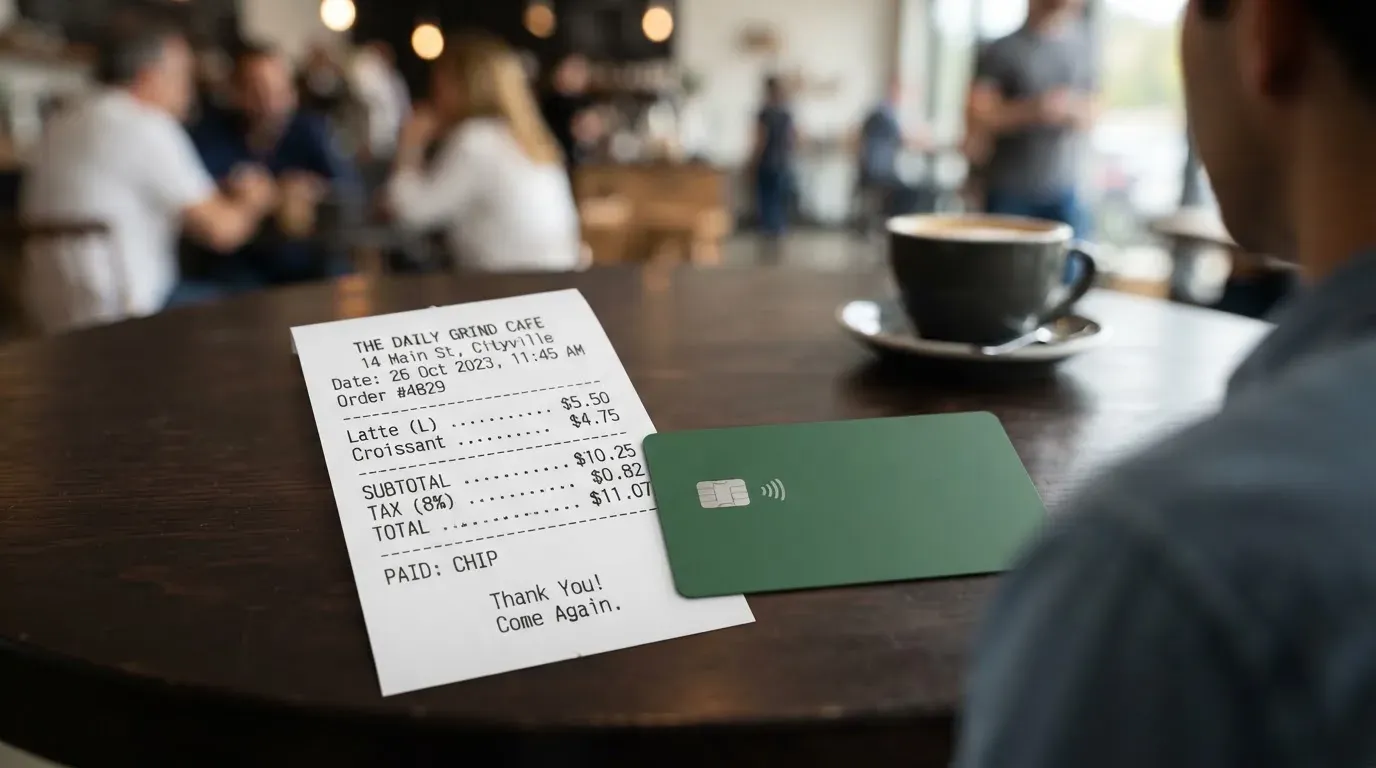
- Lunch in New York, 60 USD, paid with the physical card. Mastercard converts USD to EUR with a 2.99% mark-up. The 60 USD becomes roughly 55 EUR, the 2.99% then adds about 1.65 EUR, so the bill is closer to 56.65 EUR. There is no separate foreign-transaction fee, but the mark-up is the foreign-transaction fee in disguise.
- Top-up of 200 EUR by debit card. The card-to-card load is 2.00 EUR + 1.99% of 200 EUR, which is 2.00 + 3.98 = 5.98 EUR. The 200 EUR ends up on the card minus that fee, so the effective cost is about 3% of the value loaded.
The general rule that falls out of these three examples: the card is cheap if you top up in EUR, spend in EUR and use Apple Pay. It is more expensive if you top up in EUR by card, spend in foreign currency, or rely on USDC via card rails. None of this is hidden, but it is also not on the home page.
How to top it up
The funding side is what makes SharPay a “crypto card” rather than just another euro debit. The app supports two paths.
The fiat path is straightforward: a card-to-card load from another debit card, with the 2.00 EUR + 1.99% fee described above. The card can also be topped up by SEPA in EUR, and transfers settle in “1 to 60 minutes” on the public timeline. From there the card behaves like any other prepaid euro balance.
The crypto path is the headline feature. SharPay lists EUR plus the following coins on the price page: USDT, USDC, BTC, ETH, XRP, LTC, BCH, with DAI and TUSD appearing on some pages. XRP transfers ask for a memo/tag, which the customer has to set correctly or the funds arrive at the wrong account inside the provider. For coins other than the card’s base currency, the platform automatically exchanges at the system exchange rate, which is the spread on top of which the network fee is paid.
Two specific points that catch people out.
- Networks are not named in the FAQ. The page says you “select the currency and network” inside the top-up flow, but the public list of supported networks per coin is not on the website. For USDC, Circle stopped supporting USDC on the Tron network in February 2024, and the same is true for any chain not on Circle’s list of natively supported networks. Picking the wrong network for a top-up is one of the most common ways to lose funds to a custodian.
- USDC top-up via Mastercard/Visa is a separate fee schedule. Depositing USDC through the card rails costs 4%, and withdrawing costs 3%, which is much higher than the standard crypto deposit. The “card-to-card” line in the fees table does not cover this; it sits next to it.
For a reader who is topping up from a self-custody wallet, the practical sequence is: confirm the network in the SharPay app, send a small test transaction first, wait for the credit (typically 1 to 60 minutes for SEPA and card transfers), and only then send the full amount. The minimum top-up, as noted, lives inside the app, not on the public fee page.
Withdrawals work in the opposite direction. You can send funds to SEPA, cards, e-wallets and crypto, with the same 1-to-60-minute processing window. Card transfers are allowed only if the card has previously been topped up, which is a small but real anti-fraud control: an account that has only received SEPA credits cannot be drained back to a card. Closing a personal account costs 25 EUR; a business account costs 100 EUR. The card provider does not state what happens to any remaining balance on closure, which is a small thing to confirm before initiating a closure request.
Paying with it every day
Once the card is loaded, day-to-day use is the part that works the most smoothly. The virtual card is available the moment you order it, which means a reader who has just finished Level 2 verification can use it for an online purchase the same day. The physical card arrives in about 15 working days, which is in line with European EMI norms and not unusual for a card shipped internationally.
The two features that make the card feel modern are the contactless and mobile-wallet support. Apple Pay and Google Pay are both listed, and the card can be added to either wallet. From the cardholder’s side, this is the difference between a card that needs to be physically present and one that lives in a phone. From the merchant’s side, nothing changes: the tap goes through the Mastercard network, and the merchant sees a regular Mastercard authorisation.
The blocked merchant categories follow the SPEKA Payments Corp prohibited-activities list. The page names “illegal gambling services (including illegal online casinos, sports betting…)” and adult content. Some readers will read “illegal” as covering the legal versions too; that is a reasonable working assumption but not one that should be relied on without checking the current list, because it is the payment-services provider’s list, not the card’s own.
There is no cashback or rewards programme stated on the pages reviewed. The price page and the card page do not describe a “Spend-to-Earn” style of rebate or a tiered return. Readers choosing between cards on rewards alone should not choose SharPay for that reason.
The app is called SharPay Wallet and is available on Google Play and the Apple App Store. The home page claims “15k +” users. The store ratings and number of ratings were not visible in the materials reviewed on 2026-10-20. The app is also the place where you block and unblock cards, set OTP and 2FA, and run 3-D Secure confirmation, which are the three controls the security section relies on.
Disputes go through a 40 EUR chargeback-handling process, and the page notes that double-debit refunds are handled automatically. A full refund policy PDF is linked; the timing of refunds is not officially stated, so for a large disputed transaction, expect the bank’s standard timeline rather than a same-day reversal.
What can go wrong
A few risks are visible in the public materials; a few are absences that are worth naming.
Who actually runs the card. The site and app are designed and operated by GTM Exchange Ltd, registered in Cyprus. The card is issued by UAB Walletto, an electronic money institution authorised by the Bank of Lithuania under licence number 33. Payment services run through SPEKA Payments Corp., a Canadian money services business registered with FINTRAC as MSB M22046940. Crypto services are run “outside the EU and not to EU residents”. What this means for you is that the card itself sits in a regulated Lithuanian EMI, the crypto side sits in a Canadian MSB, and the marketing and front-end sit in Cyprus. The three-entity structure is not unusual, but a reader who needs to know who their data is shared with should read the privacy notice before signing up.
Custodial model. SharPay is a custodial product. The euro balance is held by the EMI, the crypto balance by the payments provider, and the cardholder does not hold private keys. The platform is also allowed to ask for “Proof of funds” at any time, and the safeguarding or insurance of customer funds is not stated in the public materials. If the company that runs the platform has a counterparty event, the cardholder’s claim is against that EMI, not against a deposit guarantee scheme.
Network and sanctions controls. Stops and freezes are real risks in custodial cards. SPEKA’s prohibited-activities list restricts the regions and merchant categories described above, and Tether states that it disables tokens in wallets on the OFAC sanctions list and has frozen funds tied to illicit activity, which is a reminder that stablecoins on custodial platforms are not censorship-proof.
Complaints and reviews. A targeted search for SharPay card complaints on Reddit and Trustpilot on 2026-10-20 returned only unrelated brands (Shop Pay, OnePay, Shieldpay, b-sharpe). There is no Trustpilot page for SharPay, and no public complaint themes were found. The absence of complaints is not the same as the presence of satisfied customers, but for a small EMI-backed product it is a meaningful signal.
Closed programmes are a category risk. History matters here. In 2018, Visa suspended WaveCrest in Europe, which closed every WaveCrest-issued crypto card programme overnight. In November 2022, Visa terminated its global agreements with FTX and the FTX US debit card was wound down. A crypto card is a programme that can be ended by the network, the issuer or the partner, and the customer’s recourse is the issuer’s wind-down plan, not a guarantee of continued service.
Address Verification Service declines. For US, Canadian and UK merchants, AVS checks the numeric parts of the billing address against issuer records and is generally unavailable on foreign-issued cards. A card issued in Lithuania by a euro account can be declined at checkout for that reason. This is a category issue, not a SharPay-specific one, but it shows up at exactly the moment a reader most needs the card to work.
Refunds and chargebacks. The 40 EUR chargeback-handling fee and the absence of a published timeline mean a disputed transaction is not free to pursue. For a small charge, the fee alone can exceed the value of the dispute. For a large charge, the absence of a stated timeline is the risk to manage.
What to take instead
Three alternatives cover most of the reasons a reader might be considering SharPay. None of them is a perfect substitute, and the differences are worth sitting with rather than skimming.
International Visa Card — 6.7/10. A US-issued Platinum Visa in USD with a virtual card today and a physical one “coming soon”. It is cheaper to issue ($5 one-time, no maintenance fee) and uses a free USDC or USDT deposit at 1:1, with a “Visa exchange rate + 2% FX fee” on non-USD spending. The trade-off is the prohibited-country list, which is long and overlapping with SharPay’s: Belarus, mainland China, North Korea, Cuba, India, Iraq, Iran, Israel, Myanmar, Nepal, Nicaragua, Russia, Syria, Turkey, Ukraine, Venezuela, Vietnam, plus FATF grey-list countries reviewed case by case. India, Turkey and Ukraine in particular rule out readers for whom SharPay is still an option. The card is the right pick for a US-friendly, non-prohibited reader who plans to spend in USD and wants lower fixed costs.
UNi Card — 6.1/10. A multicurrency Mastercard that draws on a UNi.Global balance and converts at “live OTC (Over-the-Counter) rates” with “no hidden exchange fees” and “no foreign transaction fee”. It earns up to 3% in Spend-to-Earn rewards, which is the single feature SharPay does not match. The trade-offs are the ones the public page does not spell out: residency rules are not stated, the funding paths are not stated, and the issuance fee is not stated, so the reader is asked to trust the rewards figure without seeing the cost book.
Morse — 7.5/10. A virtual Visa prepaid card that spends from a Morse Balance “in any currency” with “zero foreign exchange fees or markups” at the real-time Visa rate. Deposits in USDC, USDG and EURC on Solana are free; other tokens carry a fee. Morse Wallet is self-custodial, which is the structural difference from SharPay: the crypto stays in the user’s wallet until the moment of payment. The trade-offs are an “at least 18 years old” and “resident in a supported country” rule, plus a long list of countries that need an invite code (Australia, Hong Kong SAR China, Japan, New Zealand, Singapore, Switzerland, Thailand, Türkiye, the United Kingdom, Western Sahara, and others). The card is fully virtual for now, the card page does not state a fee, and the help centre has an “Earn rewards” collection that was not read for this review. Morse is the right pick for a reader who wants to keep self-custody, who is in a country that does not need an invite, and who is comfortable paying the unspecified card fee in exchange for zero FX mark-up.
| Card | Issuer / licence | Card type | FX on spend | Cashback | Score |
|---|---|---|---|---|---|
| SharPay | UAB Walletto (Bank of Lithuania EMI 33) | Mastercard debit, EUR | 2.99% mark-up | none stated | 5.9/10 |
| International Visa Card | US-issued Platinum Visa | Virtual Visa, USD | Visa rate + 2% | none stated | 6.7/10 |
| UNi Card | Mastercard network via UNi.Global | Multicurrency Mastercard | “no hidden exchange fees” | up to 3% Spend-to-Earn | 6.1/10 |
| Morse | Self-custodial wallet, Visa prepaid | Virtual Visa | “zero FX fees or markups” | not stated | 7.5/10 |
A reader who wants a euro Mastercard with stablecoin top-up and Apple Pay: SharPay, accepting the mark-up. A reader who wants lower fixed costs and a US billing address: International Visa Card, if their country is not on the prohibited list. A reader who wants rewards on a multicurrency Mastercard: UNi Card, after asking for the fee book. A reader who wants self-custody and zero FX mark-up: Morse, after checking that the country is supported.
Who I would recommend it to
I would recommend SharPay to a non-EU resident who needs a Mastercard that works in Apple Pay or Google Pay today, who is comfortable paying a known monthly fee (3 EUR per card) and a known top-up fee (2.00 EUR + 1.99% by card), and who plans to spend mostly in euros. The card’s structure rewards that pattern: the virtual card is immediate, the FX mark-up is the main thing to watch, and the network of top-up options covers the major coins without forcing a stablecoin-only workflow.
I would not recommend it to an EU resident, because crypto services are not offered to EU residents, which removes the main reason to choose this card over a domestic euro debit. I would also not recommend it to a heavy spender in non-euro currencies, where the 2.99% mark-up compounds quickly, or to a reader who values self-custody, where SharPay’s custodial model and the absence of stated fund safeguarding are the wrong shape for the job. The complaint record is clean, but the absence of complaints is not a substitute for the kind of track record that comes from years of operation, and a reader for whom continuity matters more than convenience should look at the alternatives.
For everyone else, the card does what it says. The price is the price. Read the fee table once, set the card to top up in EUR, and it works.
Frequently asked questions
What is the SharPay card?
SharPay is a Mastercard debit card issued by UAB Walletto, a Lithuanian electronic money institution, tied to a euro payment account. The card and the underlying account are operated by SharPay’s website and app, which are run by GTM Exchange Ltd in Cyprus. It can be topped up in euros, in stablecoins or in major cryptocurrencies, and it works with Apple Pay and Google Pay. It is one of several cards aimed at readers who do not have easy access to an ordinary bank card.
How does the SharPay card work?
You register in the app, complete Level 1 KYC with a passport, complete Level 2 KYC for the fiat account and the card, and order the card. The virtual card is available immediately, the physical card is shipped in about 15 working days. You top up the card in EUR or in a supported cryptocurrency, and the card then spends that balance at any merchant that takes Mastercard. Crypto top-ups in a currency other than EUR are converted at the platform’s system rate before the balance is loaded.
Is SharPay a bank?
No. SharPay is not a bank. The card is issued by UAB Walletto, which is an electronic money institution authorised by the Bank of Lithuania under licence number 33. EMI funds are safeguarded in segregated accounts or insurance but are not deposit-guaranteed the way bank deposits are in many EU jurisdictions. Crypto services are run by SPEKA Payments Corp., a Canadian money services business registered with FINTRAC as MSB M22046940, “outside the EU and not to EU residents”.
Who owns SharPay?
GTM Exchange Ltd, a company registered in Cyprus, designs and operates the SharPay website and app. The card is issued by UAB Walletto in Lithuania. Payment services, including the crypto side, are provided by SPEKA Payments Corp. in Canada. The three-entity structure is not unusual for EMI-issued cards, but a reader who needs to know which entity holds which data should read the privacy notice.
Is the SharPay card available in my country?
SharPay is available wherever the card programme is open and the applicant is not a resident of a “restricted or prohibited” country. The prohibited list attached to SPEKA Payments Corp. covers Russia, Belarus, the occupied regions (Crimea, DNR, LNR, Kherson, Zaporizhzhia), Iran, Cuba, Syria and similar jurisdictions. Crypto services are not offered to EU residents. SharPay does not publish a full list of supported countries on its public pages, so the only reliable check is the registration flow in the app, which will reject an address it cannot serve.
How do I get the SharPay card?
You download the SharPay Wallet app, register with a phone number, an email and a password, complete Level 1 verification with a passport and a video selfie, complete Level 2 verification with bank statements in English, and then order the card. The virtual card is active immediately after ordering; the physical card is shipped in about 15 working days. The website says the account can hold up to five cards. Plan at least a week for the full path, more if bank statements are slow to arrive in English.
Does the SharPay card require KYC?
Yes. KYC is mandatory. The Level 1 checks cover identity (passport, full page, uncropped) and a video selfie, plus a questionnaire on turnover, source of funds and any PEP or US-person link. Level 2 adds bank statements in English, an extra check that takes up to 5 days, and is required before the fiat account and the card can be used. The card programme’s anti-money-laundering and sanctions rules are based on residence, identity documents and ongoing transaction monitoring.
How do I top up the SharPay card?
You can top up by card-to-card transfer from another debit card (cost: 2.00 EUR + 1.99%), by SEPA in EUR, or by sending one of the supported cryptocurrencies (USDT, USDC, BTC, ETH, XRP, LTC, BCH, with DAI and TUSD on the price page). For XRP, you must include a memo or tag. The network is selected inside the app, and the public FAQ does not list the supported networks per coin. The minimum top-up is shown inside the top-up field in the app, not on the public fee page.
How do I add the SharPay card to Apple Pay or Google Pay?
After Level 2 verification and after the card has been ordered, the option to add it to Apple Pay or Google Pay appears in the app. The flow is the same as for any other Mastercard: the card number is replaced by a device-specific token, and each payment uses a one-time dynamic security code. SharPay supports both wallets, and the card can also be used for contactless payment at any point-of-sale terminal that accepts Mastercard.
Is the SharPay card safe?
The card is issued by a regulated Lithuanian EMI, uses 3-D Secure 2.0 for online payments, supports OTP and 2FA at login, and lets the cardholder block and unblock the card in the app. The model is custodial, which means the cardholder trusts the issuer and the payments provider to safeguard the balance. SharPay does not state that customer funds are insured, and a history of programme closures in the category (WaveCrest in 2018, FTX in 2022) is a reminder that any custodial product carries counterparty risk. There were no public complaints or reviews found in a targeted search on 2026-10-20.
App and neobank cards: your questions answered – cryptocardanswers
Content created by the «cryptocardanswers» team