
A Visa card you spend from a Solana stablecoin balance — with almost none of the fee schedule published
 Available in US
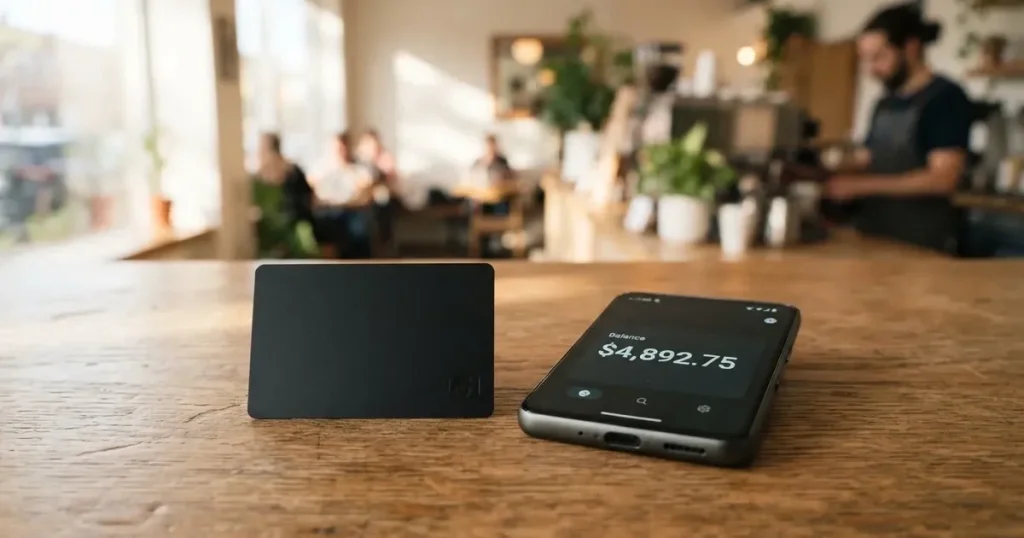
Stablecard by Western Union is a Visa card that spends a balance of USDPT, a dollar-pegged stablecoin issued by Anchorage Digital Bank and running on the Solana blockchain. You load it with crypto, and merchants get paid through the Visa network in their own local currency. In practice it is a prepaid-style card with a crypto top-up rather than a bank account with a card attached. I score it 6.7 out of 10.
The conditions described on this page are current as of October 28, 2026.
Who this suits, in one line: you already hold USDPT, or you receive money through Western Union and want to spend it as a card balance rather than as cash. Who it does not suit: anyone who wants a normal current account with a debit card on it, or anyone whose spending money comes from a bank account by bank transfer.
The verdict
The score is 6.7 out of 10. That is not a bad product score — it is a score that reflects a card that is genuinely pleasant to use day to day, sits on top of very serious infrastructure, and then runs into the single most annoying problem in this category: almost nobody publishes what the thing charges.
| Criterion | Mark | Why |
|---|---|---|
| Who can get it | 6 / 10 | 37 markets at launch, country list not published, targeting 60+ by end of 2026, “subject to geographic, regulatory, and eligibility requirements” |
| Cost | 5 / 10 | “No hidden fees” on account opening, physical card “for a fee”, “Foreign transaction fees may apply”, fee amounts not disclosed |
| Top-up options | 4 / 10 | Only USDPT on Solana, from another wallet or exchange, or by redirecting Western Union transfers |
| Reliability and complaints | 9 / 10 | The Western Union Company (NYSE: WU), issuer Rain (Third National, Visa Principal Member), USDPT issued by Anchorage Digital Bank, no incidents reported, App Store 5.0 from 10 ratings |
| Everyday use | 10 / 10 | Virtual card immediately, physical card on request, Visa, Apple Pay and Google Pay, ATM withdrawals |
Two things decide this score for me. The first is that “everyday use” is genuinely excellent — a virtual card the moment you are approved, a physical one if you want it, Apple Pay and Google Pay, and cash out at ATMs. The second is that you cannot budget with this card, because the numbers that would let you budget are not public. If you are choosing between cards and one of them tells you its fees and this one does not, that difference is worth more than any feature list.
There is also a question of fit that no score expresses. Western Union’s own customers, spending USDPT with Visa, are the people this was built for. If that is you, the product is coherent: the money transfer network and the card are the same company, and redirecting an incoming transfer into a card balance is the natural move. If you are outside that story — you have a salary, a bank account and no stablecoins — the same product looks narrow.
Will they give you the card?
Yes in many places, but you cannot check the list yourself, and that is the honest answer.
The card was available in 37 markets at launch. The specific country list is not published. The company targets 60+ markets by end of 2026, so the map is meant to widen. The card’s own wording is that availability is “subject to geographic, regulatory, and eligibility requirements” — which is the standard way of saying that approval is not automatic and is not a right.
On citizenship: no official source I checked explicitly mentions Russian or Belarusian citizens or residents, in either direction. That is not an approval and it is not a refusal. It means the answer for your nationality sits inside the sanctions screening rather than in anything published. Western Union screens against sanctions lists in the US, the EU and the UK. If you hold a passport from a sanctioned country, expect the question to be settled at that stage rather than at the signup form, and expect a closed account to be the likely outcome. I am not going to tell you how to get around that; there is no legitimate way, and the screening is a legal obligation rather than a setting.
The practical test is simple: start the onboarding, and see whether your country is accepted and your document passes. That costs you nothing and takes a few minutes.
How to get it
The path is short, and identity verification is the part that takes real time.
- Download the app. iOS requires 17.6 or later and iPhone only; Android is supported.
- Complete onboarding and identity verification.
- The virtual card is issued immediately on approval. A physical card can be requested afterwards, for a fee, and is mailed to the address on file.
There is no credit check and no minimum balance, which is a genuine plus compared with much of the category. The App Store age rating is 18+, and prepaid and debit cards are in general available to adults.
On the verification itself, the card asks for “personal information and documentation as required by applicable laws and regulations, including anti-money laundering, sanctions screening, and customer identity verification requirements.” Rain, the issuer, or its authorised service providers carry out the check. There is a single verification level — no basic-versus-advanced tiers — and the card does not publish how long approval takes, or the reasons a person might be rejected. So the honest expectation is: you will be verified or you will not, and there is no published appeal ladder.
One thing to plan for: the physical card is a request, not a given. Countries it ships to are not stated, delivery time “varies by shipping method and destination”, and the replacement cost is not stated either.
What it really costs: Fees
This is the weakest part of the product, and it is weak for a specific reason — the information is withheld rather than absent. The site says “no hidden fees” for account setup and promises a straightforward proposition. The full fee schedule sits in the terms and conditions on the company’s official website, which as of October 2026 sits behind a Cloudflare anti-phishing block and could not be read. I found no third-party source publishing exact issuance, monthly or annual fees either.
| Fee or limit | What the card states |
|---|---|
| Account setup | “No hidden fees” |
| Physical card | Mailed “for a fee” — amount not stated |
| Monthly or annual fee | No amounts published on the site; T&Cs inaccessible |
| Crypto conversion | Not stated on the public FAQ or product page |
| Foreign transaction | “Foreign transaction fees may apply” |
| Card use | “Fees may apply, including charges for card use and ATM withdrawals” |
| ATM | Supported ATMs with the Visa logo, plus Western Union agent locations; “Fees may apply”; free allowance not stated |
| Spending and transaction limits | “based on program-level risk controls and regulatory requirements”, set out in the T&Cs, may change; no amounts published |
| Tiers | Single tier; no tiered plans mentioned |
| Card currency | USDPT, pegged 1:1 to USD; merchants paid in their local currency through Visa |
Three everyday payments, to make this concrete:
- A coffee bought in a country that is not the US. The merchant is paid in their own currency through the Visa network, the balance is converted from USDPT, and foreign transaction fees may apply on top. The conversion spread is not published. This is the payment where I cannot tell you what you will pay.
- A subscription or a shop in your own currency with a card you just got. No foreign transaction layer, but the card-use fee wording (“fees may apply”) is not pinned down to a number, so the cost of an ordinary purchase stays uncertain on paper.
- Taking cash out at an ATM. Supported Visa ATMs, and Western Union agent locations globally, with fees possible and no free allowance stated. If cash is the point, you are accepting a published-unknown cost.
For limits: the card says they follow programme-level risk controls and regulatory requirements, are described in the terms, and may change. No numbers are public. That means the app, at the moment you sign in, is the only place you can learn what you may spend in a day or a month. Check it before you rely on the card for anything large.
None of this makes the card expensive. It makes it unpriceable from the outside, and for a reader budgeting in a currency that is not the dollar that is a real problem.
How to top it up
Two ways, and only two.
- Transfer USDPT from another digital asset wallet or a compatible crypto exchange wallet.
- Redirect an incoming Western Union money transfer that was originally sent for cash pickup; the fiat is converted to USDPT.
There is no minimum balance and no deposit fee stated. There is no bank card top-up and no bank transfer top-up — fiat reaches the account only by being redirected from a Western Union transfer. USDPT is issued by Anchorage Digital Bank on the Solana blockchain.
Getting money back out works the same way round. Crypto off-ramp: transfer USDPT to a compatible wallet or exchange. Fiat off-ramp: initiate a cashout to yourself through Western Union’s global network and collect cash at a Western Union retail location, with fees possible. If you close the account, the remaining USDPT balance must be transferred or spent according to the terms and conditions.
Two practical warnings before you send anything. Blockchain transfers are irreversible, so a deposit on a network the provider does not support, or sent to an address belonging to a different network, can be lost or need manual recovery with no guarantee. And the network fee — Solana gas — is charged by the blockchain, not by the card provider, and is not stated anywhere on the card’s pages. If you have never moved a token on Solana before, the first top-up is the one most likely to go wrong.
Paying with it every day
This is where the card scores highest and where I found least to complain about.
The card is Visa, virtual immediately, physical on request. Apple Pay and Google Pay are supported — you add the card to your digital wallet and pay by phone, which is how most people will actually use it. ATM withdrawals work at any supported ATM with the Visa logo, and you can also take cash at Western Union agent locations globally.
The balance is USDPT. The merchants are paid through the Visa network in their local currency. There is no multi-currency balance beyond USDPT, so anything you hold beyond dollars, you convert yourself before it reaches the card.
Rewards: there is none. No cashback or rewards programme is mentioned for Stablecard in any official source. Western Union runs a separate Rewards programme, but it covers money transfers, not this card. If you are used to earning a percent back, that is worth knowing before you move your spending here.
The app is the interface for everything else. Lock and unlock the card in-app. If a transaction goes wrong, Customer Care is reachable through in-app chat, and disputes are handled under Visa dispute rules and programme policies — time frames are not stated. Support email is [email protected]; app languages are English and Spanish; hours are not published.
App ratings are worth a caveat. The App Store shows 5.0 out of 5 from 10 ratings, read on 2026-10-21 — ten people is a very small sample. Google Play shows no star rating on the listing page but 1K+ downloads. These numbers tell you almost nothing either way, and I would not lean on them.
What can go wrong
The honest summary is: no incident has happened yet, and the product is young enough that this is not much of a comfort.
The age of the product. Stablecard launched on 2026-08-04. No official incidents — shutdowns, hacks, programme changes — have been reported since launch. Absence of incidents in this short window is not a track record, and it is worth holding that distinction.
Who is actually behind it. The Western Union Company (NYSE: WU), headquartered at 7001 E. Belleview, Denver, CO 80237, USA. Card issuer and programme manager: Rain (Nimbus LLC dba Third National), a Visa Principal Member licensed in Puerto Rico, United States. Card network: Visa. USDPT issuer: Anchorage Digital Bank, N.A., a US national trust bank. Money transfer services: Western Union Financial Services, Inc. (NMLS #906983) and/or Western Union International Services, LLC (NMLS #906985), licensed as Money Transmitters by the New York State Department of Financial Services.
Nothing that banks do, nothing banks get. This is not a deposit account. Visa and Mastercard do not issue crypto cards to consumers themselves — they license issuers, and they can suspend a programme. In November 2022 Visa said it had “terminated our global agreements with FTX”, and the FTX US debit card programme was wound down by its issuer. WaveCrest, a Visa card issuer that supplied crypto card brands, was suspended by Visa in Europe in 2018, closing all its Visa programmes. Closures typically follow a pattern: notice, then spending and loading stop, then you are asked to withdraw remaining balances.
Custody. The card describes a non-custodial digital asset wallet for USDPT, which means the private key is yours — and so is the responsibility. A seed phrase is typically 12 to 24 words and unencrypted; anyone who obtains it can restore the wallet and spend the funds. Transfers are irreversible and there is no built-in recovery: the network cannot freeze or return funds. The history of custodial platforms is not encouraging either — Mt. Gox (about US$350 million reported stolen 2011-2014), Coincheck (about US$400 million, 2018), Ronin Network (US$625 million, 2022). Two-factor authentication, spending controls and specific safeguarding arrangements are not stated for this card; the Google Play listing says data is encrypted in transit.
Sanctions are permanent. Tether says it disables tokens in wallets on the OFAC sanctions list and has frozen funds tied to illicit activity. Stablecoins are not censorship-proof, and that is a feature of the system rather than of this card.
Declines and holds. Address Verification Service is mainly offered in the US, Canada and the UK and is generally unavailable for foreign-issued cards, which can cause declines. Some merchants decline prepaid or foreign-issued cards because the BIN lookup reveals the card type and issuer country. A declined authorisation may leave a hold that persists for several days, typically up to 7. Blocked merchant categories for this card are not stated.
Payments and tax. Each card payment funded from crypto may be treated as a disposal by the tax authority. I am not giving tax advice and you should not take this as any — the point is only that it is a question to ask a professional in your own country, not to assume either way.
Support and complaints. In-app chat, an email address, two app languages, no published hours. There is no dedicated Trustpilot page for Stablecard. Western Union’s general Trustpilot page shows 4.5 out of 5 across roughly 173,168 reviews, read on 2026-10-21, but that is the money transfer business, not this card. No recurring complaint themes have emerged, which is unsurprising after ten reviews.
The trajectory. Rain joined Visa’s stablecoin settlement pilot in 2025-05 and raised $250M Series C in 2026-01. In 2026-05 Western Union unveiled USDPT on Solana, issued by Anchorage Digital Bank, designed to align with the GENIUS Act framework. In 2026-06 Bybit added USDPT trading and transfers. Stablecard launched in 2026-08-04 in 37 markets, targeting 60+ by end of 2026. The direction is clear and the pace is fast.
What to take instead
If the thing that put you on this page is difficulty getting an ordinary bank card, the honest question is whether the fix is a crypto card at all. Sometimes it is — and MetaMask scores 7.1 out of 10, above this card. Sometimes the category’s other options fit better. All three below score lower or higher; none of them is universally right.
MetaMask (7.1 / 10) — the strongest of the alternatives on cost transparency. Sign-up is open in 45 listed countries and territories (examples: Andorra, Argentina, Brazil, Canada, Mexico, Germany, France, Spain, Uruguay); other regions join a waitlist, and proof of residency is required. “Ineligible regions limit sign-ups, not spending” — which is a genuinely useful thing this card does not say. US and UK sign-ups are temporarily closed per the FAQ. Mastercard, virtual card instant, Metal can be pre-ordered in-app after Virtual approval, one card per user. Issuer Monovate, card provider Crypto Life. Virtual is free with no annual or maintenance fee; Metal is $199/year. Fees are a “minimal fee for each transaction” (amount not stated on the pages read), “no additional MetaMask fees”, and no foreign transaction fee — the Mastercard rate is used. Spends directly from the connected wallet across Linea, Base, Monad and Solana, with mUSD, wETH, EURe, GBPe, USDC, USDT named; Solana-only wallets cannot withdraw credit. Cashback in mUSD: Virtual 1%, Metal headline 3% but the footnote limits 3% to the first $10,000 spent then 1%, plus a $FLY bonus 5X (Virtual) / 7X (Metal) through the Blackbird dining app.
KAST (6.1 / 10) — the most transparent fee schedule in this comparison. Residence-based list shown at KYC (“If your country isn’t listed, it means KAST is not available there”), country list not published, and a Restricted Locations list referenced with no countries named; citizenship matters too — living in a supported country with only an ID from a restricted region may still fail KYC, dual citizens with an ID from a supported country may pass, only the account holder’s own ID is accepted, and a VPN does not bypass it. Virtual and physical cards, up to 10 per user; Visa Platinum (Standard), Visa Infinite metal (Premium), Visa Infinite gold plated (Private), plus Pengu, Solana and Bitcoin designs; balance in USD, stablecoin deposits converted 1:1 at 0% spread. Annual membership: Standard 0 USD, Premium 1,000 USD/year, Private 10,000 USD/year, billed annually upfront with no monthly option. Extra virtual card 2 USD (“in some regions” 2 USD also on included Standard virtual cards); Standard physical card 0 USD card fee plus 40 USD delivery (Premium/Private physical included); inactivity fee 1 USD/month after 12 months; renewal and reactivation fees exist, amounts not stated. Fees: stablecoin top-up 0%, card spend in USD 0%, transaction fee 0%, Apple/Google Pay 0%, non-USD FX 0.5%–1.75% depending on residence country, transaction country and card programme, non-USD transactions under 25 USD 0.10 USD, declined transaction (insufficient balance) 0.50 USD, non-stablecoin tokens may be auto-converted at a fee shown in app. Funding: USDT, USDC, PYUSD and RLUSD, with USDT/USDC on Ethereum, Solana, Polygon, Arbitrum and TRON as listed in the app, no bank account needed — though the Terms say acceptable tokens are “currently USDT and USDC”, which conflicts with the PYUSD and RLUSD listing, and that contradiction is worth reading before you fund it. Cashback in USD: Standard 1.5% on the first 2,000 USD/month, Premium 2% on the first 10,000 USD/month, Private 3% on the first 40,000 USD/month, plus KAST Points of none / +1% / +2% of eligible spend, paid when a transaction is authorised.
TokenPocket (5.8 / 10) — the weakest of the four. Visa debit for a list of European countries and territories (e.g. Germany, France, Spain, Switzerland); Mastercard debit for Australia, Canada, Hong Kong, Japan, Taiwan, New Zealand, Singapore, South Korea, UK, among others; the Americas “planned for Q2 2025”. Mastercard/Visa debit card running on Arbitrum, with cards virtual and balances in EUR24 and USD24. NFT creation fee partly covered by TokenPocket while the user pays “a small portion” (amount not stated), and “apart from these, TP Card does not charge any additional fees”. A 1% fee is charged when depositing cryptocurrency into the TP Card, to be refunded later through rewards and reduced transaction fees; FX fee not stated, and extra fees can come from inter-institution settlement. Crypto deposits come from the TokenPocket wallet; specific coins and networks are not listed in the FAQ. No cashback stated.
Set against all three, Stablecard’s own advantages are specific rather than general: a cash-out network spanning Western Union retail locations worldwide, an issuer with a large balance sheet behind it, and a top-up route that turns an incoming money transfer directly into a spendable balance. If none of those is your situation, KAST or MetaMask will simply tell you more about what you will pay.
Who I would recommend it to
I would recommend this card to someone who already holds USDPT on Solana, or who receives money through Western Union regularly and wants it as a card balance. In that case the product is coherent — you load once, you spend anywhere Visa is accepted, you can put it in Apple Pay, and you can pull cash at a Western Union counter in a lot of countries. The score of 6.7 hides how good that daily experience is; the Everyday use mark of 10 out of 10 is not generous, it is accurate.
Frequently asked questions
What is the Stablecard by Western Union card?
It is a Visa payment card that spends a balance of USDPT, a dollar-pegged stablecoin issued by Anchorage Digital Bank and running on the Solana blockchain. You load it with crypto and pay like any Visa card. Merchants receive payment through the Visa network in their local currency, and foreign transaction fees may apply. It behaves more like a prepaid card than a bank account.
How does the Stablecard by Western Union card work?
You download the app, complete onboarding and identity verification, and receive a virtual card immediately on approval. You fund it by transferring USDPT from another wallet or exchange, or by redirecting an incoming Western Union transfer into USDPT. At payment the balance is converted and the merchant is paid in local currency through Visa. Card lock, unlock and support all live in the app.
Is Stablecard by Western Union a bank?
No. The card is issued by Rain (Nimbus LLC dba Third National), a Visa Principal Member licensed in Puerto Rico, United States, and Western Union is the programme manager behind the brand. USDPT is issued by Anchorage Digital Bank, N.A. Your balance is not a bank deposit and is not covered by a deposit guarantee scheme, so you should not treat it as cash you would keep in a current account.
Who owns Stablecard by Western Union?
It is a Western Union product. The Western Union Company (NYSE: WU) is headquartered at 7001 E. Belleview, Denver, CO 80237, USA. The card was unveiled in 2026-05 and launched on 2026-08-04 in 37 markets, with the company targeting 60+ markets by end of 2026.
Is the card available in my country?
It was available in 37 markets at launch, and the specific country list has not been published. Availability is “subject to geographic, regulatory, and eligibility requirements”, and the target is 60+ markets by end of 2026. No official source checked explicitly mentions Russian or Belarusian citizens or residents, and Western Union screens against US, EU and UK sanctions lists. The only reliable test is the app itself.
Does the card require KYC?
Yes. Identity verification is required for every applicant, using personal information and documentation as required by applicable law, including anti-money-laundering, sanctions screening and customer identity verification. Rain or its authorised service providers run the check. There is no credit check and no minimum balance, and the App Store age rating is 18+. There is a single verification level, with no tiers.
How much does the card cost?
Partly unclear, and that is the point. Account setup is advertised with “no hidden fees”, and there is no credit check or minimum balance, but the physical card is mailed “for a fee” with no amount published, and “foreign transaction fees may apply”. No monthly or annual figures are on the site, and the terms on the official website were behind a Cloudflare block in October 2026.
Is the card safe to use?
It sits on serious infrastructure: a Visa network, a licensed issuer, and a stablecoin from a US national trust bank. USDPT is held in a non-custodial wallet, so you hold the keys and bear the loss risk. Two-factor authentication, spending controls and safeguarding arrangements are not stated. Treat it as a payment tool for money you can afford to lose, not as savings.
Can I add the card to Apple Pay?
Yes, Apple Pay and Google Pay are both supported, and the card says you can add Stablecard to digital wallets “such as Apple Pay and Google Pay”. This is the way most people will actually use the card day to day, and it is one of the strongest points in its favour. The card itself is Visa, virtual immediately, with a physical version available on request.
How do I get money back off the card?
Two routes. For crypto, transfer USDPT out to a compatible wallet or exchange. For cash, initiate a cashout to yourself through Western Union’s global network and collect at a Western Union retail location, with fees possible. If you close the account, any remaining USDPT balance must be transferred or spent according to the terms and conditions — it does not simply disappear.
Wallet cards: your questions answered – cryptocardanswers
Content created by the «cryptocardanswers» team