
Trustee card: usable virtual USD card, but the complaints decide it for me
 Available in US
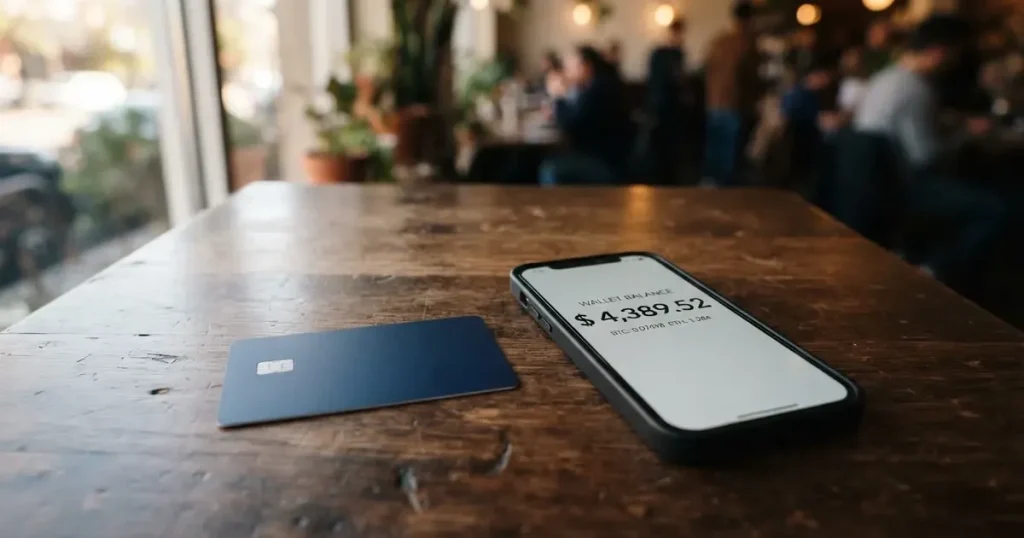
The Trustee card is one of those crypto cards that promises to solve a very practical problem for people who cannot get an ordinary bank card: pay online, pay in shops, and pay in a currency the merchant expects. On paper it does that. The virtual card is orderable, Apple Pay and Google Pay are supported, the card currency is USD and payments in other currencies convert automatically. What stops me recommending it is not the design. It is what I found in the complaint record: funds frozen under anti-money-laundering review with no timeline, withdrawals that do not complete, support replies that read as templates, and a physical card that is currently unavailable at all. My score for it is 5.1 out of 10, and that number is a compromise — it is well above zero because the card genuinely works when it works, and well below “recommended” because the failure modes are the kind that strand real money for months.
The conditions described on this page are current as of October 28, 2026.
Who this is written for: anyone, anywhere, who has trouble getting an ordinary bank card. Country and citizenship rules are told as the card states them — and the first thing to know is that this card does not state them. That gap is itself a finding, and I come back to it below.
Verdict: 5.1 out of 10, and the complaints are why
Here is the score broken down the way I built it. Each line is one criterion, with the mark I gave and the reason in my own words.
| Criterion | Mark | Why |
|---|---|---|
| Who can get it | 5 / 10 | The countries are not listed at all; the pages say only “Issued in Great Britain” and “Worldwide Crypto Card” |
| Cost | 7 / 10 | The virtual card is listed at 10.00 $ and the card advertises “0% fees on transactions”, but the conversion markup is not disclosed |
| Top-up options | 5 / 10 | USDC or USDT, first into the Trustee Plus wallet and then onto the card balance; the networks are not named |
| Reliability and complaints | 3 / 10 | The issuer is Wirex Limited; Trustpilot shows 2.2 out of 5 from 236 reviews, 56% of them one-star |
| Everyday use | 5 / 10 | The virtual card is available, the physical card is temporarily unavailable, and cash withdrawals at ATMs are not available |
| Total | 5.1 / 10 |
The single most useful thing I can tell you about who this card suits: it suits someone in the EU who wants a virtual USD card and can treat the balance as money they are willing to have sit in someone else’s hands for a while. It does not suit someone who needs to get money out — not quickly, and in some accounts not at all — because cash withdrawals at ATMs are not available at present. If your situation is “I cannot open a bank account and I need a card that behaves like one,” read the complaints section before you decide, because the failures I found there are concentrated exactly in the situations people open these cards for.
A note on what is official and what is not. Everything I say about Trustee’s own pages was checked on 2026-10-20. Where I mention third-party sites, I mark them: those figures are not confirmed by the card, they may be out of date, and where they contradict the official pages I say so.
Will they give you the card
Here is the honest answer: probably, if you get past verification, but the card does not tell you who it will give it to. The official pages list no countries. What they say is “Issued in Great Britain” and “Worldwide Crypto Card”. Those two phrases tell you the issuer’s home country and an intention, not an eligibility list.
What circulates outside the card is more specific and, importantly, unofficial. Third-party sites describe the card as being for EEA residents plus Ukraine and Moldova, usable wherever Mastercard is accepted. That description comes from review sites rather than from Trustee, carries no visible date, and sits in the 2023–2025 era, so treat it as a pointer rather than a rule. I would not plan around it. If your country is not obviously in the European Economic Area, the practical question is not “am I eligible” but “what happens when I try”.
Two things about this are worth understanding before you apply, because they apply to crypto cards generally and not just to this one. The first is that the country a card is issued in is visible to merchants at the point of sale. The card number starts with an issuer identification number of six or eight digits, and a merchant’s terminal can look that up to see which institution and country issued it. When the issuer country differs from the billing address you typed, some merchants apply extra scrutiny or decline the payment outright. That is the ordinary explanation for a card that works online and fails in a physical shop — it is not necessarily a problem with your account.
The second is that your nationality is screened separately from where you live. Anti-money-laundering checks apply to citizenship and country of birth as well as to your address, and that is true across this whole category of cards. Residence lists are therefore not the whole picture, and a card that “works in your country” may still be refused on the basis of the document you hold.
How to get it
The card requires KYC before it issues anything. The application runs through the Trustee Plus app, and the stated sequence is: install the app, complete KYC verification, order the card, then top up the balance in USDC or USDT. That last step is not optional in practice — you get a card with no money on it until you fund it, and the funding route is narrow.
The verification itself is a single flow inside the app. You go through Profile, then Identity, then choose your country, then an “Other method” option, then state the purpose of the account and the source of your income, then your address, then upload an identity document — the page says an ID card (national passport) or an international passport — and then a selfie. The card says this “usually takes little time”, but it does not publish a processing time, a set of verification tiers, or a list of reasons for rejection. I want to flag those omissions rather than fill them in: if your case is complicated, you are in the dark about it, and you should ask before you upload anything.
Documents: identity document plus selfie plus address plus the purpose and income questions are what the page states. Proof of address is not stated as a first-step requirement on the pages I read, though users report being asked for further documents later. That is a pattern worth expecting on any card that runs an ongoing anti-money-laundering review.
Two practical things about the card you end up with. It is virtual — that is the format you can actually order today. The physical card is listed as “Temporarily unavailable” with a waitlist, and delivery countries, delivery time, delivery cost and replacement terms are all not stated. If the physical card is the point for you, this card does not currently do that. On the positive side, the virtual card is issued “in a few minutes” once you are through, so if you want a card number quickly, that part works. The card currency is USD and the network is not stated.
Fees: what it really costs
The headline is attractive and the fine print is where this gets complicated. Let me give you the picture in one table first, then walk through three ordinary payments so you can see which fee attaches to which.

| Item | What the card states | Notes |
|---|---|---|
| Virtual card price | 10.00 $ | Listed on the page; not labelled as an issuance fee |
| Physical card price | Not stated as a price; listed “Temporarily unavailable” | Waitlist |
| Monthly fee | Not stated | Unofficial sources say 0 EUR in a month |
| Card transactions | “0% fees on transactions” | The advertised figure |
| Non-USD payments | Automatic conversion at the time of payment | The markup is not stated |
| ATM cash withdrawal | Not available at present | Fees and limits not stated |
| Monthly transaction limit | 30,000 USDC | Daily limit not stated |
That is the whole of the official pricing picture, and two of those rows are blanks rather than zeros. “Not stated” is what the card’s public pages say — I am not filling it in, and neither should you.
Now the three everyday situations. Buying something priced in dollars — that is the card’s home currency, and this is the case where “0% fees on transactions” is doing its job. Buying something priced in euros, Polish zloty or pounds — the card converts automatically at the moment of payment, and the conversion markup is not disclosed. You are told the conversion happens and told nothing about what it costs you. Withdrawing cash — not available. The card says that cash withdrawals from the card in Trustee Plus at ATMs are not available at the moment, and that the team is working on it. The physical card’s feature list mentions cash withdrawals, but the physical card is unavailable, so that mention describes a card you cannot have.
On the unofficial numbers, and I want to be precise that these are not confirmed by the card: third-party sources describe virtual issuance at EUR 10 and physical at EUR 25, with EUR 0 monthly maintenance, and one of them notes there was no virtual issuance charge during a promotion. The official page lists the virtual card at 10.00 $. On conversion, the figure that appears most consistently across sources from the same period is 0.5% for crypto-to-euro conversion, with card payments at 0% commission — but Trustpilot reviews cite conversion fees of up to 2%. That gap between 0.5% and 2% is not something I can resolve; it is a real uncertainty in the price you would pay. On ATMs, an older guide describes withdrawals at NFC-enabled terminals with a PIN, up to EUR 2,000 a day and EUR 10,000 a month at 1.5% plus EUR 1. That directly contradicts what the card says now, and the official statement is the one that describes the present.
One fee that is not the card’s but is worth naming, because it is the one that surprises people: on-chain network fees for your deposit are charged by the blockchain, not by Trustee. If you send USDT on a network, the network takes its cut before the money arrives.
Top up: how the money gets in
Top-up is a two-step thing, and this is the part that catches people out. You send USDC or USDT to the Trustee Plus wallet first, and then move it from the wallet to the card balance. Those are separate balances, and the card does not spend from your crypto directly. Crediting is stated as usually within up to 5 minutes.
What is not stated is as important as what is: which networks to use, what the fee is, and what the minimum is. Getting the network wrong on a stablecoin transfer is not a small mistake. Blockchain transfers are irreversible, so a deposit sent on a network the provider does not support, or sent to an address belonging to a different network, can be lost entirely or need manual support recovery with no guarantee attached. Before you send anything, find out which network the provider wants, and send a small test amount first.
There is more to the funding picture than the two stablecoins, at least according to unofficial sources. One third-party site describes 30+ assets in the wallet, naming BTC, ETH, TRX, USDT, USDC and SOL, and limits card spending to BTC, ETH and USDT, with USDC for wallet top-ups. That partly contradicts the official page, which names USDC and USDT. Treat the wider list as a description of the wallet rather than of what the card will spend.
Getting money back out is the weakest part of the whole system. The wiki links an article on withdrawing money to a bank card which I did not read, and it describes steps for moving a card balance back to crypto, but the fees and the balance on closure are not stated. The wiki also mentions a personal IBAN for SEPA transfers and an article on adding funds to the EUR balance, and a “Trustee Plus fees” article that could not be retrieved. So: euro funding and euro fees exist somewhere in their documentation, and I cannot tell you from the public pages what they are. Ask, in writing, before you rely on it.
Paying with it every day
Everyday use is where this card is decent, with two hard walls. Apple Pay and Google Pay are both supported, which for a virtual card is the practical difference between a card that sits in your wallet and one you have to paste the number into a checkout form every time. The card currency is USD, and payments in EUR, PLN, GBP and others convert automatically at the moment of payment from a single card balance. Blocked merchant categories are not stated — and that silence matters, because gambling, for instance, has a dedicated merchant category code that issuers often block on specific cards by policy rather than by law, and the blocked list varies by issuer. I cannot tell you from the page whether this card declines it.
The walls are these: the physical card is unavailable, and cash withdrawals are unavailable. If your daily life needs either, this is not yet a working answer.
On the app itself: the iPhone build listed is iOS 17.0 and above at version 2.1.6, an Android APK is offered on the site, and the developer is MIKEPAY INC. The App Store listing I looked at was the Nepal storefront and showed no rating because there are not enough ratings there, so I have no meaningful app-store score to give you. The Google Play rating was not read.
Rewards: not stated. Unofficial sources conflict — one comparison says there is no traditional cashback but there are a referral programme and hotel discounts, another says cashback is “in development”, and a sponsored piece claims up to 8% in a way that is not clearly tied to this card. I would not build any expectation around cashback here.
Disputes: not stated on either the card pages or the wiki pages I read. There is no published chargeback process, no reason codes, nothing about how long a dispute takes. This matters more than it sounds, and the next section explains why.
What can go wrong
This is the section that moved me from “interesting card” to “5.1 out of 10”. I am going to walk you through it rather than summarise it, because the specific shape of the failures tells you more than a rating does.
Start with the numbers. Trustee Plus scores 2.2 out of 5 on Trustpilot from 236 reviews, 97 of them in the last twelve months, with 56% one-star and 37% five-star. A separate Trustee Trustpilot page shows 2.5 out of 5 from 5 reviews, all one-star, from June to October 2026, with the profile unclaimed. The company replies to 98% of negative reviews, and the replies are mostly a templated “funds are safe”.
Now the themes, because they are consistent enough to name:
- Funds frozen under anti-money-laundering review, with no timeline. Reviews from April to October 2026 describe money held during a review of source of funds, including one amount of 21,360 USDT held on 1 October 2026, a wait of 53 days, and other cases of 30+ days.
- “Return to source” refunds not completed. From March to October 2026, users report being asked to send funds back to the source and then not completing it.
- Support that reads as copy-paste. June to October 2026.
- Access or verification revoked. July and October 2026.
- A blocked card. July 2026 — and in that case the company’s reply, dated 30 July 2026, attributes the block to the card issuer rather than to itself.
- A chargeback request followed by account closure. On the Trustee page, 22 September 2026. Also 12 October 2026, a request for five documents.
That last one is the one I would think hardest about if I were you. You have no published dispute process on the card or the wiki. A user asks for a chargeback, and the account closes. I am not saying that is what will happen to you — I am saying that the absence of a documented dispute route, combined with a reported instance of closure after one, is a bad combination for anyone whose money depends on being able to contest a charge.
On the corporate side, the issuer is stated as Wirex Limited, and the Trustee entity itself is not named on the page. That is worth noting because of how card programmes work. When you hold a card, several parties are involved: the network (Visa or Mastercard) routes the messages and sets the rules, the issuer is the bank or e-money institution licensed to issue under that network’s licence and holds the card programme, and the crypto brand is often only a programme manager and front end. So a block can genuinely be the issuer’s decision rather than the brand’s — which is exactly what the July 2026 reply says. It also means that when you need help, the company you are talking to may not be the company that can fix it.
Two more things you should know before you deposit. The Trustee Plus page rating is currently unavailable due to a guideline breach, so I cannot give you an in-app rating. And on security, the card’s own page carries a sentence that deserves a second reading: “We safeguard, but we do not control.” It does not explain what that means for custody. Sign-in can use a passkey, Face ID, or an Apple or Google account, and the company advertises multi-level two-factor authentication, vulnerability testing by Hacken, a HackenProof bug bounty and 24/7 reserve monitoring. Insurance is not mentioned, and a card freeze function is not stated.
Finally, on custody, in general terms rather than about this card. With a custodial wallet the provider holds the credentials, so you must trust the provider completely, and a seed phrase — typically 12 to 24 words — is an unencrypted form of the private key that anyone who obtains it can use to restore the wallet and spend the funds. There is no built-in recovery: crypto transfers are typically irreversible and a stolen key cannot be frozen or reversed. The industry record on this is not reassuring — Mt. Gox (about US$350 million reported stolen, 2011–2014), Coincheck (about US$400 million, 2018) and the Ronin Network (US$625 million, 2022). That does not tell you what will happen to your money here. It tells you what the category’s failure mode looks like when it happens.
What to take instead
Let me take you through three alternatives I looked at, because the comparison is more useful than a verdict on one card. All three are virtual-first, all three require KYC, and all three are stronger on disclosure than Trustee — which, given what I found above, is the main thing I was looking for.
| Alternative | Score | Card and issuer | Price | Fees worth knowing |
|---|---|---|---|---|
| TokenPocket | 5.8 / 10 | Visa debit for a list of European countries/territories (Germany, France, Spain, Switzerland among them); Mastercard debit for Australia, Canada, Hong Kong, Japan, Taiwan, New Zealand, Singapore, South Korea, UK; Americas “planned for Q2 2025” | NFT creation fee partly covered by TokenPocket, user pays “a small portion” (amount not stated); no other fees | 1% fee on depositing cryptocurrency into the card, to be refunded later via rewards or reduced transaction fees; FX fee not stated |
| MetaMask | 7.1 / 10 | Mastercard, virtual card issued instantly, Metal pre-orderable after Virtual approval, one card per user; issuer Monovate, card provider Crypto Life | Virtual free, no annual or maintenance fee; Metal $199/year | “Minimal fee for each transaction” (amount not stated on the pages read); no foreign transaction fee, Mastercard rate used |
| KAST | 6.1 / 10 | Visa: Platinum (Standard), Infinite metal (Premium), Infinite gold plated (Private), plus Pengu, Solana and Bitcoin designs; up to 10 cards per user | Annual membership: Standard 0 USD, Premium 1,000 USD/year, Private 10,000 USD/year, billed annually upfront | Stablecoin top-up 0%, USD spend 0%, transaction fee 0%, Apple/Google Pay 0%; non-USD FX fee 0.5%–1.75%; declined transaction 0.50 USD |
KAST is the one whose fee schedule I would most want a competitor to copy. Every domestic number is a zero, and the foreign-exchange fee is given as a range that depends on your residence country, your transaction country and the card programme. It publishes a detailed list of stablecoins — USDT, USDC, PYUSD and RLUSD, on Ethereum, Solana, Polygon, Arbitrum and TRON — and says spending comes from your own balance, deducted immediately, not credit. Its rules on who can use it are unusually explicit: the country list is shown at KYC and not published beforehand, and if your country is not listed, KAST is not available there. It also states that living in a supported country while holding an ID from a restricted region may still make you ineligible, that dual citizens with a supported ID may pass, that only the account holder’s own ID is accepted, and that a VPN does not bypass this. Its own Terms conflict slightly with the app, saying acceptable tokens are “currently USDT and USDC”. Cashback is in USD: 1.5% on the first 2,000 USD a month on Standard, 2% on the first 10,000 USD a month on Premium, 3% on the first 40,000 USD a month on Private. The catch is the tier prices — Premium and Private are expensive, and there is a 1 USD a month inactivity fee after 12 months.
MetaMask scores highest of the three at 7.1, and the reason is structural: the virtual card is free with no annual or maintenance fee, and it spends directly from the connected wallet rather than from a pre-loaded balance you have to top up first. It names its networks — Linea, Base, Monad, Solana — and its tokens, including mUSD, wETH, EURe, GBPe, USDC and USDT. Sign-up is open in 45 listed countries and territories, with proof of residency required, and the FAQ makes a point worth quoting: ineligible regions limit sign-ups, not spending. US and UK sign-ups are temporarily closed. Its drawbacks: cashback is 1% on Virtual, and while Metal’s headline is 3%, the footnote limits 3% to the first $10,000 spent and then it drops to 1%; there is also a $FLY bonus of 5X (Virtual) or 7X (Metal) through the Blackbird dining app. And the transaction fee is only described as “minimal” — the amount is not on the pages I read, with a fee table linked.
TokenPocket sits closest to Trustee in shape and lowest on disclosure. It runs on Arbitrum, its balances are in EUR24 and USD24, and the cards are virtual. It covers part of the NFT creation fee and says there are no other fees, but charges 1% on depositing cryptocurrency into the card, refunded later through rewards or reduced transaction fees. The 1% is not free money deferred — it is a charge you pay now. Specific coins and networks are not listed in the FAQ.
If you want the blunt comparison: Trustee’s advantage over all three is that it names two stablecoins plainly and its virtual card is 10.00 $. Its disadvantage is that it does not tell you the conversion markup, it has no published dispute process, its ATM access is withdrawn, and its complaint record is the worst of anything I looked at.
Who I would recommend it to
Three groups, in order of how comfortable I would be.
Someone in the EU who wants a virtual USD card, holds USDT or USDC, and can leave the balance in place. If your money goes in and mostly stays there, with occasional payments in dollars or a converted currency, and you read the complaint record and accept the AML risk, then this card can do a normal job for normal spending. Apple Pay and Google Pay make the day-to-day part easy.
Someone experimenting with a small balance. The virtual card is 10.00 $, it arrives in minutes, and the app runs a straightforward KYC. Keeping the balance small is the single most effective thing you can do about every risk I have described here — the frozen-AML complaints I found involve five-figure amounts, and that is the number to hold in mind when deciding what to leave behind.
Someone who needs cash, needs a physical card, needs to move money out regularly, or needs to dispute a charge. I would not recommend this card to you today. The physical card is on a waitlist, ATM withdrawals are not available, the withdrawal fees and the balance-on-closure position are not stated, and there is no published dispute process. If you need a chargeback route, you need a card that documents one.
And the question underneath all of it: is this a bank? No. It is a card programme with an issuer named as Wirex Limited and a crypto front end on top. If you are in the EU, an electronic money institution can issue e-money, payment cards and e-wallets but cannot lend, and its customer funds must be safeguarded — segregated in dedicated accounts or insured — which is not the same as a bank deposit and may not sit inside a deposit guarantee scheme. A crypto card often depends on two licences: the card itself is a payment service under e-money or payment-services law, while the crypto side is covered separately by the markets regulation, MiCA (Regulation (EU) 2023/1114), which ESMA says took legal effect in June 2023, with its rules on asset-referenced and e-money tokens applying from 30 June 2024 and the remaining provisions, including crypto-asset service provider rules, from 30 December 2024. Under MiCA, e-money tokens may be issued only by a credit institution or an electronic money institution. The transitional period for providers already operating under national law runs until 1 July 2026 or until they receive or are refused an authorisation, whichever comes first. ESMA keeps an interim register of authorised providers, white papers and non-compliant entities, and that register is where you check a provider — not a marketing page. I am not giving you tax or legal advice here; how spending from crypto is treated for your own tax position depends on your circumstances and your jurisdiction, and you should take that to a professional. What I will say is the general principle: in the US the IRS treats digital assets as property, so exchanging them for goods, services or dollars generally produces a taxable gain or loss measured at fair market value on the date of the transaction — which means each card payment funded from crypto may be a separate disposal.
Frequently asked questions
What is the Trustee card?
Trustee is a crypto payment card and app. You verify your identity in the Trustee Plus app, order a virtual card, load USDC or USDT into the wallet, move that to a separate card balance, and spend it. The card currency is USD and other currencies convert automatically at payment time. It is a payment tool, not a bank account.
Is Trustee a bank?
No. The issuer stated on the card’s page is Wirex Limited, with “Issued in Great Britain”, and the Trustee entity itself is not named there. A crypto card is usually a programme run by a crypto brand on top of a licensed issuer’s card programme, which is why a block can come from the issuer rather than the brand.
Who owns Trustee?
The public card pages do not say. The issuer is named as Wirex Limited, and no Trustee legal entity is listed. If ownership matters to your decision, that is a question to ask the company directly in writing rather than something the pages answer.
Which countries can get the Trustee card?
The card does not list any. Its pages say only “Issued in Great Britain” and “Worldwide Crypto Card”. Unofficial third-party sources describe EEA residents plus Ukraine and Moldova, usable wherever Mastercard is accepted — but that is undated third-party information from around 2023–2025 and may be out of date. Check with the company before you rely on it.
Does the Trustee card require KYC?
Yes, KYC is required before the card is issued. The in-app flow covers profile, identity, country, an “Other method” route, the purpose of the account and source of income, address, an ID card or international passport, and a selfie. Levels, processing times and rejection reasons are not stated, and further documents may be requested later.
How much does the Trustee card cost?
The virtual card is listed at 10.00 $ and the card advertises “0% fees on transactions”. The monthly fee is not stated. Unofficial sources say EUR 0 monthly, virtual issuance EUR 10 and physical EUR 25, and a 0.5% conversion fee, while reviews cite conversion fees of up to 2%. The markup on automatic currency conversion is not disclosed.
Can I get cash out with the Trustee card?
Not at present. The card states that cash withdrawals at ATMs are not available in Trustee Plus and that the team is working on it, and the physical card — whose feature list mentions cash withdrawals — is temporarily unavailable on a waitlist. Unofficial older guides describe ATM limits and fees, but they contradict the current official position.
How do I top up the Trustee card?
Send USDC or USDT to the Trustee Plus wallet first, then move it to the card balance, which is a separate balance. Crediting is usually within up to 5 minutes. The supported networks, the fee and the minimum are not stated, and transfers are irreversible — so a wrong network can mean lost funds.
Is the Trustee card safe?
It uses passkey or biometric sign-in, multi-level two-factor authentication, Hacken vulnerability testing and a bug bounty, but its own page says “We safeguard, but we do not control” without explaining custody, insurance is not mentioned, and the complaint record includes funds frozen under AML review for 53 days and longer. Safety here depends as much on the provider as on the technology.
Is the Trustee card worth it?
For a small, stable balance and spending you can leave in place, possibly. For cash access, a physical card, regular withdrawals or a documented dispute route, no — the physical card is unavailable, ATM withdrawals are not available, and no dispute process is published. My overall mark is 5.1 out of 10.
Wallet cards: your questions answered – cryptocardanswers
Content created by the «cryptocardanswers» team