
A Bitcoin-first Visa debit card for people inside the EEA who want to spend BTC like cash
 Available in US
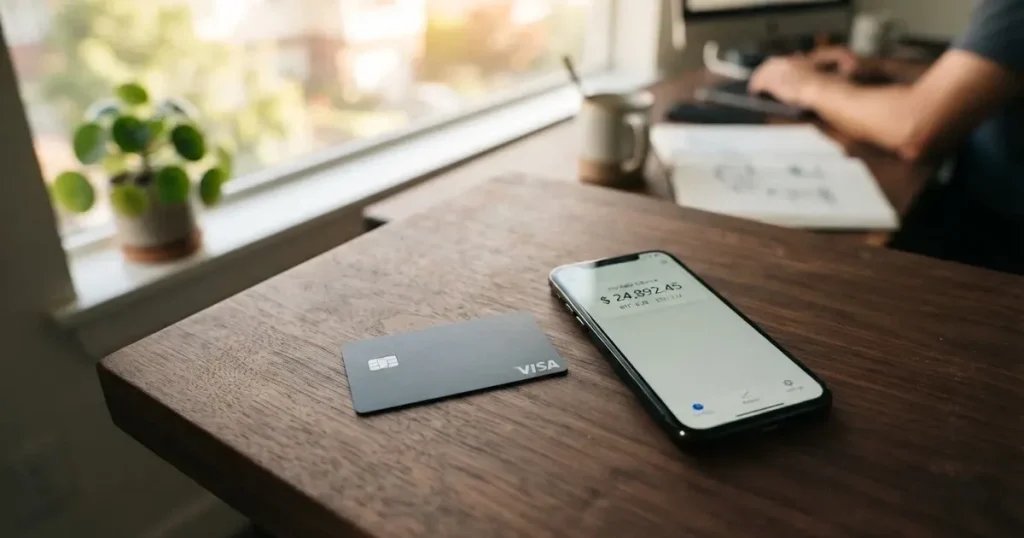
The wavecard is a Visa debit card, virtual or physical, that holds your balance in Bitcoin and converts to euro at the moment you pay. The card is run by Wave Space Exploration UAB, a Lithuanian company, with payment services provided by Lightspark Payments Europe AS in Tallinn, and the plastic itself issued through a white-label partner. It is a niche product rather than a mainstream one: it works for a defined audience, in a defined region, with one funding asset. Whether that audience includes you, and whether the trade-offs are worth it, is what this review sets out to answer.
Conditions in this review are current as of October 28, 2026.
My verdict on wavecard
I give wavecard 6.3 out of 10. That number is built from the five criteria below, and the reasons behind each mark matter more than the total.
| Criterion | Score | Why I scored it this way |
|---|---|---|
| Who can get it | 5 / 10 | Every EEA resident aged 18 and over, by place of residence, not by citizenship. That excludes the UK, Switzerland, the US, Canada and most of the rest of the world. |
| Cost | 7 / 10 | Issuance is paid in BTC (about 2.99 EUR virtual, 29.99 EUR physical), the monthly fee is free, the BTC conversion is 1%, the spread is around 0.5% inside the BTC price, there is no FX fee between fiats, and ATM withdrawals cost 3% plus 2 EUR. |
| Top-up options | 6 / 10 | Bitcoin on-chain or via Lightning, euro on a personal vIBAN that buys BTC, an optional “PRO” mode that connects your own Lightning wallet through NWC. No stablecoins. |
| Reliability and complaints | 6 / 10 | Operated by Wave Space Exploration UAB in Lithuania with Lightspark Payments Europe AS in Tallinn, card issued via a white-label partner. Trustpilot sits at 4.3 across 25 reviews, and at least one user account was blocked with funds held in January 2026. |
| Everyday use | 8 / 10 | Virtual card instant, physical card on tracked delivery in 5 to 9 working days, default support for Google Pay, Samsung Pay, Fitbit Pay and Garmin Pay, ATM up to 350 EUR a day. Apple Pay only through the Curve app. |
| Total | 6.3 / 10 |
Who wavecard suits is, in one line, EEA residents who want to spend Bitcoin from a euro IBAN and who are comfortable holding their spending balance in BTC. If you only hold stablecoins, if you live outside the EEA, or if you need a fully self-custodial card, this is not the product. If you are a Lightning user in, say, Germany or Portugal, who wants a Visa debit for everyday shops and does not mind a 1% conversion fee on top of the spread, then wavecard was designed with you in mind.
Who will actually give you the card
Wavecard is geographically narrow. The official rule is that the card is available to all residents aged 18 and over in the European Economic Area, and the rule is by residence, not by citizenship. That means the card is offered in Austria, Belgium, Bulgaria, Croatia, Cyprus, Czechia, Denmark, Estonia, Finland, France, Germany, Greece, Hungary, Ireland, Italy, Latvia, Lithuania, Luxembourg, Malta, the Netherlands, Poland, Portugal, Romania, Slovakia, Slovenia, Spain, Sweden, Liechtenstein, Norway and Iceland — thirty countries in total, of which the last three are EFTA members of the EEA rather than EU members. If you are a citizen of one of these countries but live in, say, Dubai, you are not eligible. If you are a citizen of Brazil living in Berlin, you are.
The reason that distinction matters is that sanctions screening, issuer risk policy and onboarding rules usually look at both the address and the country of birth or nationality. Wavecard, by tying eligibility to residence, is taking a narrower cut than the law requires, and that has a knock-on effect on who can practically apply.
Beyond geography, two conditions apply. You must be at least 18, and you must pass the platform’s KYC. The card programme only talks about one KYC level, “Tier 2”, and that tier lifts the monthly spending ceiling to 15,000 EUR; other tiers, processing times and rejection reasons are not stated in public documents. What is stated is that the verified wave.space account is free of charge, and that the on-screen flow is meant to take under five minutes. The exact documents you will be asked for, and the kind of proof of address that is accepted, are not stated.
What is not stated matters here, because the answer is the same in almost every case: a passport or national ID, a selfie or short video check, and a recent proof of address such as a utility bill or bank statement. Treat anything else as not confirmed.
How to get the card
Getting a wavecard is a three-step process: open and verify a wave.space account, request a personal vIBAN, and then order a virtual or physical card from the same app.
- Sign up and verify. The first step is to create a wave.space account, which is described as taking under five minutes. KYC is free of charge. The platform only describes one verification level, Tier 2, and that is what unlocks the higher monthly limit of 15,000 EUR. What is not stated is what the other tiers are, how long verification takes, and which documents are accepted for proof of address. Until those details are published, treat the “under five minutes” figure as an aspiration rather than a promise.
- Request a vIBAN. Verified users get a personal vIBAN, which is the euro entry point. You do not “load” euros onto the card; you top up the vIBAN, the euro is converted into Bitcoin at the platform’s rate, and the card spends that BTC. The vIBAN is also how you receive salaries and transfers, and it is your refund path if a payment is reversed.
- Order the card. A virtual card is available instantly and costs 2.99 EUR paid in BTC. A physical Visa debit card costs 29.99 EUR paid in BTC, ships tracked to any of the thirty EEA countries in 5 to 9 working days for free standard delivery, with an express option in 2 to 3 working days for 30 EUR. The card is activated on delivery. The card currency itself is not stated publicly; what is stated is that the vIBAN is euro, that there is no FX fee between fiat currencies, and that the card’s behaviour is euro-equivalent for merchants. You can create more than one card from the same account.
There is no Apple Pay shortcut. Apple Pay is supported only through the Curve app, which adds another layer of fees and a third-party failure mode. Google Pay, Samsung Pay, Fitbit Pay and Garmin Pay are added by default on physical cards. Direct Apple Pay support is described as “coming soon” on the platform’s own pages, which I read as not yet shipped.
What wavecard really costs: Fees
Cost is the part where wavecard is neither cheap nor expensive for the category. The card opening is paid in Bitcoin, the monthly fee is free, the headline conversion is 1% and there is no FX fee between fiat currencies — but the spread is real, the ATM is expensive, and almost every other limit is silent. The costs table below is built only from what the platform states publicly.

| Fee or limit | Amount | Notes |
|---|---|---|
| Virtual card issuance | 2.99 EUR (paid in BTC) | Instant |
| Physical card issuance | 29.99 EUR (paid in BTC) | 5–9 working days tracked; express 2–3 working days 30 EUR |
| Monthly fee | Free | — |
| Bitcoin conversion fee (at spend) | 1% | “Crypto to Euros swaps” per terms |
| Spread inside the BTC price | About 0.5% | “Already baked into the BTC price” |
| FX fee between fiat currencies | None stated | Multi-currency balances not stated |
| ATM withdrawal | 3% + 2 EUR | Free allowance not stated |
| Daily spend limit | 10,000 EUR | Up to 15,000 EUR with Tier 2 KYC |
| Monthly spend limit | 10,000 EUR | Up to 15,000 EUR with Tier 2 KYC |
| Daily ATM limit | 350 EUR | — |
| Monthly ATM limit | 3,000 EUR | — |
| Deposit fee | Not stated | Network fees may apply |
| Minimum top-up | Not stated | — |
| Replacement card cost | Not stated | — |
To make those numbers feel real, here are three everyday payments and what they actually cost.
Coffee at 4 EUR. You tap the card at a café. The merchant sees 4 EUR. Wavecard sells 4 EUR worth of BTC at the platform’s quoted rate, charges a 1% conversion fee on top, and the spread inside the BTC price is roughly 0.5%. All in, the fee is 1% plus about 0.5% spread before the card network’s own interchange and scheme fees, which the merchant pays, not you. For 4 EUR the absolute cost is small — roughly six cents — but the percentage is what you’d compare.
Weekly grocery shop at 120 EUR. Same mechanics, same 1% conversion fee and 0.5% spread. For 120 EUR, the total cost is roughly 1.80 EUR. There is no extra foreign-exchange layer, because the card is euro, the merchant is euro, and the BTC-to-EUR conversion happens at the moment of payment.
ATM withdrawal of 100 EUR. Here the bill climbs. The 3% + 2 EUR formula means you pay the 3% charge plus the 2 EUR fee on a 100 EUR withdrawal, plus any fee the ATM operator itself charges on top. At that point, the cost is significant, and it gets worse for smaller amounts. Wavecard is not a card to use for cash.
Two figures that are not stated publicly are the deposit fee and the minimum top-up. Treat anything you read on a forum as unofficial and not confirmed by the card.
How to top up wavecard
The funding story is narrower than most crypto cards, because there is exactly one asset you can put on the card: Bitcoin. There are several routes to that BTC, and which one is cheapest depends on where the BTC is already sitting.
On-chain BTC. The straightforward option: send Bitcoin to a deposit address the app gives you. The trade-off is that you pay the Bitcoin network fee, which fluctuates with mempool congestion, and you wait for confirmations. Wavecard’s terms note that the deposit fee is not stated explicitly and that network fees may apply; this is the same as saying “we pass the miner’s fee through”. The card holds the BTC until you spend, and sells at the moment of payment, so you are exposed to BTC price moves between top-up and spend.
Lightning. Send via a Lightning invoice or an LN address, which is cheaper and faster for small amounts than on-chain and bypasses mempool queues. There is no on-chain fee beyond the channel cost your wallet pays. If you are paid in sats and want to spend them the same day, Lightning is the natural choice.
Euro to a personal vIBAN. You do not “fund” the card in euros; you fund your vIBAN, and the platform converts the euros to BTC at its quoted rate. The terms describe a 1% conversion for the swap. This is the path for salary, a SEPA transfer from a regular bank, or any other euro that starts life outside crypto.
PRO mode: a self-custodial Lightning wallet via NWC. PRO is the option for users who do not want to give up control of their private keys. The card connects to your own Lightning wallet through Nostr Wallet Connect (NWC); Alby is named in the platform’s documentation as the recommended wallet. In this mode, the BTC never leaves your wallet until the moment of payment, so the cardholder bears the cost and the responsibility of running that wallet. Self-custody is described in more detail in the background section below.
There is no stablecoin funding, no USDT, no USDC, no EURC. If your balance is in stablecoins, you have to convert them to BTC off-platform, and the spread and fee for that conversion are someone else’s problem.
Refunds go back as Bitcoin. The terms say card refunds are “converted back to BTC at the available market rate”, so the asset you get back is the asset you spent, even if the merchant refunds in euro.
Account closure is by email to [email protected]. What happens to a remaining balance on closure is not described in detail, and accounts inactive after 365 days may be closed or charged a maintenance fee — the exact rule is not stated.
Paying with wavecard every day
In normal use, the card behaves like any other euro Visa debit, and that is the point. The virtual card is instant and the physical one is a Visa debit. Google Pay, Samsung Pay, Fitbit Pay and Garmin Pay are added by default, which covers the bulk of contactless phones and watches. Apple Pay is only available through the Curve app, which means an extra app, an extra layer of tokenisation, and the failure modes of two companies instead of one when something goes wrong.
The merchant experience is euro. There is no foreign-exchange layer, because the card is euro, the vIBAN is euro, and the conversion is BTC-to-EUR inside the platform. The blocked merchant categories are not stated publicly; the assumption should be that standard issuer rules apply, which usually means gambling and a small list of high-risk MCCs, but treat that as a guess, not a fact.
The dispute and refund process is the weakest part of the everyday story. There is no chargeback process described in the platform’s own documentation, and cardholder claims are referred to the Card Issuer’s Terms. The platform says it will respond to claims within two business days. Refunds are converted back to BTC. Whether the issuer behind the white-label arrangement offers Regulation-E-style US rights or a similar EU equivalent is not stated, and US-style chargeback rights do not apply to a euro card, so the question is really what the issuer’s terms give you in writing.
The web app lives at app.wave.space. There is no App Store or Google Play rating recorded here. If you decide to install, check the store page yourself, because the rating changes faster than any review can keep up.
There is no cashback or rewards programme stated publicly. Treat any “earn” feature you see advertised elsewhere as unofficial and not confirmed by the card.
What can go wrong with wavecard
The risks fall into three groups: counterparty risk, regulatory risk, and the kind of operational risk that shows up in user reviews.
Counterparty risk. Wave Space Exploration UAB is the company behind the product. It is registered in Lithuania under company number 306727148. The licensable financial services are provided by Lightspark Payments Europe AS, registered in Tallinn under 16298772. The card is “issued through a white-label arrangement with a third-party provider, and Wave Space acts as the distributor”. The licence type is not stated, and the contract is governed by Lithuanian law. When you put BTC onto the card, you are trusting the chain of Wave Space, Lightspark and the unnamed white-label partner, and the safeguarding arrangements of all three.
Account freeze with funds held. The most concrete operational risk is a January 2026 user report on Trustpilot: the user said their account was blocked after sending money and that funds were kept. The company replied on 18 March 2026 that the account was suspended for compliance reasons and that a full refund was offered. This is one case, but it is the case the platform has been asked to explain in public. If you keep spending balance on the card, that is your exposure.
Trustpilot pattern. Wavecard’s Trustpilot score is 4.3 from 25 reviews, with a star graphic showing 4.5 — read on 21 October 2026. The themes that show up across reviews are the same as the compliance case: account freeze with withheld funds (January 2026), a claim that some reviews are fake (June 2025, disputed by the company), requests for Lightning support and a physical card (January to August 2025), and slow Bitcoin confirmations (January 2025). 25 reviews is a small sample, so the pattern is suggestive, not decisive. A score of 4.3 is not bad.
Self-custody responsibilities. If you use the PRO mode that connects your own Lightning wallet through NWC, the BTC stays in your wallet until the moment of payment, which is the right answer to the counterparty problem. The trade-off is that you alone are responsible for the seed phrase, the channel liquidity, the address you paste, and the malware that may try to swap a copied address. Cryptocurrency transfers are typically irreversible, and a stolen private key has no built-in recovery: the network cannot freeze or return the funds.
Programme-level risk. A payment card depends on the card network and the issuer. Visa and Mastercard do not issue crypto cards to consumers themselves; they license issuers, and they can suspend a programme. The relevant precedents are the FTX programme wound down after Visa terminated its global agreements in November 2022, and the WaveCrest suspension in 2018 that closed a generation of European crypto Visa programmes. A 2026 secondary-source report described a programme closure with new loads ending on 8 July 2026 and spending stopping on 8 August 2026 — that is a single source and is unconfirmed, but it is the kind of timetable to be aware of.
Security features in the app. You can freeze the card, change limits, set a 3-D Secure password and use recovery codes. A pseudonymous name on the card is allowed. Whether the funds are safeguarded in a segregated account, in the way an electronic money institution would, is not stated, and that detail matters: segregated funds are not bank deposits, but unguaranteed funds are simply unsecured creditors’ claims in an insolvency.
Support channels. Live chat on Telegram (t.me/wavespacecommunity), email at [email protected] and [email protected], an FAQ, and a live support widget. Response time is stated as “within 2 business days”. If your problem is an account freeze, “within 2 business days” can feel long.
What to take instead of wavecard
Wavecard is one of several Bitcoin-or-crypto-first Visa and Mastercard programmes, and the honest comparison is to cards that accept the same kind of user, with a different set of trade-offs. The four below are the ones I would actually look at alongside wavecard.
International Visa Card. A US-issued Platinum Visa virtual card, with the physical card “coming soon”. Card use in USD is free on every plan, foreign-currency payments take a 2% FX fee on top of the Visa rate, and deposits in any form are free. Plans are Classic (free), Pro (9 USD a month) and Max (19 USD a month). It is paid for in USDC and USDT into the USD account, with USD, EUR, SEPA, SWIFT and FedNow deposits also supported. The catch is geography: the card is not available to residents or legal registrants of Belarus, mainland China, North Korea, Cuba, India, Iraq, Iran, Israel, Myanmar, Nepal, Nicaragua, Russia, Syria, Turkey, Ukraine, Venezuela and Vietnam, with FATF grey-list countries reviewed case by case, and purchases are blocked in North Korea, Cuba, Iran, Russia, Syria, Ukraine and Venezuela. If you are in the EEA and the country is on the list, this card is not an option. Score: 6.7 / 10.
UNi Card. A multicurrency Mastercard that spends from a UNi.Global account balance. The platform says “no annual fee or foreign transaction fee”, with assets converted at “live OTC (over-the-counter) rates” and “no hidden exchange fees”. The headline perk is a “Spend-to-Earn rewards” programme of up to 3% on UNi Card spending. Physical and virtual form factors and the exact eligibility list are not stated. If multicurrency and a Mastercard acceptance footprint matter to you, this is the one to read up on. Score: 6.1 / 10.
Morse. A self-custodial Visa prepaid debit, currently fully virtual, that spends from a Morse Balance “in any currency” with “zero foreign exchange fees or markups” and the real-time Visa rate. The wallet is self-custodial, USDC, USDG and EURC on Solana are free to deposit, and other tokens and chains carry a fee; Bitcoin, USDT, Ethereum and other tokens can be deposited. Eligibility is by residence, not citizenship, and the P2P app is available in over 140 countries, with local add/withdraw in over 70. The card is closed-beta in a long list of countries (American Samoa, Australia, Cape Verde, Guernsey, Hong Kong SAR China, Isle of Man, Japan, Jersey, New Zealand, Serbia, Singapore, Switzerland, Thailand, Türkiye, the United Kingdom and Western Sahara) and the user has to check the app for current card availability; “the card is available only in certain countries”. Sanctions from the US, UK, EU and UN apply. If you want a self-custodial card with multi-currency balances, this is the closest in design to wavecard’s PRO mode but with a different set of assets. Score: 7.5 / 10.
A short note on how the four compare on the dimensions that matter most:
- Geography: wavecard (EEA, 30 countries), International Visa Card (excludes a long sanctions-style list), UNi Card (not stated), Morse (140+ P2P countries, narrower card list).
- Asset on the card: wavecard (BTC only), International Visa Card (USDC/USDT/USD), UNi Card (multicurrency), Morse (multicurrency).
- FX fee: wavecard (none between fiats), International Visa Card (2% on non-USD), UNi Card (none stated), Morse (none).
- Self-custody option: wavecard (PRO via NWC), International Visa Card (custodial), UNi Card (not stated), Morse (self-custodial).
- Apple Pay: wavecard (only via Curve), International Visa Card (not stated), UNi Card (not stated), Morse (not stated).
Who I would recommend wavecard to
The honest answer is a narrow one. I would recommend wavecard to an EEA resident, aged 18 or over, who already holds Bitcoin, who wants a euro Visa debit that converts BTC at the moment of payment, and who is willing to accept that the card is operated by a small Lithuanian company with a white-label issuer behind it. I would suggest the PRO/NWC option to anyone who can run their own Lightning wallet, because it limits the counterparty risk to the moment of payment.
I would not recommend it to anyone outside the EEA, to anyone whose primary spending asset is a stablecoin, to anyone who needs Apple Pay as a default, to anyone who relies on cash from ATMs more than occasionally, and to anyone who is unwilling to read the issuer’s terms before keeping a non-trivial balance on the card. The account-freeze case from January 2026 is a single data point, but it is the data point that exists, and the 1% conversion plus 0.5% spread is what you pay for the privilege of holding BTC on a Visa.
If your situation is a close fit, wavecard is a reasonable product. If it is not, the alternatives above are worth a read before you sign up.
Frequently asked questions
What is wavecard?
A Visa debit card, virtual or physical, that holds your balance in Bitcoin and converts it to euro at the moment of payment. It is operated by Wave Space Exploration UAB in Lithuania, with payment services from Lightspark Payments Europe AS in Tallinn, and the card itself is issued via a white-label partner.
How does wavecard work?
You verify a wave.space account, get a personal euro vIBAN, fund the vIBAN (in euro) or send BTC on-chain or via Lightning, and the platform holds the BTC. When you pay, the card sells the BTC at the platform’s rate, charges a 1% conversion fee plus roughly 0.5% in spread, and the merchant receives euro. The optional PRO mode connects your own Lightning wallet through Nostr Wallet Connect, so the BTC stays in your wallet until payment.
Is wavecard a bank?
No. Wave Space Exploration UAB is a Lithuanian company, and the licensable financial services are provided by Lightspark Payments Europe AS, an Estonian payment institution. The card is issued through a white-label arrangement with a third-party provider, and Wave Space acts as the distributor. Funds are not bank deposits, and deposit-guarantee schemes do not apply.
Who owns wavecard?
Wave Space Exploration UAB, registered in Lithuania under company number 306727148. The licensable financial services are provided by Lightspark Payments Europe AS, registered in Tallinn under 16298772. The card-issuing partner behind the white-label arrangement is not named in the public documents.
Is wavecard available in my country?
The card is available to residents aged 18 and over in the EEA, which is Austria, Belgium, Bulgaria, Croatia, Cyprus, Czechia, Denmark, Estonia, Finland, France, Germany, Greece, Hungary, Ireland, Italy, Latvia, Lithuania, Luxembourg, Malta, the Netherlands, Poland, Portugal, Romania, Slovakia, Slovenia, Spain, Sweden, Liechtenstein, Norway and Iceland. Eligibility is by residence, not by citizenship. It is not offered in the UK, Switzerland or the US, and that list is not stated to expand.
How do I top up wavecard?
Three routes: send BTC on-chain to a deposit address, pay a Lightning invoice or LN address, or send euros by SEPA to your personal vIBAN. The euro path converts to BTC at the platform’s rate, with a 1% conversion fee per the terms. Stablecoins are not accepted.
How do I add wavecard to Apple Wallet?
You cannot, directly. The platform describes Apple Pay support as “coming soon”. Today, the only path to Apple Pay is through the Curve app, which tokenises the wavecard into Apple Pay. Google Pay, Samsung Pay, Fitbit Pay and Garmin Pay are added by default on physical cards.
Is wavecard safe?
That depends on what you mean. The card has standard app-based safeguards — freeze, limits, 3-D Secure, recovery codes, and the option to keep your BTC in your own wallet via the PRO mode. The platform is not a bank and funds are not covered by deposit guarantees, and at least one user account was blocked with funds held in January 2026. The Trustpilot score is 4.3 from 25 reviews. Treat it as a small issuer with a small user base, and do not keep more on it than you can afford to leave there.
How do I delete my wavecard account?
Send an email to [email protected] and ask for closure. The platform does not describe what happens to a remaining balance on closure in detail, and accounts inactive for 365 days may be closed or charged a maintenance fee. Refunds go back as Bitcoin, not as the fiat equivalent at the time of the original payment.
Is wavecard worth it?
For an EEA resident who already holds Bitcoin, who is happy to spend BTC and accept a 1% conversion fee plus about 0.5% spread, and who does not need Apple Pay, yes, with eyes open. For anyone outside the EEA, anyone who wants stablecoin funding, or anyone who needs a card with a deep track record, no.
App and neobank cards: your questions answered – cryptocardanswers
Content created by the «cryptocardanswers» team