
YPT card, reviewed from the outside: who it suits, what it costs, where it stumbles
 Available in US

The YPT card lets you spend BTC, ETH, USDT and USDC through a virtual Visa/Mastercard-style number, converted to fiat at the point of payment. It is a product of YPT Company together with RedotPay, aimed at people who hold crypto and want a normal card experience without first cashing out to a bank. The headline is straightforward: it works, it is broadly accessible, and the fees are visible on the website. The question is whether the gaps the card does not talk about — the unnamed issuer, the networks you deposit on, the physical card that is not yet here — are deal-breakers for you.
Conditions are current as of October 28, 2026.
Verdict
I put the YPT card at 7.4 out of 10. That is a respectable score for a niche product: it is honest about its fees, easy to get into, and the everyday experience is clean for a virtual card. It loses points for not naming the card network, the issuer or the deposit networks, for not publishing an issuance price, and for the physical card being marked “coming soon” without a date. The score below is how I got there.
| Criterion | Mark | Why it scores where it does |
|---|---|---|
| Who can get it | 9 / 10 | Only five mailing-address exclusions; the billing address is not restricted, so most people can sign up |
| Cost | 7 / 10 | 1% in USD, 2.2% in other currencies; small-authorisation and decline fees are disclosed; issuance price is not published |
| Top-up options | 7 / 10 | USDT, USDC, BTC, ETH; converted at payment; networks are not listed; minimum above 1U |
| Reliability and complaints | 7 / 10 | Backed by YPT Company and RedotPay; assets held by a licensed trust company with $50 million in insurance; issuer not named; no complaints surfaced |
| Everyday use | 6 / 10 | Virtual card with Apple Pay and Google Pay; physical card and ATM access “coming soon” |
If you mainly want to spend stablecoins or the larger crypto assets from a balance you already control, the YPT card does the job. If you need a physical card now, an ATM, or a clearly named card scheme on the front, you will want to wait, or look at a more mature alternative.
Will they give you the card
YPT is unusually open about who it serves. The help centre names five places it cannot ship a physical card to as a mailing address: Egypt, Tunisia, Palestine, Puerto Rico and Tanzania. The billing address is a separate field and is not on that list, which matters: in practice, many of the people I would expect to be blocked — for instance those living under sanctions or in jurisdictions the card issuer will not touch — are not excluded here, as long as the card itself is delivered somewhere else.
That split between delivery country and billing country is the kind of detail worth pausing on. A card that ships to one country and bills from another is not unusual in the prepaid world, but it can cause friction later: some merchants check whether the issuer country matches the billing country and may apply extra scrutiny if it does not. If you plan to use the card mostly online, this is rarely a problem. If you plan to use it face-to-face abroad, expect an occasional confused cashier or a declined authorisation at hotels and car rentals that pre-authorise large amounts.
YPT does not publish a citizenship rule separately from a residence rule, and it does not run a tiered eligibility system. You are either in or you are not, on the basis of the address you give.
How to get it
Signup goes through Sumsub, a third-party identity-verification provider widely used in crypto. You submit your full legal name, date of birth and an identity document — an ID card, a passport or a driver’s licence. YPT notes that further information can be requested, which is the standard line a regulated issuer will use to ask for proof of address or a source-of-funds declaration at a later stage. Unofficial sources, including a May 2025 iq.wiki summary, describe KYC as required for compliance; the official product page treats it the same way.
What you end up holding is, for now, a virtual card. The navigation on the YPT site lists a “physical card” entry, but the page itself is marked “IT WILL BE PUT INTO USE SOON” and gives no further detail. There is no statement of the card scheme (Visa or Mastercard), no currency symbol on the front, and no delivery time or shipping fee for the physical version. I take this as the single largest gap in the product today: the public-facing card description is incomplete on the questions most readers ask first.
There is no public activation step that I can see beyond funding the card. There is no separate “tier” of verification that unlocks more spending, and no stated maximum age other than the usual adult requirement for prepaid products. In short, the signup is short, the KYC is standard, and the rest of the process depends on a physical card that does not yet exist in a form the company has documented.
Fees: what it really costs
The fee schedule is the cleanest part of the YPT offering. It is published on the site, in numbers, and it does not shift between “starting from” and “depends on usage” the way some competitors do. The table is the spine of this section, and the examples that follow show how those numbers land on real spending.

| Fee or limit | Value |
|---|---|
| Issuance | Not stated |
| Monthly fee | Not stated |
| Conversion (default currency, USD) | 1% |
| Conversion (non-default currency) | 2.2% |
| Small-authorisation fee | $0.20 per transaction between $0 and $1 (first 5 per card per month waived) |
| Declined-transaction fee | $0.5 (first 3 per card per month waived) |
| ATM withdrawal | Not stated; physical card marked “coming soon” |
| Per-transaction limit (USD card) | $100,000 |
| Daily limit (USD card) | Unlimited |
A few examples show what the schedule feels like in practice.
Buying coffee in the US for $5. You pay 1% in conversion, so 5 cents. There is no small-authorisation fee because the transaction is above $1, and there is no decline fee. Total: about 5 cents on a $5 purchase.
Buying a book online from a European shop for €20, billed in EUR. Your USD balance is converted to EUR at the card’s wholesale rate, then a 2.2% non-USD fee is added. On a €20 transaction, that is about 44 cents. If the merchant converts the price into USD at its own rate and charges you in USD, the 1% applies instead, and you may get a worse merchant rate; which path the payment takes depends on the merchant’s settings, not yours.
A $0.50 in-app purchase on a subscription. A 1% conversion fee would be half a cent, but the $0.20 small-authorisation fee kicks in because the transaction is below $1. Five of these a month are free, after which each one costs you 20 cents on top of the price. This is the fee most likely to bite a casual user.
A declined transaction. $0.5, with the first three each month waived. Declines happen — an expired card on file, a merchant in a blocked category, a 3-D Secure failure — and a $0.5 charge per failed attempt can add up if a subscription is retrying.
The issuance price for the physical card is not stated. If you only need a virtual card, this is probably irrelevant; if you intend to use the physical card the moment it ships, ask [email protected] before you fund the account.
Top up: how to fund the card
Funding is the part of the YPT card I find the most “crypto-native” and also the most under-documented. The supported coins are USDT, USDC, BTC and ETH. The app shows you a deposit address (or a QR code) for the coin you choose, you send the funds, and YPT converts the crypto to fiat only at the moment you pay, not at the moment you deposit. That last point is the key: a euro-priced dinner in Berlin is converted from your crypto balance at the rate the moment you tap, not at the rate the day you topped up. This is the cleaner of the two models, because you keep the upside (and the downside) of any price movement in between.
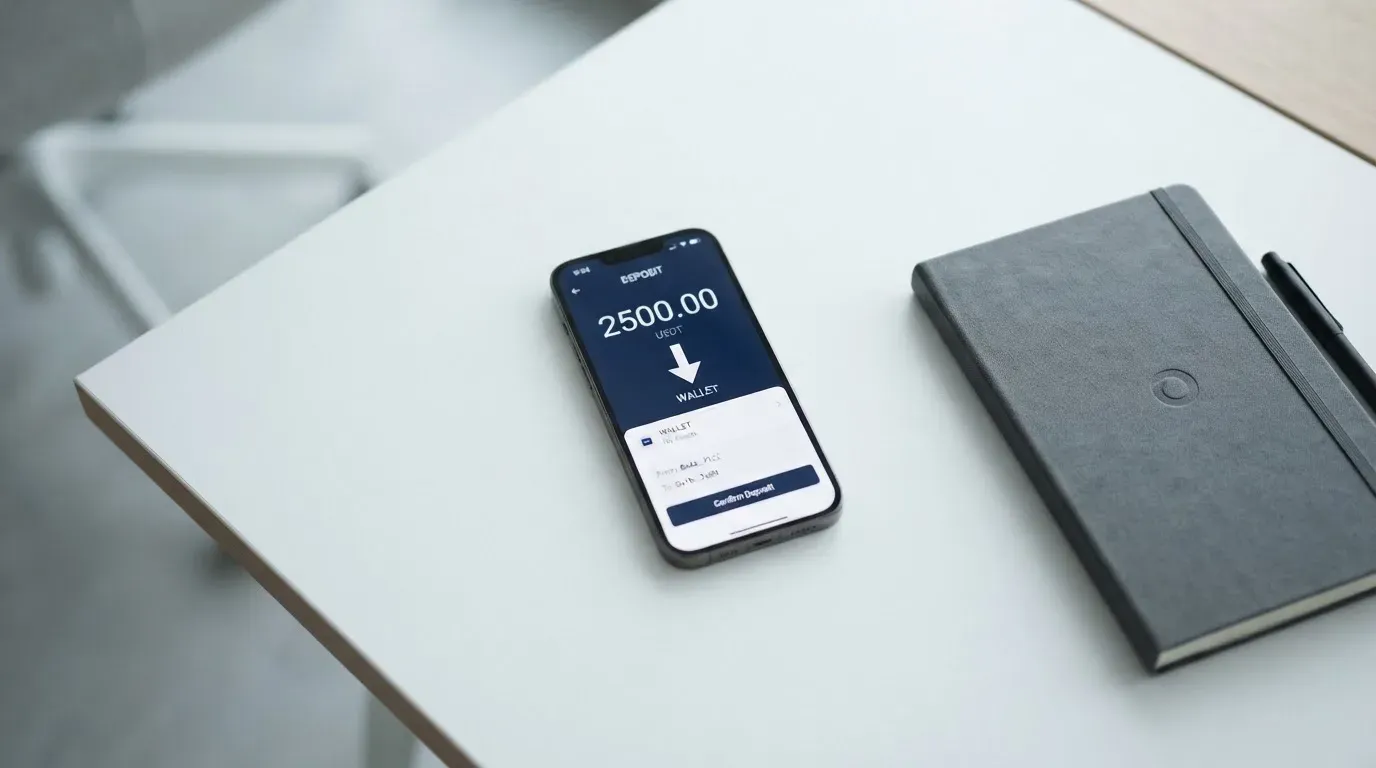
What YPT does not tell you on the public pages, and which I would want to know before my first deposit, is the network. USDT and USDC exist on many blockchains — Ethereum, Tron, Solana, Polygon, Arbitrum, Avalanche and others — and each one has a different address format, different speed and different fee. Sending USDT on the wrong network is one of the most common ways people lose money in crypto. The in-app flow requires you to pick a network, which is reassuring, but the website does not name the supported networks or document them, so you have to trust the app screen at the moment of deposit.
The minimum is described simply: a top-up must be higher than 1U (1 unit of whichever coin you pick, or its USD equivalent — the site uses the symbol “U” without specifying). Anything below that is not credited and cannot be retrieved. Unsupported coins, or coins sent on unsupported networks, are lost. This is not unusual for crypto cards but it is worth treating as a real risk: the “send to the right address” step is irreversible and the wrong choice is not recoverable.
There is no stated withdrawal path from the YPT card back to crypto or to a bank. If the product works the way the description suggests, the card balance is a fiat balance that is spent down, and any leftover stays on the card. If you want to cash out, you would normally pay yourself at a merchant or push the balance back through the app — the page does not say.
Paying with it every day
Day-to-day use is built around the virtual card. YPT describes the ability to bind the card to Apple Pay, Google Pay and “multiple payment platforms”, which in practice means mobile wallets and probably browser-based payment tools. The 3-D Secure layer, which prompts you for a one-time code on online purchases, is the industry default for cards with a European-style authorisation flow; YPT does not say explicitly that it uses Visa Secure or Mastercard Identity Check, but the same protection is part of how a regulated card works.
There is no published list of blocked merchant categories, and no rewards or cashback scheme in the public materials. That is unusual but not a deal-breaker: some users do not want a points scheme that is funded by interchange and quietly raises the merchant’s cost. The trade-off is that the card gives nothing back for spending.
The mobile app is described in unofficial sources (iq.wiki, May 2025) as available on iOS and Android, used for card applications, deposits and tracking. I have not read the store ratings, and YPT does not officially document the app on the product pages, so treat the iOS/Android availability as unofficial and not confirmed by the card. The refund process is the one operational detail YPT does publish: refunds usually take 2 to 15 days, with some taking longer than a month, and YPT credits the user only after receiving the refund from the merchant. This is the standard timeline, but the “some longer than a month” caveat is the kind of language that matters when you are disputing a charge.
What can go wrong
The risk section is the one I would push back on if I were rating the card alone, but it is also where YPT has built some genuine protection.
Issuer and scheme are not named. The site does not say which bank or e-money institution issues the card, nor whether it runs on Visa or Mastercard. Most well-known crypto cards name both. A named issuer is regulated in a specific jurisdiction, has a specific complaints procedure and is reachable through a specific regulator; a “white-label” feel to the card makes the complaints path harder to predict. YPT Company and RedotPay jointly run the programme, and RedotPay is a known name in the crypto-card space, but the issuing bank is the part you most need to know about when something goes wrong.
The crypto side has a trust company behind it. YPT says the digital assets backing user balances are held by a licensed trust company with $50 million in insurance. That is a meaningful number, even if it is far smaller than the balance sheet of a large custodian, and it is the kind of language you want to see from a card that holds user funds. The “unique blockchain address per user” line, combined with Sumsub KYC, a PIN code, and anti-misuse fees and negative-balance rules, points to a fairly standard set of controls for a regulated product. Unofficial sources (iq.wiki, May 2025) mention the PIN code, which matches the official description.
No public complaints found. I did not find a Trustpilot page for YPT Group, and no widespread complaint thread on the usual consumer forums. That can mean the card is too small to draw complaints, or that complaints are routed through support rather than review sites. Either way, the absence of a public complaints record is not the same as a clean record, and it is the kind of thing to take as a single data point rather than a verdict.
Stablecoins are not a guarantee. USDT and USDC aim to hold a 1:1 peg to the US dollar, but they are not risk-free: TerraUSD collapsed in May 2022, and USDC briefly lost its peg in March 2023 during the US banking stress. YPT converts at the moment of payment, so a temporary depeg at exactly the wrong moment would show up as a slightly worse rate on a single transaction. This is more of a market-structure risk than a YPT-specific one, but it is the kind of thing you should not be surprised by if you are new to spending stablecoins.
Network and address risk on deposit. Sending USDT on the wrong network, or to an address of a different coin, is the most common way individuals lose money in crypto. YPT’s app asks you to choose a network, but the website does not document the supported ones. The rule “unsupported coins or networks are lost” is enforced by the blockchain, not by YPT.
Regulatory shift. Crypto cards live at the intersection of payment regulation and crypto regulation, and the rules are still moving. In the EU, MiCA (Regulation (EU) 2023/1114) took legal effect in June 2023, with the stablecoin provisions from 30 June 2024 and the rest of the framework from 30 December 2024. A transitional period runs until 1 July 2026 for providers already operating under national law. A non-EU card like YPT, which is not described as MiCA-authorised in the public materials, is not directly caught by these rules, but its banking partners are. Card programmes have been wound down before — FTX’s US debit card after Visa terminated its global agreements in November 2022, and the WaveCrest suspensions in Europe in 2018 — usually with a notice period, then a stop on new loads, then a request to withdraw remaining balances. None of this is specific to YPT, but it is the category risk worth knowing.
Support channels. Email [email protected], Telegram @ypt_official, X @ypt_official, and a GitBook help centre in English. The lack of a phone line is normal for this product type, and Telegram as a primary support channel is also normal in the category; it is worth knowing that disputes over real money are sometimes best raised by email so you have a written record.
What to take instead
These alternatives are not ranked; they are simply cards I would look at alongside YPT. The summaries are limited to the available facts, and I have noted where the official pages do not say.
CardFlow
CardFlow is built around Nigeria: the site describes it as “Nigeria’s smartest fintech card platform” and is aimed at “Nigerians and global users”. It does not list country exclusions and does not publish a country-by-country eligibility map. The card is a virtual USD Mastercard, and the FAQ says creating a virtual card is “completely free”. Monthly fees are not stated, and the broader fee schedule is not on the pages I could read. Funding accepts Bitcoin, USDT, ETH or a Naira bank transfer, with no networks stated. Rewards are not described. The score I would put on it is 4.9 out of 10: a clean virtual-card product with very thin public information on costs and reach.
HyperCard
HyperCard is a prepaid card whose App Store listing says it works in “more than 176 countries” — that figure is about acceptance, not eligibility, since the official HyperCard pages do not publish a country list. The card balance is in USD or EUR, and the funding model is deposit crypto such as USDT, BTC, ETH in the app, converted to USD or EUR on the card. Networks are not stated. Cost and fees are not stated on the pages I could read, and the App Store listing lists no fees. Rewards are not described. I would score it 4.7 out of 10: broad reach on paper, but very little on the page to anchor a real comparison.
Card.fi
Card.fi is the more complete of the three alternatives. The site says cards ship to “200+ countries” and bars residents of, or orders from, a country subject to sanctions that would prohibit the service. The product line is the deepest: Virtual Classic, Virtual Premium, physical Classic and Premium, and a metal (stainless steel) tier. Every physical order includes a virtual card. The card scheme is described as “issued under licence from the relevant card schemes” — Visa and Mastercard are not named on the public page — and the card currency is not stated.
The cost table is fully published: Virtual Classic $49 once, Virtual Premium $249 once, no monthly or annual fee, no inactivity or minimum-balance fee. Top-up fees are 1.5% + $1.00 for Classic, 1% for Premium. FX fees are 3.5% for Classic, 2.5% for Premium. A conversion fee is shown before each top-up. Funding accepts 32 coins across 5 networks — Ethereum, Base, BNB Chain, Solana, Kaanch — including USDT, USDC, ETH, BNB, SOL, KAANCH. The deposit address is per card, conversion is at market rate on arrival, and wrong-chain deposits carry a risk of permanent loss.
The rewards structure is the richest of the three: cashback on card spending only — Classic 0.8% (capped at 10 USDT/month), Premium 1%, Metal 1.2% (capped at 100 USDT/month, 5,000 USDT) or 2% (capped at 250 USDT/month, 20,000 USDT) — plus a headline 10% at coffee shops (capped at 10 USDT/month) and an “earn on balances” rate of up to 18% on the Metal tier, variable. I would score Card.fi 6.6 out of 10: more expensive up front than YPT, but a much more fully documented product with clearer pricing and a richer rewards story.
How the three compare to YPT
- Cost vs. YPT: CardFlow is the cheapest at signup (free virtual card), but YPT’s published 1% in USD / 2.2% elsewhere is more transparent than the alternatives. Card.fi is the most expensive to start ($49–$249) but is the only one with a fully published fee table.
- Eligibility vs. YPT: YPT names five mailing-address exclusions. CardFlow is focused on Nigeria. HyperCard claims the widest acceptance footprint without naming an eligibility list. Card.fi claims “200+ countries” with a sanctions bar.
- Funding vs. YPT: YPT accepts four coins; CardFlow accepts three coins plus a Naira bank transfer; HyperCard accepts three coins; Card.fi accepts 32 coins across 5 named networks — the clearest deposit story of the four.
- Rewards vs. YPT: YPT does not publish a rewards scheme. The alternatives range from no rewards (CardFlow, HyperCard) to a tiered cashback programme (Card.fi).
Who I would recommend it to
I would recommend the YPT card to a reader who already holds USDT, USDC, BTC or ETH, is comfortable choosing a network in an app, and wants a virtual card they can put into Apple Pay or Google Pay quickly. The fee schedule is honest, the KYC is standard, and the trust-company custody line is a meaningful — though not a complete — safeguard.
I would not recommend it yet to a reader who needs a physical card, an ATM, or a clearly named Visa or Mastercard on the front. I would also be cautious about a reader whose main need is a published rewards rate: YPT does not offer one in the public materials, and you will get more back from Card.fi’s metal tier if rewards matter to you. And if the card scheme and the issuer are the kinds of details that matter to your decision, wait for YPT to publish them, or pick an alternative that already does.
The honest summary is that YPT is a sensible middle-of-the-road crypto card: more transparent than the cheapest alternatives, more accessible than the most feature-rich, and held back by a few specific gaps that are easy to point at. None of those gaps is fatal. Whether they matter depends on what you are asking the card to do.
Frequently asked questions
What is the YPT card?
The YPT card is a virtual payment card that lets you spend USDT, USDC, BTC and ETH at merchants that accept card payments, with the crypto converted to fiat at the moment of payment. It is run by YPT Company together with RedotPay.
How does the YPT card work?
You complete KYC through Sumsub, create a virtual card, and fund it by sending crypto to a deposit address in the app. When you pay, YPT converts the crypto to fiat and routes the payment through a card network to the merchant. The card can be added to Apple Pay or Google Pay.
Is YPT a bank?
No. YPT is not a bank. It runs a card programme together with RedotPay, and the public materials say the digital assets backing user balances are held by a licensed trust company with $50 million in insurance. The issuing bank is not named on the public pages.
Who owns YPT?
The card is jointly launched by YPT Company and RedotPay. The card programme is run under that joint arrangement, and the issuer behind the card is not named on the public pages.
How do I get the YPT card?
You sign up, complete Sumsub identity verification with your full legal name, date of birth and an ID document, and create a virtual card. The physical card is described in the navigation but the product page is marked “coming soon” without a date.
Does the YPT card require KYC?
Yes. KYC is required for compliance. You submit your full legal name, date of birth and an identity card, passport or driver’s licence, and may be asked for further information. Unofficial sources (iq.wiki, May 2025) describe KYC as required for compliance, which matches the official flow.
How do I top up the YPT card?
You open the app, choose a currency (USDT, USDC, BTC or ETH) and a network, and send funds to the deposit address or QR code shown. The top-up must be higher than 1U, and coins sent on an unsupported network are not credited and cannot be retrieved. Networks are not listed on the website, so follow the in-app screen.
How do I add the YPT card to Apple Wallet?
The public materials say the card can be bound to Apple Pay, Google Pay and “multiple payment platforms”. The exact in-app steps for Apple Wallet are not in the public documentation; the card app should surface an “Add to Apple Wallet” button once the virtual card is issued.
Is the YPT card safe?
The card uses Sumsub KYC, a PIN code, anti-misuse fees, negative-balance rules and a unique blockchain address per user, and the crypto side is held by a licensed trust company with $50 million in insurance. The card scheme and the issuer are not named, and the website does not publish a country list for the programme. Treat the published safeguards as a partial answer, not a complete one.
How do I delete my YPT account?
The public pages do not describe an account-deletion flow. The standard route is to email [email protected], withdraw any remaining balance, and ask for the account and KYC data to be deleted; the response time and the data-retention rules are not stated.
Virtual cards: your questions answered – cryptocardanswers
Content created by the «cryptocardanswers» team